What Are Deepfakes? Every Generator Type Explained (2026)
What are deepfakes and how are they made? 14 generator types across image, video, and audio — from diffusion models to voice clones. Complete guide.
Key Takeaways
- Deepfakes are not one thing — they span at least 14 distinct generator types across image, video, and audio
- Diffusion models (Stable Diffusion, Midjourney, Flux) are the dominant image generators in 2026, but face swaps and commercial APIs are catching up fast
- Video generation has exploded: tools like Sora, Veo, and Kling now produce full synthetic video from a text prompt
- Voice cloning needs as little as three seconds of sample audio and is already being used in fraud at scale
- Each generator type leaves different forensic traces — understanding the generator helps you understand what to look for
What Is a Deepfake?
A deepfake is any piece of media — image, video, or audio — that has been created or manipulated by artificial intelligence to depict something that never happened. The term was coined in 2017 by an anonymous Reddit user who used deep learning to swap celebrity faces into videos, but the technology has since expanded well beyond face swaps.
What makes deepfakes different from traditional photo or video editing is that they are generated by neural networks, not assembled by hand. A human editor works pixel by pixel. A generative model learns statistical patterns from millions of real examples and produces new content that follows those same patterns. The output is not a collage of existing pieces — it is an entirely new creation, synthesized from learned distributions.
In 2026, deepfakes include fully synthetic photographs of people who never existed, cloned voices that need only three seconds of sample audio, face swaps applied in real time on video calls, and complete AI-generated videos with dialogue, motion, and sound. The common thread is this: a machine produced it, and it is designed to look, sound, or feel real.
Not all synthetic media is harmful. AI-generated art, voice assistants, and special effects are legitimate uses of the same technology. The concern arises when synthetic media is presented as authentic — when a generated face is used for fraud, a cloned voice impersonates a real person, or a fabricated video is passed off as evidence.
Understanding the different types of generators is the first step toward understanding what detection systems are up against.
Why Generator Types Matter
When most people hear "deepfake," they picture a face swap. That was accurate in 2018. It is nowhere close to the full picture in 2026.
Today's synthetic media comes from over a dozen distinct technologies, each with different capabilities, different limitations, and different forensic fingerprints. A face swap leaves different traces than a diffusion-generated image. A voice clone has different artifacts than a lip-sync deepfake. A text-to-video model produces errors that a face-reenactment tool does not.
This matters for two reasons. First, if you are trying to spot synthetic content, knowing what kind of generator produced it tells you where to look. Second, if you are evaluating detection tools, you need to understand the full threat surface — not just one slice of it.
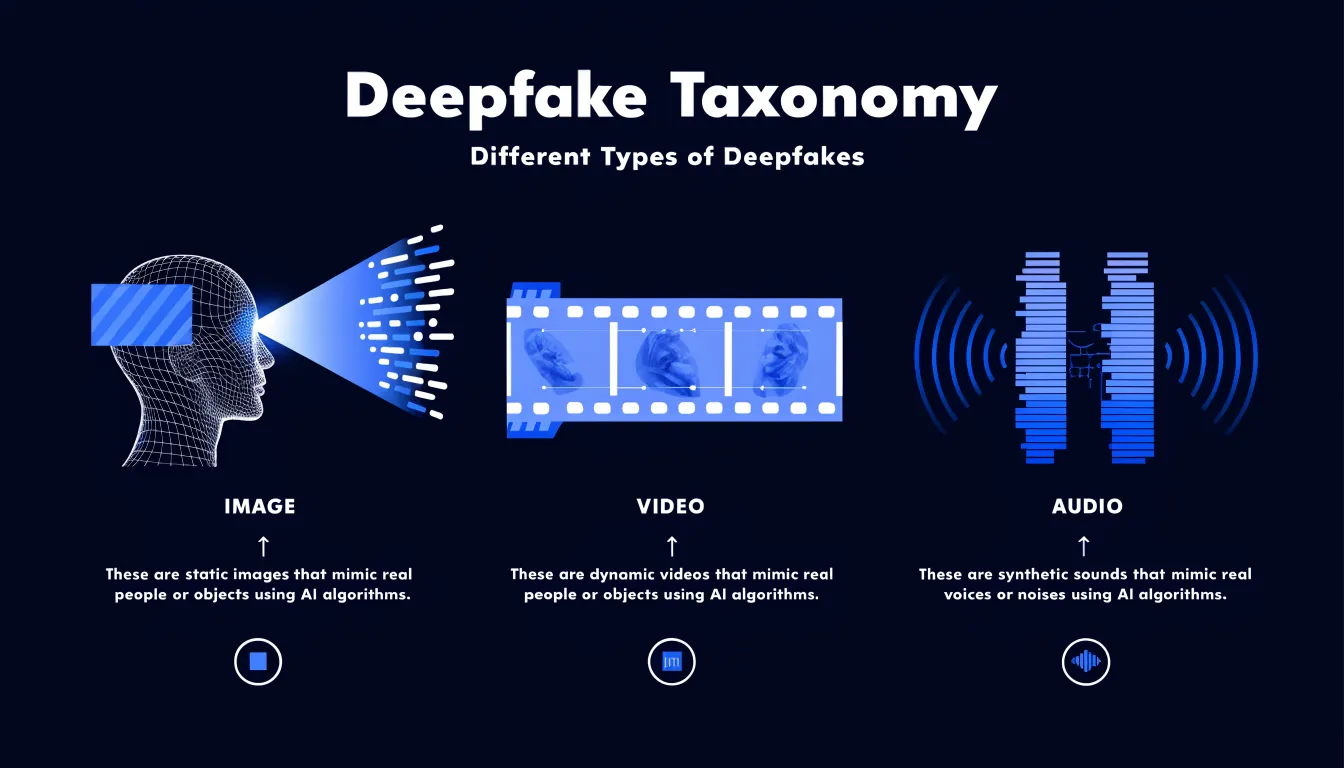
This guide breaks down every major generator type by modality: images, video, and audio.
Image Generators
Image deepfakes are the most common and the most varied. There are six major categories, each with distinct methods and artifacts.
GANs (Generative Adversarial Networks)
Common tools: ProGAN, StyleGAN 1-3, BigGAN, StarGAN, CycleGAN
Era: 2017-2022
What they produce: Primarily faces and objects. GANs work by pitting two neural networks against each other — a generator that creates images and a discriminator that tries to distinguish them from real ones. The generator improves until its output fools the discriminator.
GANs dominated the first wave of deepfakes. StyleGAN in particular became infamous for generating photorealistic human faces that never existed (remember thispersondoesnotexist.com?).
Forensic traces: GAN-generated images carry characteristic upsampling artifacts — repeating patterns in the frequency domain caused by the transposed convolution layers used to upsample images. They also exhibit spectral anomalies: when you transform a GAN image into the frequency domain, it shows periodic peaks that real photographs do not. These artifacts made early GAN detection relatively straightforward for trained classifiers.
Status in 2026: Older, less common. Most generators have moved to diffusion architectures. GAN-generated content still circulates, but new GAN output is increasingly rare outside of specific face-editing applications.
Diffusion Models (Text-to-Image)
Common tools: Stable Diffusion 1.4/1.5/2.1/3.5/XL, Midjourney 6-7, DALL-E 3, Flux 1/2, Imagen 3-4, Ideogram 3, Seedream, HiDream
Era: 2022-present
What they produce: Anything. Text-to-image diffusion models generate photorealistic images from natural language descriptions. A prompt like "a photograph of a person standing in Times Square at sunset" produces a convincing result in seconds.
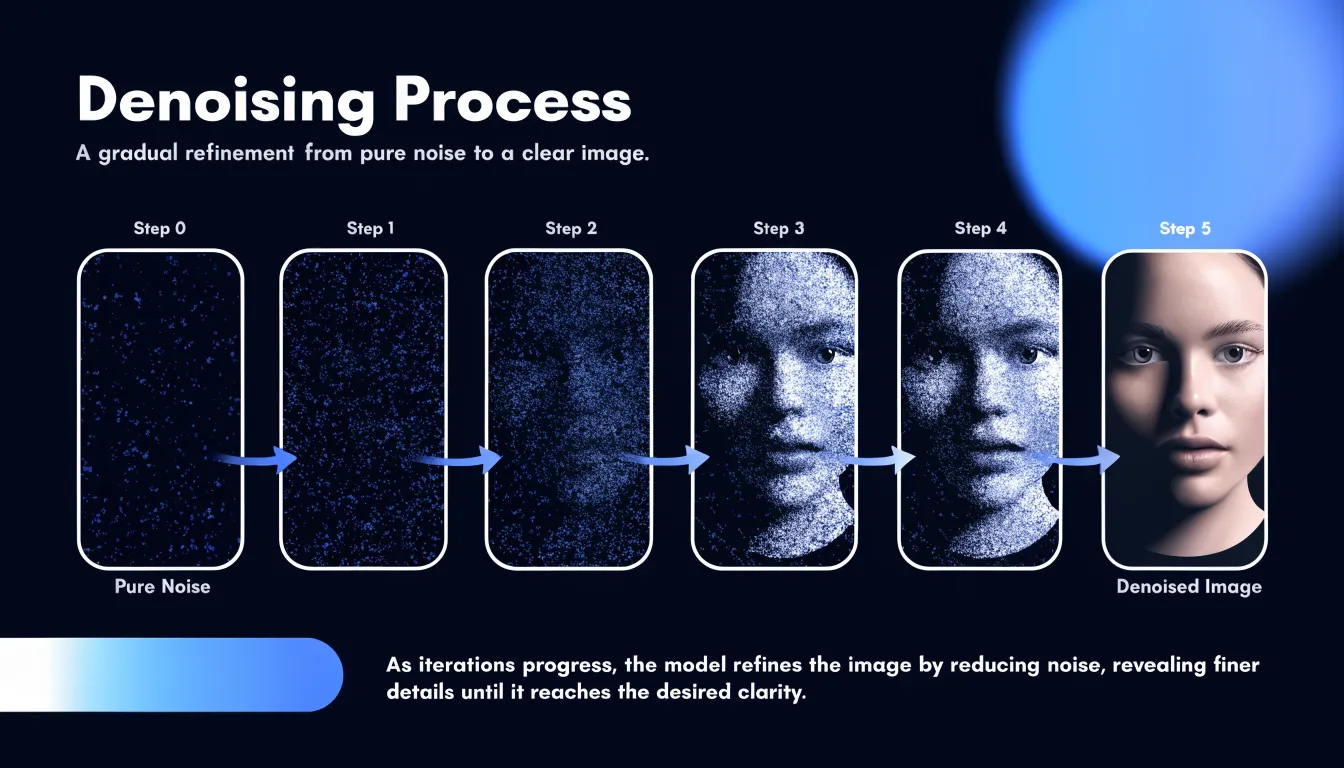
Diffusion models work by learning to reverse a noise-addition process. During training, the model learns to gradually remove noise from a completely random image until a coherent image emerges. At generation time, it starts from pure noise and iteratively denoises, guided by the text prompt.
Forensic traces: Diffusion models leave subtler fingerprints than GANs. The key artifacts are in noise residuals — the statistical distribution of noise in the generated image differs from camera sensor noise in ways that are invisible to the eye but measurable computationally. Different diffusion architectures (U-Net vs. DiT) and different schedulers (DDPM, DDIM, DPM-Solver) produce distinct noise signatures.
Status in 2026: Dominant. The vast majority of AI-generated images encountered online in 2026 come from diffusion models. Detection systems must be trained heavily on diffusion output to be effective.
Diffusion Models (Image-to-Image)
Common tools: ControlNet, img2img, inpainting, SD-Turbo, LCM
Era: 2023-present
What they produce: Modified or enhanced versions of existing images. Unlike text-to-image, these tools take a real photograph as input and alter specific aspects — replacing a background, changing clothing, modifying objects in a scene, or filling in removed areas.
Inpainting is a particularly challenging variant: the user masks a region of a real photograph, and the model fills it with generated content. The result is an image that is partially real and partially synthetic.
Forensic traces: Partial edits are among the hardest deepfakes to detect. The unedited portions of the image retain their original camera fingerprints, while the edited regions carry diffusion artifacts. Detection systems must be able to localize — to identify which specific regions of an image are synthetic rather than simply classifying the entire image.
Status in 2026: Growing rapidly. Image-to-image tools are increasingly accessible through consumer apps and built into photo editing software. They represent a particularly tricky detection challenge because the output blends real and synthetic content.
Commercial APIs
Common tools: GPT Image 1/1.5, Grok Image, Qwen Image, Gemini Imagen
Era: 2024-present
What they produce: High-quality images generated through proprietary, closed-source architectures. Unlike open-source models where the architecture is known, commercial APIs are black boxes.
Forensic traces: Commercial APIs often apply post-processing that strips or alters the artifacts that detectors rely on. Some add invisible watermarks (like Google's SynthID), but not all do, and watermarks can be removed. The proprietary nature of these systems means detection researchers cannot study their architectures directly — they must work from output samples alone.
Status in 2026: Rapidly expanding. As major AI companies integrate image generation directly into their products (ChatGPT, Gemini, Grok), commercial API output is becoming an increasingly large share of AI-generated content. The post-processing these platforms apply makes detection harder than with open-source models.
Face Swaps
Common tools: DeepFaceLab, FaceSwap, FSGAN, SimSwap, HeyGen, BlendFace
Era: 2018-present
What they produce: A source person's face mapped onto a target person's body. The original deepfake technique. Modern face-swap tools can produce convincing results in real time, and some (like HeyGen) are available as consumer services.
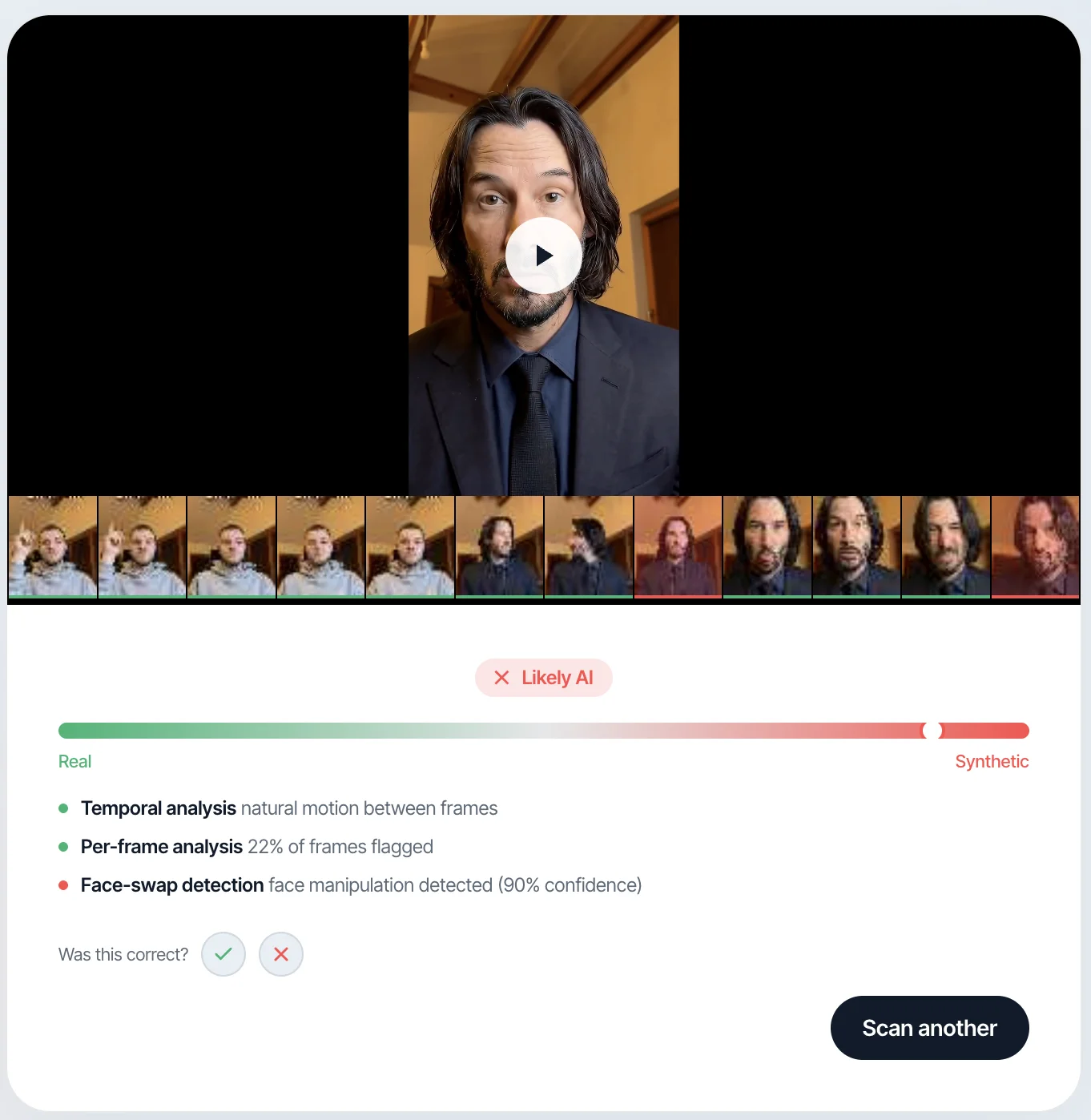
Forensic traces: Face swaps produce characteristic boundary artifacts where the swapped face meets the target head and neck. Skin texture and lighting often mismatch between the swapped face and the surrounding area. In video, temporal inconsistencies — slight jitter, unnatural blending at the face boundary — become visible across frames even when individual frames look convincing.
Status in 2026: Still widely used. Face swaps remain the primary tool for impersonation-based fraud and non-consensual content. The technology has improved significantly, but boundary artifacts remain a reliable detection signal.
Face Reenactment
Common tools: Face2Face, NeuralTextures, First Order Motion, LivePortrait
Era: 2016-present
What they produce: Expression transfer. These tools take a driving video (the source of expressions and head movements) and apply those expressions to a target person's face in a different video. The target person appears to make facial expressions and head movements they never actually made.
Forensic traces: In video, face reenactment produces temporal inconsistencies — subtle jitter in head pose, unnatural transitions between expressions, and inconsistencies between the reenacted face and the rest of the body. Single-frame detection is harder since individual frames may look natural.
Status in 2026: Less common than face swaps or diffusion models, but used in targeted attacks — particularly video calls and live impersonation scenarios.
Face Editing
Common tools: FaceApp, StarGAN, InterFaceGAN
Era: 2019-present
What they produce: Localized changes to facial attributes — age progression/regression, gender modification, expression changes, hairstyle alterations. Unlike face swaps (which replace the entire face), face editors modify specific attributes while preserving the person's identity.
Forensic traces: Because the edits are localized, the modified regions often have different noise statistics and texture properties than the unedited portions of the face. Detection requires localization — identifying which facial regions have been altered rather than making a binary real/fake determination on the full image.
Status in 2026: Common in consumer apps. FaceApp alone has been downloaded over 500 million times. While often used for entertainment, face editing raises concern when used to create misleading images — for example, aging or de-aging a person in a news context.
Video Generators
Video deepfakes are evolving faster than any other modality. What required days of training and expensive hardware in 2023 now runs in seconds through commercial APIs.
AI-Generated Video (Text/Image-to-Video)
Common tools: Sora 1-2, Veo 2-3, Kling 1-3, Runway Gen-3, Pika, Wan Video
What they produce: Full synthetic video from a text prompt or a single reference image. These models generate every frame, every object, and every motion from scratch. Output ranges from a few seconds to over a minute, with quality improving rapidly.
Forensic traces: Current text-to-video models produce several categories of artifacts:
- Temporal inconsistencies: Objects may subtly shift shape, size, or position between frames in ways that real objects do not
- Physics violations: Liquid may not flow correctly, shadows may not track light sources, reflections may not match their objects
- Fine detail degradation: Hands, text, small background objects, and repeated patterns are often rendered inconsistently across frames
- Motion artifacts: Camera motion may not follow physically plausible paths, and object motion may have unnatural acceleration or deceleration
Status in 2026: Rapidly improving. Sora, Veo, and Kling are producing output that fools casual viewers. Detection still benefits from temporal analysis — looking across frames rather than at single frames in isolation — but the window is narrowing.
Face-Swap Video
Common tools: DeepFaceLab, FaceSwap, FSGAN, SimSwap, HeyGen
What they produce: Video in which one person's face is replaced with another's, frame by frame. The original deepfake video technique and still the most common form of video deepfake used for impersonation.
Forensic traces: Frame-by-frame face replacement produces boundary flicker — slight variations in the blending mask between the swapped face and the target head across consecutive frames. Temporal artifacts include inconsistent lighting direction, skin color shifts, and occasional "ghosting" where the original face bleeds through.
Status in 2026: Remains the most common video deepfake type. Real-time face-swap tools make it possible to impersonate someone on a live video call, which has been used in documented fraud cases costing millions of dollars.
Lip-Sync Deepfakes
Common tools: Wav2Lip, VideoReTalking, DINet, TalkLip, IP_LAP
What they produce: Altered video in which a person's mouth movements are re-driven to match a different audio track. The rest of the face and body remain unchanged — only the lip region is modified. This makes the person appear to say words they never actually spoke.
Forensic traces: The key artifact is phoneme-lip mismatch under close analysis. While the generated lip movements are synchronized with the audio at a macro level, they often fail to reproduce the precise tongue positions, teeth visibility, and lip shapes associated with specific phonemes. The boundary between the modified lip region and the unmodified face may also show subtle blending artifacts.
Status in 2026: A significant concern for misinformation. Lip-sync deepfakes are particularly dangerous because the source video is real — only the mouth region is altered, making the manipulation harder to detect than a full face swap or fully generated video.
Talking Head / Avatar Generation
Common tools: SadTalker, AniPortrait, LivePortrait, EMO
What they produce: Full head animation from a single photograph and an audio track. Given one still image of a person and a voice recording, these tools generate a video of the person speaking with realistic head movements, eye blinks, and facial expressions.
Forensic traces: Because the entire animation is generated from a single image, these tools produce unnatural motion patterns. Head movements may be overly smooth or repetitive. Eye blinks may not follow natural patterns. Hair and background remain unnaturally static while the face moves. The disconnect between the animated face and the frozen body/background is often the strongest detection signal.
Status in 2026: Increasingly used for social engineering and scam content. The low barrier to entry — one photo and one audio clip — makes this technique accessible to anyone.
Audio Generators
Audio deepfakes are arguably the fastest-growing and most immediately dangerous category. They require minimal source material and are already being used in fraud at scale.
Voice Cloning (Text-to-Speech)
Common tools: ElevenLabs, Resemble AI, XTTS, Bark, CoquiTTS, SV2TTS
What they produce: Synthetic speech that matches a target person's voice. Modern voice cloning systems can produce a convincing clone from as little as three seconds of sample audio. The output can speak any text in the cloned voice with natural intonation and pacing.
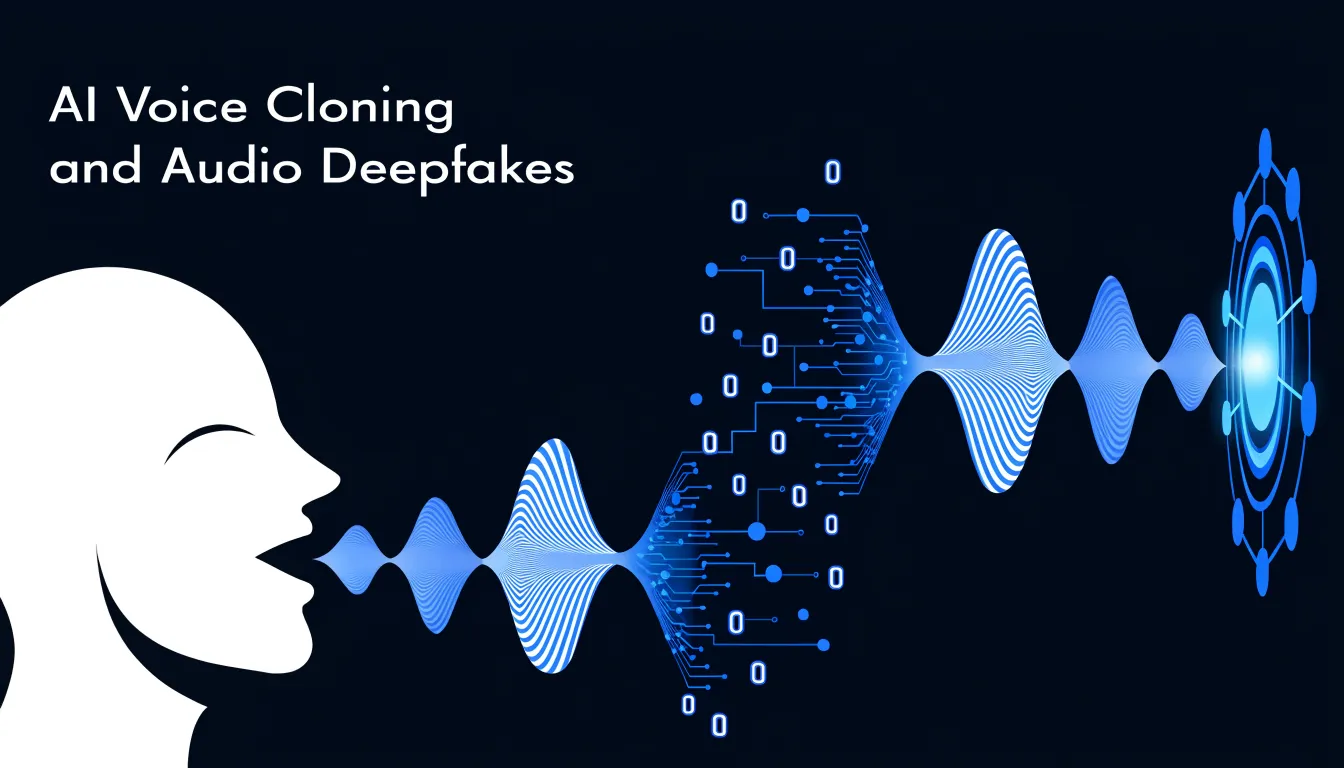
Forensic traces: Cloned voices contain spectral anomalies — subtle differences in the frequency spectrum compared to real speech. Specific artifacts include:
- Micro-prosody irregularities: The tiny variations in pitch, timing, and emphasis that characterize natural speech are approximated but not perfectly replicated
- Breathing patterns: Real speech contains natural breathing sounds at physiologically appropriate intervals. Cloned speech may have artificial or absent breathing patterns
- Formant consistency: The resonant frequencies (formants) that give a voice its characteristic timbre may vary unnaturally across long utterances
Status in 2026: The most immediately dangerous deepfake technology. Voice cloning is already being used in phone-based fraud — the Pindrop Voice Intelligence & Security Report documented deepfake attacks on contact centers increasing from one every two days in 2023 to seven per day in 2024. Individual cases have resulted in losses of hundreds of thousands of dollars.
Voice Conversion
Common tools: RVC, So-VITS-SVC, FreeVC
What they produce: Real-time conversion of one person's voice to sound like another's. Unlike text-to-speech cloning (which generates speech from text), voice conversion takes live or recorded speech as input and transforms it to match a target voice. The words, pacing, and emotion of the original speaker are preserved — only the timbre changes.
Forensic traces: Voice conversion produces formant artifacts — slight inconsistencies in the resonant frequency patterns that result from the mathematical transformation of one voice's characteristics to another's. Because the system must transform in real time, the artifacts tend to be more pronounced in fast speech or unusual vocalizations (laughing, whispering, shouting).
Status in 2026: Common in gaming and content creation communities (where it is used for voice modulation), but also a tool for impersonation. Real-time voice conversion on a phone call is now feasible with consumer hardware.
Audio-Visual Deepfakes
What they produce: Combined synthetic media where both the visual and audio tracks are generated or manipulated. This is not a single tool but a combination of techniques — typically voice cloning or conversion paired with face-swap or lip-sync video.
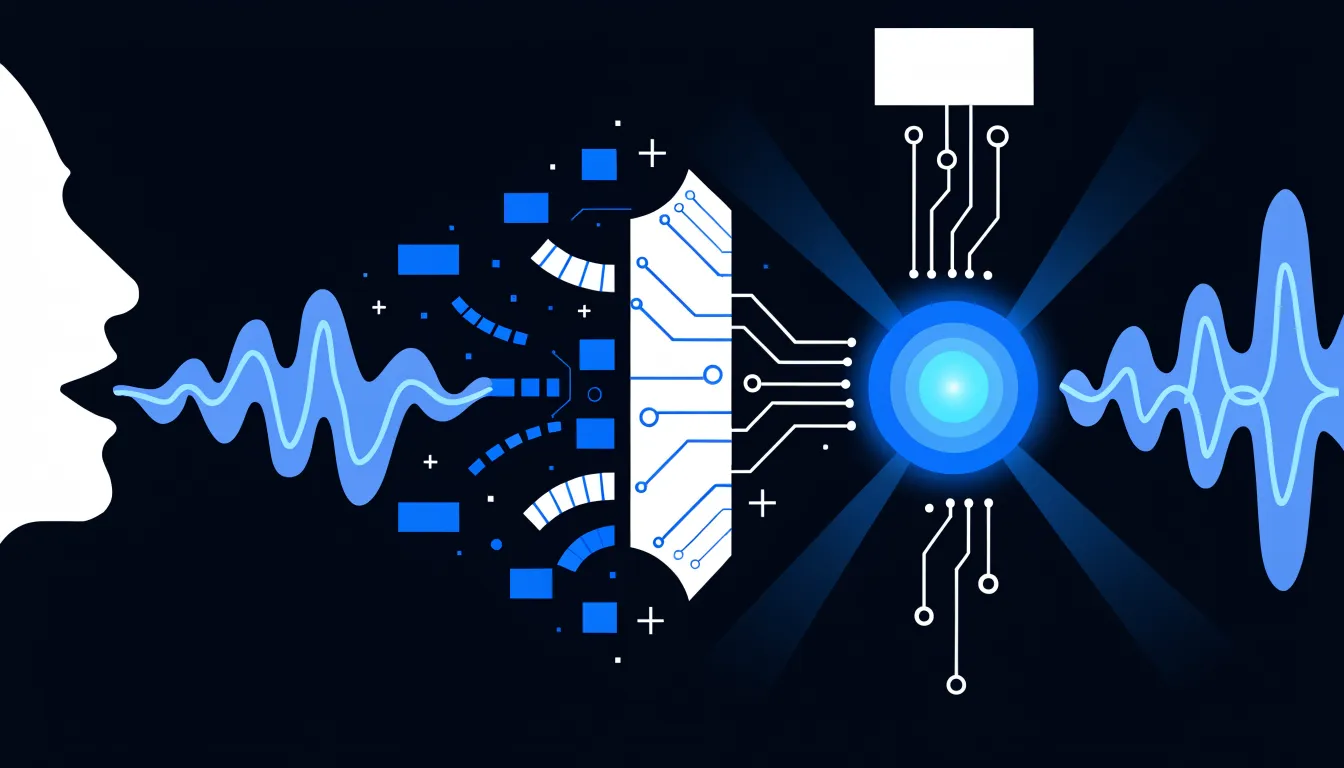
Forensic traces: The strongest detection signal for audio-visual deepfakes is audio-visual mismatch. Even when the audio and video are individually convincing, the coordination between them may be imperfect — subtle timing mismatches between lip movements and speech, inconsistencies between facial expression and vocal emotion, or environmental audio cues that don't match the visual scene.
Status in 2026: Used in the most sophisticated deepfake attacks, including live video call impersonation. The Arup case ($25.6 million lost) reportedly involved a live video call with multiple deepfaked participants.
What This Means for Detection
The diversity of generator types is the core challenge of deepfake detection. A tool trained only on GAN-generated faces will miss diffusion output. A tool that analyzes only images will miss lip-sync video. A tool focused on visual media will miss voice clones entirely.
Effective detection in 2026 requires:
- Breadth across generator types: The detector must handle output from GANs, diffusion models, face swaps, commercial APIs, and emerging architectures
- Multi-modal awareness: As generators span image, video, and audio, detection must follow
- Continuous retraining: New generators appear monthly. A detector frozen in time becomes obsolete within months
- Ensemble approaches: No single detection method catches everything. The most effective systems combine multiple analysis techniques — pixel forensics, frequency analysis, temporal analysis, and provenance checks — into an ensemble that covers more of the threat surface
The threat is not a single technology. It is an expanding ecosystem of tools, each requiring its own detection strategy. Understanding what you are looking at is the first step to knowing whether it is real.