What Is Deepfake Detection? A Complete Guide for 2026
How deepfake detection works, why it matters, and which tools are available in 2026.
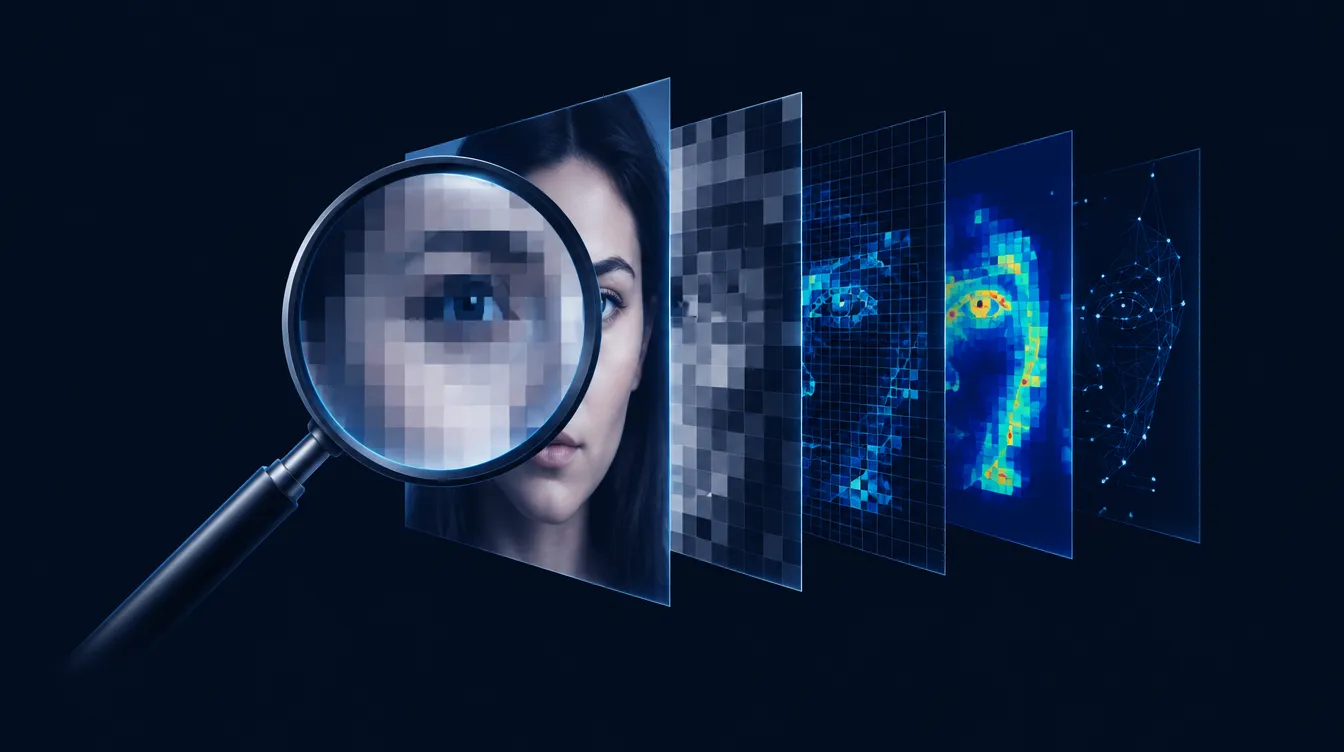
Key Takeaways
- Deepfake detection uses AI to identify synthetic or manipulated media that the human eye cannot reliably catch
- 99.9% of people cannot distinguish modern AI-generated faces from real ones (Jafiser et al., 2025)
- Detection methods include pixel forensics, frequency analysis, provenance verification, and ensemble approaches
- No single detection method catches everything — ensemble systems that combine multiple approaches achieve the highest accuracy
- Detection is an arms race: as generators improve, detectors must continuously retrain on new synthetic content
What Is a Deepfake?
A deepfake is any piece of synthetic media — an image, video, or audio clip — created or manipulated by artificial intelligence to depict something that did not actually happen. The term emerged in 2017 from online communities using deep learning to swap faces in videos, but the technology has evolved far beyond face swaps.
Today's deepfakes include:
- AI-generated faces that never existed, created by models like StyleGAN, Stable Diffusion, and Midjourney
- Face swaps that map one person's face onto another's body in video
- Voice clones that replicate a specific person's speech from just a few seconds of sample audio
- Lip-sync deepfakes that alter video to make someone appear to say words they never spoke
- Full-body generation where entire scenes, people, and environments are synthesized from text prompts
The common thread: these are not crude Photoshop edits. They are statistically generated media, produced by neural networks trained on millions of real examples. The output is designed to be indistinguishable from authentic content.
Why Deepfake Detection Matters in 2026
The scale of the problem
The numbers are staggering. According to DeepStrike, the volume of deepfake content online grew from approximately 500,000 in 2023 to over 8 million by 2025 — a 16x increase in just two years. Deepfake videos alone saw a 550% increase since 2019, with nearly 96,000 detected in 2023. And these are only the ones that were identified.
The financial impact is equally alarming. Deloitte estimates US fraud losses driven by synthetic media will reach $40 billion by 2027. Individual incidents have already been devastating: in February 2024, UK engineering firm Arup lost $25.6 million in a single deepfake-enabled fraud attack. Another documented case involved cybercriminals stealing $243,000 using AI-generated audio to impersonate a company executive on a phone call.
As of 2026, creating a convincing deepfake image requires no technical skill. Services like Midjourney, DALL-E 3, and dozens of open-source alternatives produce photorealistic output from a text description in seconds. Face-swap apps on mobile devices can generate video deepfakes in real time. Deepfake attacks on contact centers alone increased from one every two days in 2023 to seven per day in 2024 (Pindrop Voice Intelligence & Security Report).
Who is affected
Deepfakes are not an abstract future threat — they are causing harm today across multiple domains:
Individuals and families: Non-consensual deepfake imagery is the most prevalent form of deepfake abuse. A 2023 report found that 96% of deepfake videos online are non-consensual intimate content, predominantly targeting women. Parents face the additional challenge of their children encountering — or being targeted by — this content in school and social media environments.
Journalists and fact-checkers: Synthetic images of public figures, conflict zones, and breaking news events circulate on social media within minutes of major events. Newsrooms must now verify visual evidence before publication in ways that were unnecessary even five years ago. The Reuters Institute has reported that visual verification is now a core newsroom competency.
Businesses and HR teams: CEO fraud scams using cloned voices have resulted in documented losses of $25.6 million (Arup, 2024) and $243,000 (executive voice impersonation) in single incidents. According to the Entrust 2025 Identity Fraud Report, deepfakes now account for 1 in 5 biometric fraud attempts, with the top targeted sectors being cryptocurrency (9.5%), lending and mortgages (5.4%), and traditional banking (5.3%). The average loss per deepfake fraud incident ranges from $280,000 to $343,000, with 61% of affected organizations losing over $100,000.
Legal and insurance professionals: The admissibility of visual evidence in legal proceedings is increasingly contested. Courts in multiple jurisdictions have begun requiring authentication of photographic evidence, and insurance adjusters report a rise in claims supported by manipulated imagery.
Democracy and public discourse: Deepfakes of political figures making inflammatory statements have been documented in elections across at least 16 countries since 2023. The ability to fabricate convincing evidence of events that never occurred poses a fundamental challenge to informed democratic participation.
The human perception gap
Perhaps the most important reason detection matters: human judgment is no longer reliable.
The data is stark. An iProov study found that only 0.1% of people could accurately differentiate real from deepfake content — and 60% of participants were confident in their answers despite performing poorly. A separate analysis published in Computers in Human Behavior Reports found an average human detection rate of just 55.54% across formats, barely better than flipping a coin.
This is not a failure of attention or intelligence. It is a fundamental limitation of human visual perception being exceeded by the statistical sophistication of modern generators. The artifacts that once made deepfakes obvious — distorted hands, asymmetric faces, blurry backgrounds — have been systematically eliminated through better training data and architecture improvements.
Meanwhile, AI detection tools are performing significantly better. The DeepFake-Eval-2024 benchmark found that current AI detectors achieve 78% accuracy on real-world content, while UC San Diego's detector reached 98.3% accuracy in controlled conditions. The gap between human and machine detection is widening.
How Deepfake Detection Works
Detection methods target the signals that generators cannot perfectly replicate — artifacts that exist below the threshold of human perception but are measurable by trained computational systems.
1. Pixel-level forensics
Every camera sensor produces images with a characteristic noise pattern — a unique fingerprint embedded in the pixel values. Generative models produce their own distinct patterns, different from any physical camera.
Pixel forensic detectors are neural networks trained on millions of real and synthetic images. They learn to identify generation artifacts in:
- Noise residuals: The statistical distribution of noise in a generated image differs from camera sensor noise in ways that are invisible to the eye but measurable computationally
- Color channel correlations: Real cameras produce specific relationships between RGB channels due to the Bayer filter. Generators approximate but don't perfectly replicate these correlations
- Edge artifacts: The boundaries between objects in generated images have subtly different frequency characteristics than those captured by optical lenses
- Texture statistics: Skin, fabric, and natural materials have fractal-like texture properties that generators approximate but don't perfectly reproduce
The strength of pixel forensics is universality — it works on any image without requiring prior knowledge of the generator used. The limitation is sensitivity to post-processing: screenshots, social media compression, and image editing can degrade or destroy the artifacts that detectors rely on.
2. Frequency domain analysis
When an image is transformed from the spatial domain (pixels) to the frequency domain (using a Fast Fourier Transform or wavelet decomposition), real and synthetic images reveal distinctly different patterns.
Real photographs contain frequency distributions that reflect physical properties of light, lenses, and sensors. Generated images, while visually convincing in the spatial domain, often contain anomalies in their frequency spectra — periodic patterns, missing high-frequency detail, or unnatural energy distributions at specific frequency bands.
Frequency analysis is particularly useful because:
- It captures global image properties that are difficult for generators to control
- It is partially robust to JPEG compression and resizing
- It complements pixel-level analysis (they detect different artifacts)
However, frequency analysis alone has limited accuracy on heavily compressed or very small images, where the frequency information is already degraded.
3. Biological signal detection
For face-specific deepfakes, some detection methods look for the absence of biological signals that real faces exhibit:
- Pupil shape and reflections: Real eyes contain reflections that are consistent between both eyes and physically plausible given the lighting. Many generators produce asymmetric or impossible reflections
- Skin micro-texture: Real skin has pores, fine wrinkles, and texture variations that follow anatomical patterns. Generated skin often has an "averaged" quality at high magnification
- Physiological plausibility: Detectors can check whether facial proportions, skin color gradients, and muscle positions are anatomically consistent
These methods are highly specialized — they work well on face content but don't apply to other types of deepfakes.
4. Provenance and metadata verification
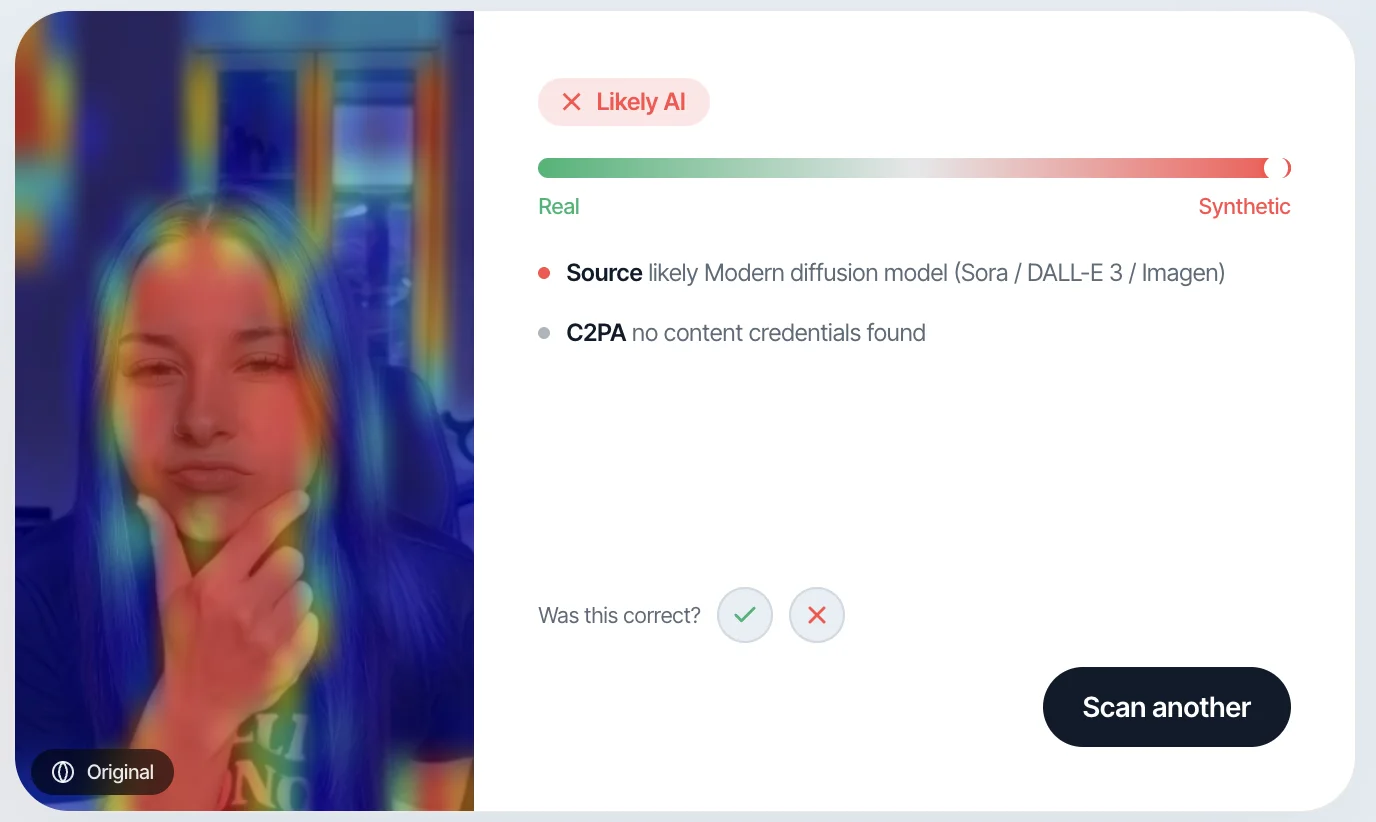
The Coalition for Content Provenance and Authenticity (C2PA) has developed an open standard for embedding cryptographic signatures in media at the point of capture. When a C2PA-enabled camera captures an image, a tamper-evident signature is attached that records the capture device, time, location, and any subsequent edits.
If an image carries a valid C2PA signature with an unbroken chain of custody, its authenticity can be verified with high confidence. If the chain is broken or absent, it doesn't prove the image is fake — but it removes one layer of assurance.
The limitation of provenance is adoption: as of 2026, C2PA is supported by a growing but still small fraction of cameras, phones, and platforms. Most images in circulation have no provenance data.
5. Ensemble detection
No single detection method catches everything. Each approach has blind spots:
- Pixel forensics fails on heavily compressed images
- Frequency analysis struggles with small images
- Biological signals only apply to faces
- Provenance requires prior adoption
Ensemble detection combines multiple methods and cross-references their verdicts. If a pixel classifier, a frequency analyzer, and a biological signal detector all agree an image is synthetic, the confidence is much higher than any individual method alone.
The most effective ensemble systems:
- Weight each method's confidence based on its known strengths for the input type
- Use methods that make independent errors (diverse architectures, different training data)
- Continuously retrain as new generators emerge
- Provide calibrated confidence scores rather than binary verdicts
The Arms Race: Why Detection Must Evolve
Deepfake detection is not a solved problem, and it may never be in a permanent sense. It is an ongoing adversarial competition between generators and detectors.
When researchers publish a new detection method, generator developers study the paper and adapt their models to avoid producing the detected artifacts. This cycle — detect, adapt, re-detect — drives continuous improvement on both sides.
What this means for users:
- Detection tools must be actively maintained. A detector trained only on 2023-era content will miss artifacts specific to 2026 generators
- Retrained regularly. The best detection systems incorporate new synthetic content into their training data as it emerges
- Transparent about limitations. Honest confidence scores — including "I'm not sure" — are more valuable than overconfident binary verdicts
How to Evaluate a Detection Tool
Not all detection tools are equal. When choosing a tool, consider:
Research backing: Is the detection method published in peer-reviewed venues? Methods that have survived academic scrutiny are more likely to be robust than proprietary "black box" claims.
Update frequency: How often is the model retrained? Detection tools that haven't been updated in six months may not catch the latest generators.
Confidence calibration: Does the tool provide a confidence score, or just "real/fake"? Calibrated confidence lets you weight the result appropriately for your use case.
Input handling: Does it work on screenshots, compressed images, and cropped content? Many tools only perform well on pristine, unprocessed images.
Ensemble approach: Does it use multiple detection methods? Single-method tools have inherent blind spots.
Privacy: What happens to your image after analysis? Is it stored, used for training, or deleted immediately?
What You Can Do Today
Deepfake detection is not just for experts and newsrooms. Anyone can — and should — develop habits for verifying visual content:
- Question high-stakes images: If an image provokes a strong emotional reaction, that's the most important time to verify it
- Use detection tools: Automated analysis catches artifacts your eyes physically cannot perceive
- Check provenance: Look for C2PA signatures and metadata when available
- Verify through multiple channels: If someone sends you a suspicious image, contact them through a different channel to confirm
- Be especially careful with faces: Face generation is the most mature deepfake technology, making face images the highest-risk content type
- Educate others: Help family, colleagues, and friends understand that visual verification is now a necessary digital literacy skill
Frequently Asked Questions
Can AI detect deepfakes with 100% accuracy?
No. Detection accuracy depends on the type of content, the generator used, and the amount of post-processing applied. The best ensemble systems achieve 95%+ accuracy on clean content but lower accuracy on heavily compressed or edited images. Honest tools report their confidence rather than claiming certainty.
Are deepfake detection tools free?
Some tools offer free tiers with limited usage. Professional-grade detection with ensemble methods, video support, and detailed analysis typically requires a paid subscription. The cost reflects the continuous model retraining required to keep up with new generators.
Can screenshots be analyzed for deepfakes?
Yes, but with reduced accuracy. Screenshots add compression artifacts and remove metadata, which reduces the signals available to detectors. Direct image files (JPG, PNG) produce more reliable results than screenshots.
How fast is deepfake detection?
Modern detection tools analyze images in 2-10 seconds. Video analysis takes longer, as multiple frames must be extracted and analyzed. Most tools prioritize accuracy over speed, as a confident result in 5 seconds is more valuable than an uncertain result in 1 second.
What's the difference between detection and authentication?
Detection asks "is this image AI-generated?" and analyzes the content itself for artifacts. Authentication asks "can we prove this image is real?" and relies on provenance chains (like C2PA) established at capture time. Both are valuable and complementary — detection works on any image, while authentication provides stronger guarantees when available.