Is This Profile Photo AI-Generated? A Checklist
An 11-point checklist to spot AI-generated profile photos on dating apps, LinkedIn, and marketplaces. Covers symmetry, background artifacts, lighting, and automated AI image detection tools.
Fake people are flooding the internet. Researchers at Stanford found over 1,000 AI-generated faces being used as LinkedIn profile photos in a single study, and that was back in 2022, before the latest generation of image models made fakes dramatically more convincing [1]. Whether you are vetting a new connection on social media, a match on a dating app, or a seller on a marketplace, the profile photo is the first thing worth scrutinizing. This checklist gives you a practical, step-by-step method for doing exactly that.
Why Profile Photos Matter More Than Ever
AI-generated profile pictures are no longer a novelty. They are an infrastructure layer for fraud. The FTC reported that consumers lost over $10 billion to fraud in 2023, with social media being the most frequently cited contact method for scams [2]. A convincing fake profile photo is often the first step in romance scams, investment fraud, impersonation schemes, and influence operations.
The faces are cheap to produce. Sites like ThisPersonDoesNotExist.com generate a new one on every page refresh. Paid tools can produce dozens per minute with specific ages, ethnicities, and expressions on demand. The barrier to creating a believable fake identity has effectively collapsed to zero.
The threat is volume, not perfection. Most AI-generated profile photos do not need to fool an expert. They only need to look real enough that you do not think to question them.
The Checklist: 11 Things to Examine
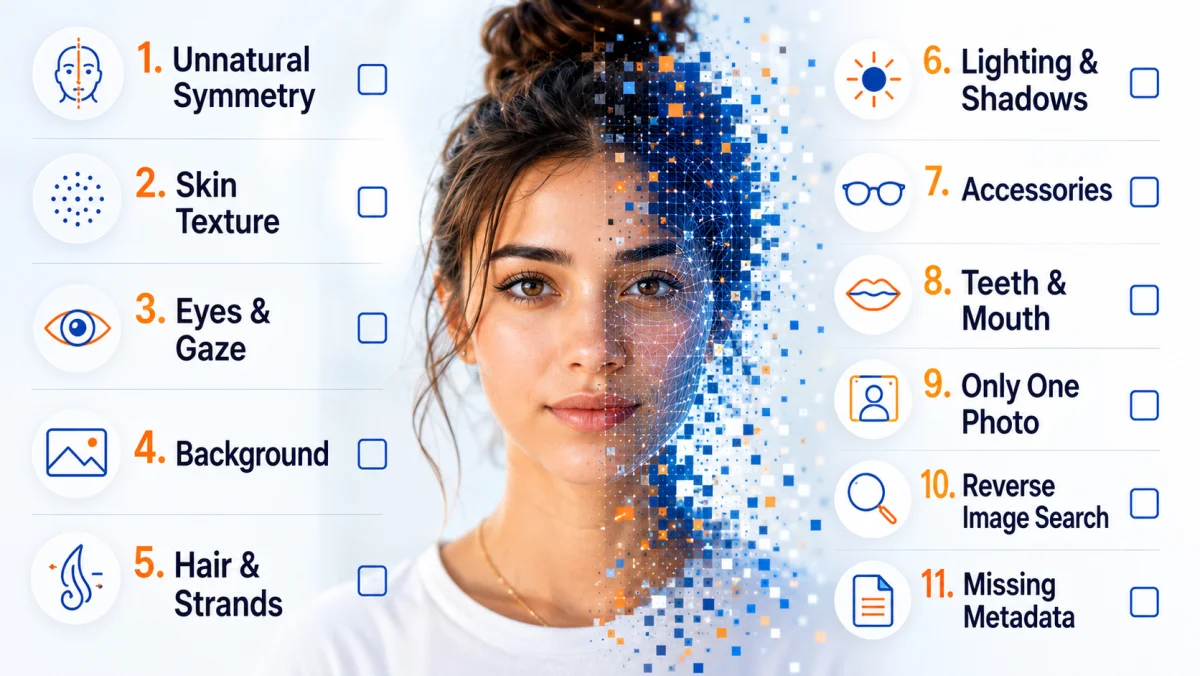
Print this, bookmark it, or just keep it in mind the next time a stranger's photo feels a little off. Not every item on this list will apply to every image, but the more flags you find, the more suspicious you should be.
1. Symmetry That Feels Too Perfect
Real human faces are asymmetrical. One ear sits slightly higher, one eyebrow arches differently, one nostril is a fraction wider. AI-generated faces, especially those from older GAN models, tend to produce near-perfect bilateral symmetry. If the face looks like it could be mirrored down the middle with no difference, take note.
2. Skin Texture That Looks Like Plastic
AI-generated faces tend to produce unnaturally smooth skin. Pores, fine lines, and subtle blemishes that exist on every real human face are often absent or uniformly blurred. Look for skin that resembles airbrushed magazine covers rather than a phone camera snapshot. The forehead and cheeks are the easiest places to check — real skin has visible texture, even in low-resolution photos.
3. Eyes and Gaze That Feel Off
Look carefully at the eyes. Common AI tells include:
- Reflections that don't match between left and right eyes (different catchlight shapes or positions)
- An unnervingly direct, unblinking stare with no natural asymmetry
- Iris patterns that look too uniform or lack the organic irregularity of real eyes
- Pupils that are slightly different sizes or shapes
4. The Background Is a Smear
Look behind the person. AI models prioritize the face and frequently produce backgrounds that are blurry, abstract, or subtly incoherent. You might see shapes that almost look like bookshelves or trees but dissolve into nothing on closer inspection. A real photo almost always has a legible background, even if it is out of focus.
5. Hair Anomalies at the Edges
Hair is one of the hardest things for generative models to render cleanly. Look where hair meets the background or the forehead. Common artifacts include:
- Strands that merge into the background color
- A hard, unnatural boundary between hair and skin
- Asymmetric hair that changes texture or color from one side to the other
- Stray wisps that appear to float with no connection to the head
6. Lighting and Shadows That Don't Agree
Check whether the lighting on the face matches the rest of the image. In a real photo, light comes from a consistent direction: if the left side of the face is illuminated, the shadow should fall on the right, and objects in the background should follow the same light source. AI-generated images sometimes produce lighting that looks natural in isolation but contradicts itself — a shadow falling the wrong way, or ambient light that doesn't match the apparent time of day or environment.
7. Earrings, Glasses, and Accessories That Don't Match
If the person is wearing earrings, check both ears. AI models often generate mismatched jewelry: different shapes, different sizes, or an earring on only one side with no stylistic reason for it. The same applies to glasses, where one lens may have a different shape or reflection pattern than the other.
8. Teeth and Mouth Irregularities
Zoom in on the mouth. Common tells include:
- Teeth that blend together into a single white block
- An uneven number of visible teeth on each side
- Gum lines that shift color abruptly
- Lips with no visible texture or skin lines
9. The "Only One Photo" Problem
A real person has many photos of themselves across different contexts, lighting conditions, and time periods. A fake profile typically has one polished headshot and nothing else. If the account has a single photo that looks professionally lit but no candid shots, group photos, or older pictures, that is a significant red flag.
10. Reverse Image Search Returns Zero Results
Right-click the image (or long-press on mobile) and run a reverse image search through Google or TinEye. A real person's photo will often appear across multiple platforms or contexts. An AI-generated face, created uniquely for that profile, will return no results at all. Paradoxically, a photo with zero matches anywhere on the internet can be more suspicious than one with many.
11. Metadata Is Missing or Stripped
Every photo taken by a real camera embeds metadata: the device model, the date, sometimes GPS coordinates. AI-generated images typically contain no camera metadata whatsoever. While social media platforms often strip metadata on upload, if you can obtain the original file, checking for EXIF data can be revealing.
What This Checklist Cannot Catch
Here is the uncomfortable truth: the latest diffusion-based models, including Midjourney v6, DALL-E 3, and Flux, have largely fixed many of the visual artifacts listed above. Teeth look normal. Backgrounds are coherent. Hair renders cleanly. A study published in Psychological Science found that AI-generated faces are now rated as more trustworthy than photos of real people [3].
This means the checklist above is necessary but not sufficient. It will catch lower-effort fakes and older GAN-generated images, which still account for a large share of fraudulent profiles. But for high-quality AI-generated photos, visual inspection alone is no longer reliable.
When your eyes are not enough, use detection tools. AI-generated images contain statistical patterns invisible to humans but detectable by analysis software trained to find them.
Going Beyond the Visual Checklist
When a profile photo passes your visual inspection but something still feels wrong, there are additional steps worth taking.
Check the account's history. When was it created? How far back do posts go? A brand-new account with a polished photo and immediate outreach is a pattern worth questioning.
Ask for a live photo. Request a selfie holding a piece of paper with a specific word or today's date written on it. This is difficult to fake on the fly, even with advanced tools. A refusal or excuse is informative.
Look for contextual consistency. Does the person's claimed location match their language patterns? Do their stated interests align with their post history? AI-generated profiles are often shallow: the photo looks right, but the details behind it do not hold up to scrutiny.
Run the image through a detection tool. If you have a profile photo that you want to verify, upload it to a detector built for exactly this purpose. Run it through Witness at witness.vision/scan — free, no account required. The scan analyzes the image for statistical signatures that generative models leave behind, even when the output looks flawless to the human eye.
A Note on False Positives
Not every odd-looking photo is AI-generated. Heavy filters, beauty apps, professional retouching, and aggressive compression can all make a real photo look artificial. Snapchat and Instagram filters routinely smooth skin, enlarge eyes, and reshape jawlines in ways that mimic generative AI outputs.
The checklist is a triage tool. It helps you decide which photos deserve a closer look or a second opinion, not which photos are definitively fake. Use it to raise questions, then use detection tools and contextual investigation to find answers.
Quick Reference
When you encounter a profile photo that feels off:
- Run through the 11-point visual checklist above
- Reverse image search the photo
- Check the account's age, post history, and contextual details
- Ask for a live, specific selfie if you are in direct contact
- Upload the photo to witness.vision/scan for AI detection analysis
The goal is not paranoia. It is pattern recognition. Most people you interact with online are real. But the cost of trusting a fake profile, emotionally, financially, or reputationally, is high enough that a sixty-second check is always worth your time.
- [1]Stanford Internet Observatory, "Launching the Largest LinkedIn Fake Profile Study," 2022, https://cyber.fsi.stanford.edu/news/launching-largest-linkedin-fake-profile-study
- [2]Federal Trade Commission, "FTC Reports 2023 Data Shows Consumers Reported Losing More Than $10 Billion to Fraud," 2024, https://www.ftc.gov/news-events/news/press-releases/2024/02/nationwide-fraud-losses-top-10-billion-2023-ftc-steps-efforts-protect-public
- [3]Nightingale, S.J., & Farid, H., "AI-synthesized faces are indistinguishable from real faces and more trustworthy," Proceedings of the National Academy of Sciences, 2022, https://www.pnas.org/doi/10.1073/pnas.2120481119