Deepfake Fraud: The $442 Billion Problem Nobody Can Solve
Deepfake fraud losses hit $442 billion in 2025. Voice cloning needs three seconds. How deepfake fraud works and what stops it.

Key Takeaways
- INTERPOL estimates global fraud losses reached $442 billion in 2025
- Voice cloning requires just seconds of audio and operates in real time on phone calls
- The world's leading deepfake forensics researcher says he can no longer reliably tell real from synthetic
- Autonomous AI agents can now run complete fraud campaigns without human oversight
- Individual detection is no longer a viable defense — systemic and tool-based approaches are required
When the Detector Admits Defeat
There is a moment in every arms race when one side acknowledges the other has pulled ahead. For deepfake detection, that moment arrived this week.
Hany Farid, a UC Berkeley professor who has spent thirty years as the world's go-to authority on detecting manipulated media, gave an interview to the New York Times in which he described his current ability to distinguish AI-generated content from real recordings. His words: "I feel like I'm going blind."
This isn't a junior researcher hedging. This is the person governments and newsrooms call when they need to verify whether a piece of media is authentic. And he's saying the game has changed — not in some future scenario, but right now.
His research quantifies the problem: ordinary people correctly identify AI-generated voices about 60% of the time. That's barely better than guessing. And when the experts aren't much better, the implication is clear — we need to stop relying on human perception as a line of defense.
The Voice in the Phone
To understand why this matters practically, consider what voice cloning looks like in 2026.
A scammer needs roughly three seconds of your voice. A clip from an Instagram story, a snippet from a conference recording, a voicemail greeting. From that fragment, a neural network extracts a mathematical fingerprint of how you speak — your pitch, your rhythm, your cadence, the texture of your vowels.
That fingerprint gets fed into a synthesis model. The output is a voice that sounds like you, saying whatever the attacker wants, in real time, with less than a tenth of a second of delay. It works on phone calls. It works on video conferences. And the person on the other end has no reliable way to tell it isn't you.
This isn't speculative technology. It's commercially available, runs on consumer hardware, and requires no technical skill to operate.
The Price Tag
The financial impact of AI-enabled fraud has moved from concerning to staggering.
INTERPOL's Global Financial Fraud Threat Assessment, published in March 2026, puts global financial fraud losses at $442 billion for 2025. To put that in perspective: it's roughly the size of Denmark's entire economy.
The FBI's 2025 Internet Crime Report shows $20.9 billion in cybercrime losses in the United States alone — a 26% single-year increase. For the first time in the report's 26-year history, the FBI created a separate category for AI-related complaints, logging more than 22,000 complaints with losses exceeding $893 million. Even the FBI acknowledges this dramatically undercounts the actual AI-driven share.
In Europe, Europol's 2026 Organized Crime Threat Assessment calls fraud the fastest-growing category of organized crime in the EU, with losses reaching $64.1 billion.
In the UK, authorized push payment fraud rose 19% in 2025 to £576.4 million — even as banks reimbursed £354.3 million under mandatory rules.
And Sumsub's 2026 Identity Fraud Report found that deepfake fraud now accounts for 11% of all global fraudulent activity — with attempts in the UK alone rising 94% year over year.
The trajectory is clear. Deloitte projects that without intervention, AI-facilitated fraud losses in the US alone will hit $40 billion by 2027 — growing at a 32% compound annual rate from $12.3 billion in 2023.
What a Modern Fraud Attack Looks Like
The attacks making headlines aren't sophisticated in the way we traditionally think of cybercrime. They're sophisticated in a different way — they exploit trust.
The video conference that wasn't. In early 2024, a finance employee at Arup, a global engineering firm, joined what appeared to be a routine video call with the CFO and several colleagues. Everyone on the call looked and sounded normal. Over the course of the meeting, the employee authorized 15 wire transfers totaling $25.6 million. Every person on that call was an AI-generated deepfake.
The daughter who wasn't. A Florida mother received a phone call from her daughter — crying, panicked, saying she'd been in a car accident and needed $15,000 for bail. The voice was perfect. The emotion was convincing. The mother wired the money. Her actual daughter was fine. The voice had been cloned from a social media video.
The investment that wasn't. Pig butchering networks — operations where scammers build fake relationships over weeks or months before steering victims into fraudulent investment platforms — processed an estimated $75 billion between 2020 and 2024, according to University of Texas blockchain analysis. Many of the operators are themselves trafficking victims, forced to work in scam compounds across Southeast Asia.
These aren't edge cases. They represent the mainstream of modern financial fraud.
The Self-Improving Adversary
What makes the current wave fundamentally different from previous fraud eras is autonomy.
INTERPOL describes it as "the industrialization of fraud." AI-enhanced fraud is 4.5 times more profitable than traditional methods. But the real shift isn't just efficiency — it's that the attacker learns from failure.
Autonomous AI agents — what researchers call "agentic AI" — can now execute complete fraud campaigns from initial target research through social engineering to financial extraction, without human direction. When an approach fails, the system analyzes why and adjusts. A 2025 academic study (ScamAgents) demonstrated AI agents conducting multi-turn scam calls that adapted in real time to victim responses, evaded safety filters, and completed end-to-end fraud pipelines.
The implication is uncomfortable: a defense you adopt today becomes training data for the system attacking you tomorrow. The attacker's playbook updates faster than yours can.
Dark web fraud-as-a-service platforms have made this accessible to anyone willing to pay $50 a month. They operate like legitimate SaaS businesses — subscription tiers, customer support, feature updates, plug-and-play kits. The barrier to entry for sophisticated fraud has collapsed.
What Actually Works
Given that human detection has been effectively neutralized, what defenses remain?
Farid's advice — echoed by INTERPOL, the FBI, and financial regulators — is counterintuitive but essential: stop trying to judge whether the media is real. Judge the request instead.
Scams follow behavioral patterns that AI hasn't changed:
- Urgency: "You need to act now." No legitimate institution demands immediate action.
- Secrecy: "Don't tell anyone about this call." Real emergencies don't require secrecy.
- Unusual payment: Wire transfers, gift cards, cryptocurrency. Chosen because they're irreversible.
If a call hits any of these signals, it doesn't matter how real the voice sounds. Hang up. Call back on a number you independently verify.
Concrete steps
Family safe word. A short phrase known only to your household. Any caller claiming to be family in an emergency must provide it. This single measure defeats the majority of voice cloning family emergency scams.
Credit freeze. Free at all three bureaus, reversible when you need it, and it prevents synthetic identity fraud — where attackers blend your real data with fabricated details to create phantom accounts in your name.
Multi-factor authentication. Use authenticator apps, not SMS. On every account connected to money or identity.
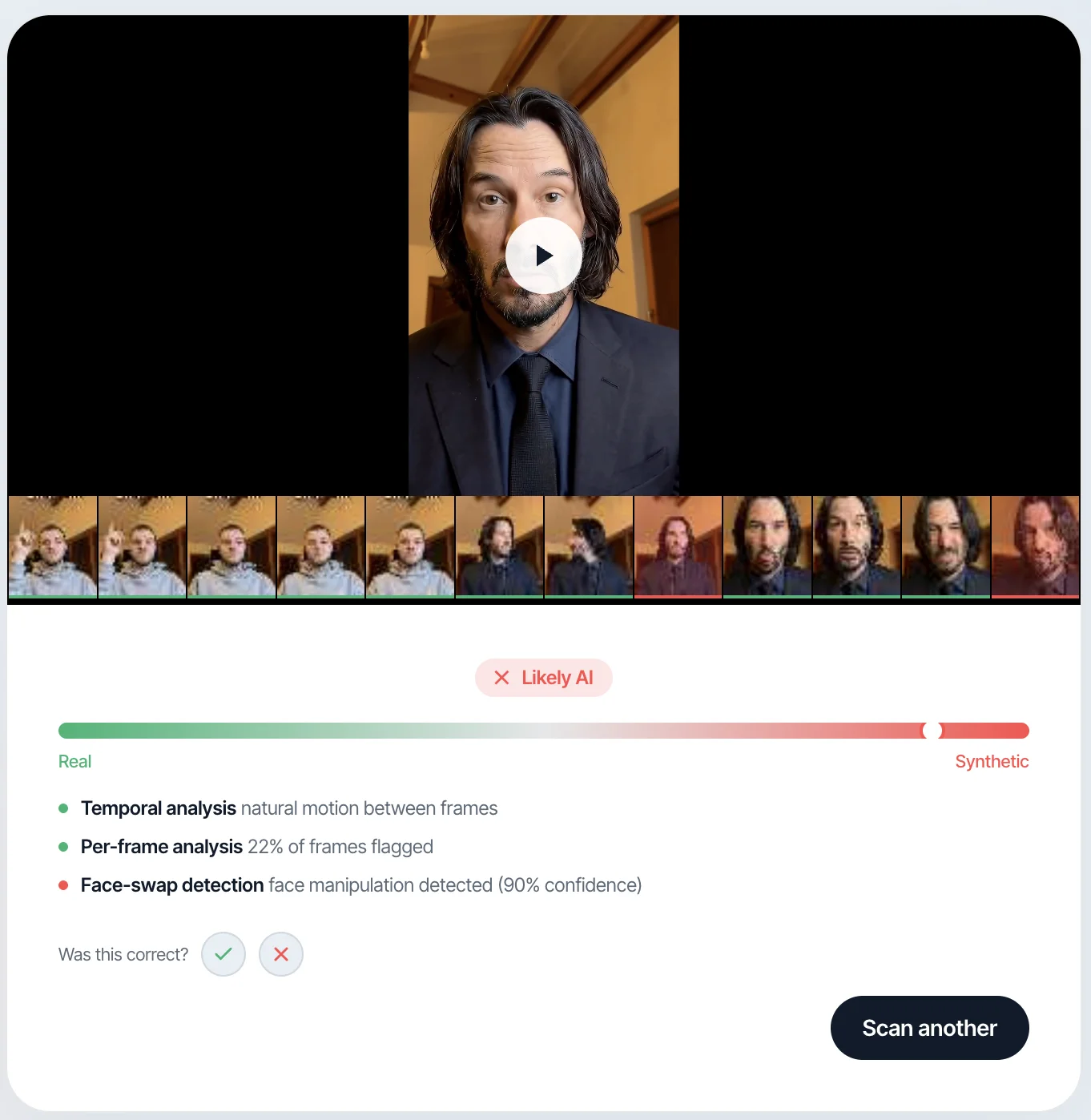
Detection tools for visual content. While voice authentication by ear is no longer viable, image and video detection tools can analyze visual content at levels human perception cannot reach — identifying generation artifacts, noise patterns, and frequency anomalies that are invisible to the eye but measurable by trained models.
Reduce your audio footprint. The more of your voice that exists publicly online, the easier it is to clone. Review your social media privacy settings, especially for video content.
The Structural Gap
Individual vigilance helps but cannot match an industrialized, self-improving adversarial system. The UK's mandatory bank reimbursement scheme — requiring banks to refund fraud victims up to £85,000 within five days — returned £354.3 million to victims in 2025. But total fraud losses still rose 19%. Reimbursement addresses harm after the fact. It doesn't reduce the volume of attacks.
The structural response requires three things working together: platform accountability for the tools enabling fraud, AI-based detection deployed at the infrastructure level, and regulatory frameworks that shift the cost of fraud from individual victims to the systems that enable it.
Until those structures are in place, the defense comes down to two things: protocols that don't depend on human perception (safe words, verification callbacks, credit freezes), and detection tools that can see what you can't.
The safe word buys time. The detection tool provides a second opinion. Together, they're the best individual defense available while the systemic response catches up.
Frequently Asked Questions
Can experts detect deepfake voices?
As of June 2026, no — not reliably. Hany Farid, the world's leading authority on synthetic media forensics, stated publicly that he can no longer consistently distinguish AI-generated voices from real ones. His research shows ordinary people succeed about 60% of the time. The defense must shift from detection to verification protocols.
How much audio is needed to clone someone's voice?
Approximately three seconds. A social media clip, voicemail greeting, or podcast snippet provides sufficient data for current zero-shot voice cloning models. These models require no per-person training — the brief sample is enough to generate convincing speech in real time.
What is the most effective personal defense?
A family safe word combined with a credit freeze. The safe word defeats voice cloning emergency scams (the most common attack on individuals). The credit freeze prevents synthetic identity fraud. Both are free, take minutes to set up, and address the highest-frequency attack vectors.
Are businesses at greater risk than individuals?
Both face serious exposure through different vectors. Businesses face deepfake video call fraud (Arup lost $25.6M) and AI-enhanced social engineering. Individuals face voice cloning scams, romance fraud, and identity theft. AI has reduced the cost and skill required for all of these attacks, expanding the threat to everyone.