SynthID Detector
Check if an image was watermarked by Google, OpenAI, or other participating AI tools. For content without watermarks, Witness runs AI detection to catch what watermarks miss.
What is SynthID?
SynthID is an invisible watermarking technology developed by Google DeepMind. It embeds an imperceptible signal into AI-generated images, audio, video, and text so the content can later be identified as machine-created.
Since its launch, Google has applied SynthID to over 100 billion pieces of content generated through its products. The technology has also been adopted by other companies: OpenAI embeds C2PA metadata in DALL-E outputs, ElevenLabs watermarks AI audio, and Kakao has integrated SynthID into its platforms.
SynthID is designed to survive common modifications like screenshots, cropping, and light compression. It works by subtly altering pixel values in ways invisible to humans but readable by a trained detector.
Where to check for SynthID today.
SynthID detection is not publicly available as a standalone API. Here are the tools that currently surface watermark and provenance information.
Google 'About this image'
In Google Chrome or Google Images, click the three-dot menu on any image and select 'About this image.' If the image was generated by a Google AI product and carries a SynthID watermark, Google will display that information.
OpenAI verification
Images generated by DALL-E 3 include C2PA metadata identifying them as AI-created. You can verify this through OpenAI's media verification portal or by reading C2PA metadata with tools like Content Credentials Verify.
C2PA metadata readers
The Content Authenticity Initiative's Verify tool (contentcredentials.org/verify) reads C2PA provenance data embedded by participating generators. This covers images from Adobe Firefly, OpenAI, and other C2PA adopters.
Why watermarks alone are not enough.
SynthID is a step forward, but watermarking only works when the generator cooperates. Most AI content on the internet carries no watermark at all.
Most generators skip watermarks
Midjourney, Stable Diffusion, Flux, and hundreds of open-source models do not embed SynthID or any other watermark. Content from these tools is invisible to watermark-based detection.
Watermarks can be stripped
Re-encoding, format conversion, and adversarial post-processing can degrade or remove embedded watermarks. A detection strategy that relies only on watermarks has a known failure mode.
Absence proves nothing
No watermark does not mean real. The most harmful deepfakes and AI-generated misinformation typically come from tools and workflows that do not participate in any watermarking standard.
Adoption is still partial
While SynthID adoption is growing, only a fraction of AI-generated content on the internet carries any provenance signal. Detection needs to work on content with no metadata at all.
Detection that works with or without watermarks.
Witness combines provenance verification with AI classification. It catches content that watermark-only approaches miss.
C2PA provenance reading
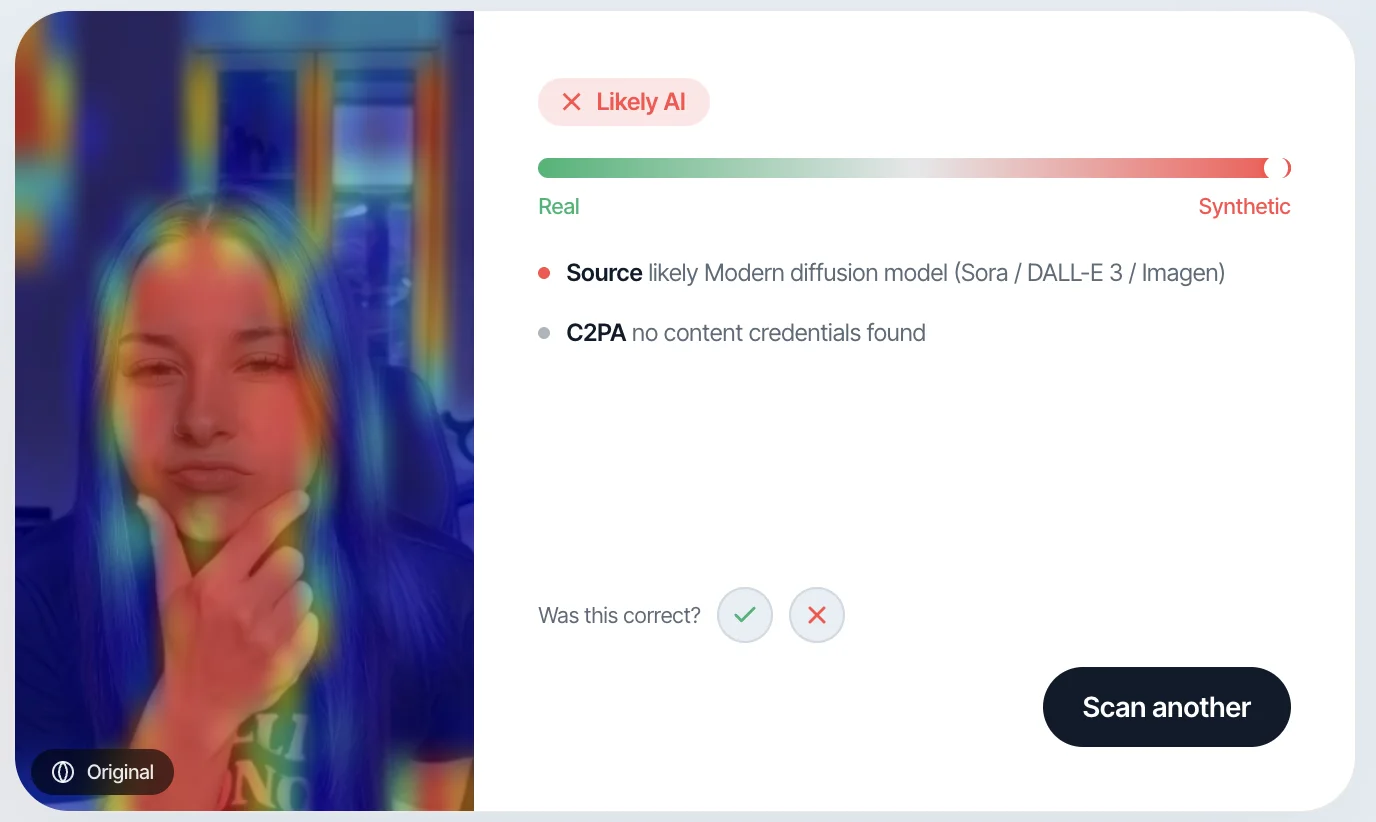
Witness reads C2PA metadata embedded by participating generators and cameras. When provenance data is present, you get a clear chain of origin without relying on AI classification.
AI classification
For content with no watermark or provenance metadata, Witness runs ensemble AI detection models trained on output from every major generator. It identifies statistical fingerprints invisible to the human eye.
Complementary layers
Watermarks and provenance work when generators cooperate. AI classification works when they do not. Together, these layers cover more content than either approach alone.
What a scan looks like.
Common questions.
What is SynthID?
SynthID is an invisible watermarking technology from Google DeepMind. It embeds an imperceptible signal into AI-generated images, audio, video, and text. Google has applied it to over 100 billion items. Other companies including OpenAI, ElevenLabs, and Kakao have also adopted the technology.
Can I check if an image has SynthID?
You can check through Google's own tools. Use 'About this image' in Chrome or Google Images to see if Google flags the image as AI-generated. For DALL-E images, OpenAI provides a verification portal. There is no public third-party API for reading SynthID watermarks directly.
Does no SynthID mean the image is real?
No. Most AI generators do not embed SynthID or any watermark. Midjourney, Stable Diffusion, Flux, and open-source models produce content with no provenance signal. The absence of a watermark tells you nothing about whether an image is real or AI-generated.
What does Witness detect?
Witness combines C2PA provenance reading with ensemble AI classification. When provenance metadata is present, Witness reads it. When it is not, Witness runs detection models trained on output from every major AI generator. Free to use, no account required.
Check any image for AI generation. Free.
Watermark or no watermark. Upload an image and get a clear answer in seconds. No account needed.