Deepfake Detection for Parents: What You Need to Know
A practical guide for parents on AI-generated content. What risks exist, how to talk to your kids about deepfakes, and how to check suspicious images and videos.
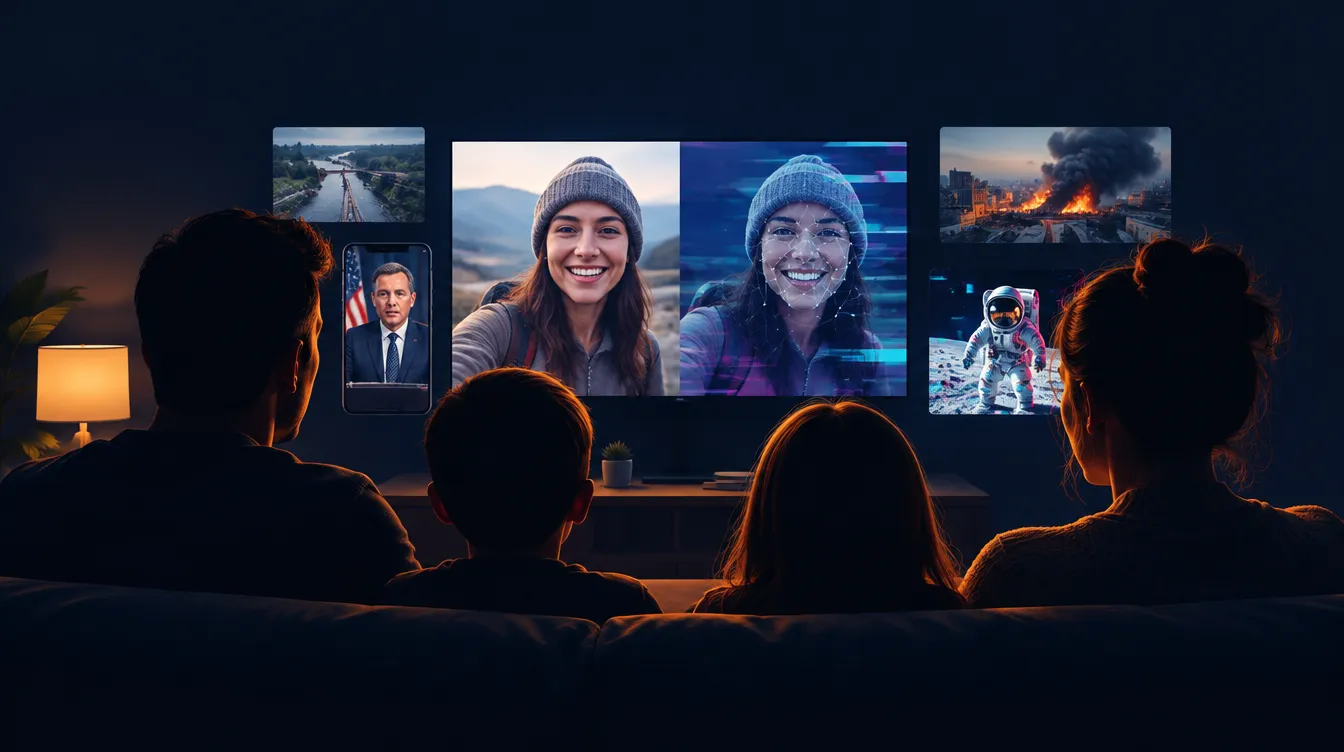
Key Takeaways
- Children encounter AI-generated content daily on social media, group chats, and messaging apps
- The risks include non-consensual synthetic imagery, catfishing, misinformation, and unrealistic standards
- Teaching "pause and check" habits is more effective than monitoring or restriction
- Detection tools function like a seatbelt — you hope you don't need them, but having them changes behavior
- Age-appropriate conversations about synthetic media are now a core digital literacy requirement
Why This Matters for Your Family
Your children are growing up in an environment that is fundamentally different from even five years ago. According to DeepStrike, the volume of deepfake content online grew from approximately 500,000 in 2023 to over 8 million by 2025. AI-generated images — realistic photographs of people, places, and events that never existed — are now a routine part of the visual landscape they navigate daily.
This is not a future concern. It is happening today, in their group chats, on their social media feeds, and in the content shared in their school communities. An iProov study found that only 0.1% of people can accurately differentiate real from deepfake content — and your children are no exception.
Understanding deepfakes and having tools to verify visual content is no longer optional digital literacy. It sits alongside password hygiene and privacy awareness as a basic competency for anyone — especially young people — who interacts with digital media.
What Your Children Are Encountering
On social media
AI-generated content is pervasive on every major social media platform. On Instagram, TikTok, X (formerly Twitter), and Snapchat, your children encounter:
- AI-generated influencer content: Some "people" with hundreds of thousands of followers are entirely synthetic — AI-generated faces, AI-written captions, AI-composed photos
- Manipulated news imagery: During any major news event, AI-generated images circulate within minutes, often before legitimate reporting has time to verify what actually happened
- AI beauty filters at scale: Beyond simple filters, some content uses AI to fundamentally alter faces and bodies, setting appearance standards that are literally impossible to achieve naturally
- Synthetic memes and viral content: Humorous or shocking AI-generated images that spread rapidly, blurring the line between entertainment and deception
A 2025 survey by the Center for Countering Digital Hate found that teenagers encounter an average of 15-20 AI-generated images per day on their social media feeds. Fewer than 10% correctly identified any of them as synthetic.
In group chats and messaging
The more private context of group chats presents additional concerns:
- Forwarded deepfakes: Images shared through WhatsApp, iMessage, and Discord group chats have already been downloaded, screenshotted, and re-shared multiple times — stripping metadata and making verification harder
- Peer-generated content: Access to face-swap apps and image generators means that teenagers can — and do — create synthetic content featuring classmates, teachers, or public figures
- Bullying and harassment: AI-generated imagery is increasingly used as a tool for bullying, creating fake but convincing images of peers in embarrassing or compromising scenarios
In school contexts
Educational settings are not immune:
- AI-generated homework and project imagery: Students using AI to generate images for assignments, sometimes presenting synthetic content as documentary evidence
- Synthetic identification: Instances of students using AI-generated faces for fake social media accounts
- Academic misinformation: AI-generated historical or scientific images that look convincing but depict events or phenomena inaccurately
The Specific Risks for Young People
Non-consensual synthetic imagery
This is the most serious risk. AI tools can generate synthetic intimate imagery of real people using just a few publicly available photos — profile pictures, school photos, social media posts.
This form of abuse has affected people of all ages, but young people are disproportionately targeted. A 2024 report from the Internet Watch Foundation documented a significant increase in AI-generated child sexual abuse material, and multiple schools in the US, UK, and Australia have dealt with incidents involving AI-generated intimate imagery of students.
What makes this particularly dangerous is the speed and ease of creation. Unlike traditional image manipulation, which required skill and time, current AI tools can generate this content in seconds from publicly available photos.
Catfishing and predatory contact
AI-generated faces are extensively used to create fake profiles on social media and dating platforms. For teenagers and young adults who are still developing their ability to assess online relationships, this creates a significant safety concern.
A synthetic profile can combine a convincing AI-generated face, an AI-written bio, and AI-generated conversational responses to create a persona that is entirely fabricated but difficult to distinguish from a real person.
Misinformation and manipulation
Young people are particularly susceptible to visual misinformation because they tend to consume information primarily through images and short videos rather than text-based reporting. An AI-generated image of a shocking event, shared without context in a group chat, can shape beliefs and opinions before any fact-checking occurs.
Unrealistic standards and mental health
The connection between social media imagery and body image issues is well-established. AI generation amplifies this by making it trivial to create images of "people" with physically impossible proportions, flawless skin, and idealized features. When young people compare themselves to images that don't represent real humans, the psychological impact is compounded.
How to Talk About It
Start with curiosity, not alarm
The most effective conversations about deepfakes begin with genuine curiosity rather than parental concern. Telling a teenager "be careful, the internet is dangerous" is likely to be dismissed. Showing them an AI-generated image and asking "do you think this is a real photo?" engages their critical thinking.
Try:
- "I saw this image online — what do you think, real or AI?"
- "Have you seen any AI-generated content in your group chats?"
- "Some people use AI to make fake photos of real people. Has that come up at school?"
Frame it as a skill, not a rule
Detection is a skill — like learning to evaluate news sources or manage privacy settings. Frame it as something useful and empowering rather than a restriction.
Effective framing:
- "Everyone gets fooled by AI images — even experts. Having a way to check is like having a superpower"
- "Checking an image before you share it takes 10 seconds and can save someone a lot of trouble"
- "When something looks too perfect or too shocking, that's the signal to check"
Acknowledge the complexity
Don't pretend all AI-generated content is harmful. Many young people use AI tools creatively — for art, for school projects, for fun. The problem isn't generation itself; it's deception and harm.
A nuanced message:
- AI-generated art and creativity: great
- AI-generated images presented as real to deceive: not okay
- AI-generated images of real people without consent: harmful and in many places illegal
Be honest about your own limitations
Admitting that you can't tell AI images from real ones either builds credibility and shared vulnerability. This is a problem you solve together, not a lecture from someone who has it figured out.
Practical Steps for Families
1. Install a detection tool on family devices
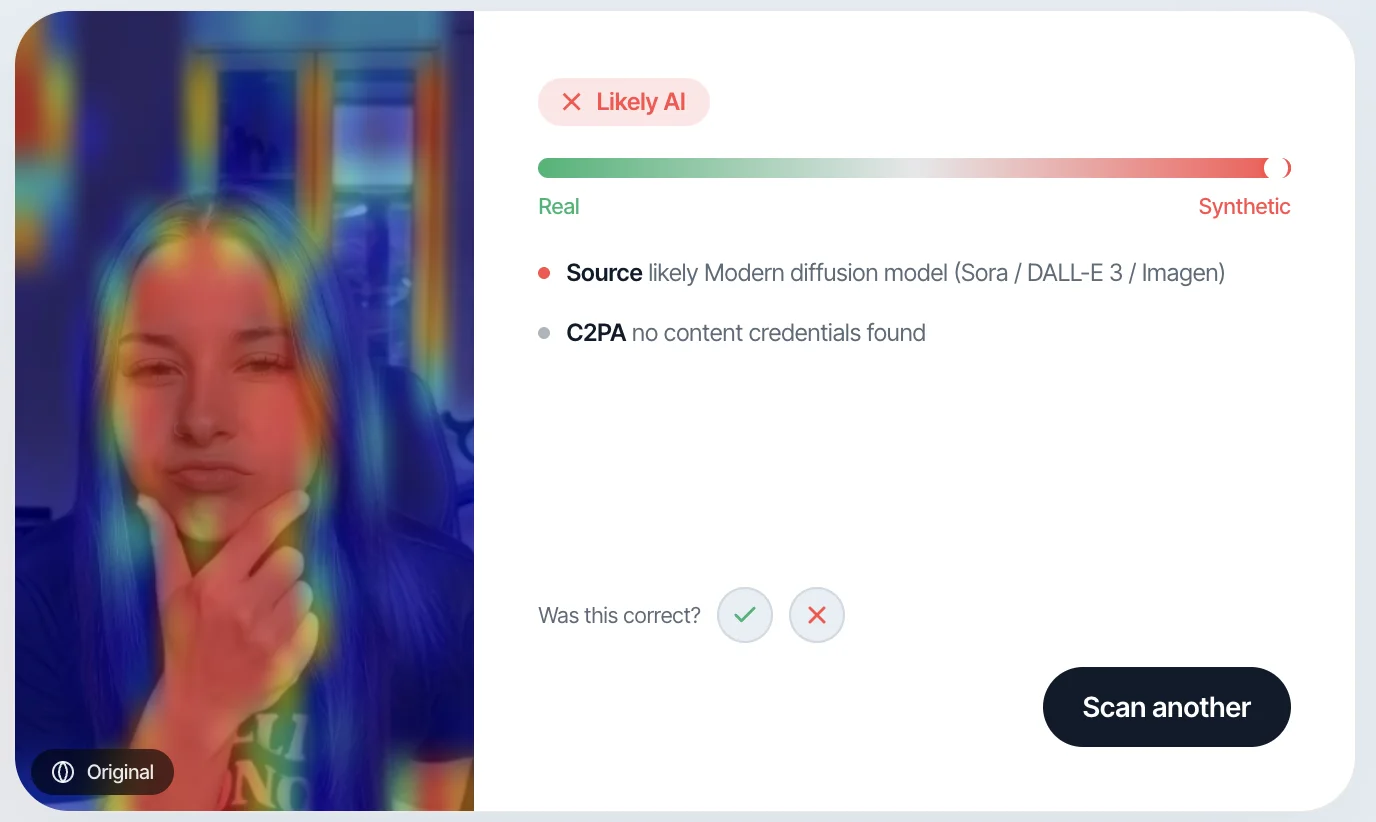
Make checking images as easy as opening an app. The share sheet integration on mobile devices is particularly useful — your child can share any suspicious image directly to a detection app from Messages, Instagram, or any other app without leaving their conversation.
2. Establish the "pause and check" norm
Before sharing, reacting to, or believing a striking image:
- Pause: Does this seem too perfect, too shocking, or too convenient?
- Check: Run it through a detection tool (10 seconds)
- Consider: Who shared this, and why?
This applies to everyone in the family, including parents. Modeling the behavior is more effective than prescribing it.
3. Know the reporting channels
If your child encounters non-consensual synthetic imagery — of themselves or someone else:
- Report it to the platform immediately (all major platforms have reporting mechanisms for this)
- Document the content (screenshot the post and the account, but do not save or share the imagery itself)
- Contact the school if it involves students
- In serious cases, contact law enforcement — creating and distributing non-consensual synthetic intimate imagery is illegal in an increasing number of jurisdictions
4. Stay informed yourself
AI generation technology evolves rapidly. What was state-of-the-art six months ago may be obsolete today. Follow reliable sources on AI safety and detection to keep your understanding current.
5. Have the conversation early and revisit regularly
The first conversation about deepfakes should happen before your child has a significant social media presence — ideally alongside other digital literacy conversations about privacy, passwords, and online behavior. Revisit it periodically as the technology and their online activities evolve.
What Not to Do
- Don't ban AI tools entirely: Prohibition is counterproductive. AI image generation has legitimate creative and educational uses. Focus on the ethical dimension (consent, deception) rather than the technology itself
- Don't monitor every image: Surveillance damages trust and doesn't scale. Building judgment and providing tools is more sustainable
- Don't panic about every AI image: Most AI-generated content is benign — art, memes, entertainment. Reserve serious concern for deception and harm
- Don't assume you'll catch everything: You won't. Neither will your child. The goal is to build habits that reduce risk, not eliminate it entirely
Frequently Asked Questions
At what age should I talk to my child about deepfakes?
Start age-appropriate conversations when your child begins regularly encountering images online — for most families, this is around ages 10-12. The conversation evolves as they grow: awareness and curiosity for pre-teens, practical detection skills for teenagers, and ethical reasoning for older teens and young adults.
What should I do if my child has been targeted with deepfake imagery?
Prioritize emotional support first — being targeted is distressing regardless of whether the imagery is "real." Report the content to the platform for removal, document the source, inform the school if applicable, and consult law enforcement if the content is intimate in nature or involves threats. Consider professional support if the experience is causing significant distress.
Are schools addressing this?
Increasingly, yes. Many schools have begun incorporating AI literacy into their digital citizenship curricula, and some have specific policies addressing AI-generated content involving students. Ask your child's school what their approach is — and advocate for it if it doesn't exist yet.
Can I check images without my child knowing?
You can use detection tools on any image you have access to. However, the more effective long-term approach is to teach your child to check images themselves. Covert monitoring is a short-term solution; building judgment is a permanent one.
How reliable are detection tools?
Current ensemble detection systems achieve 90-97% accuracy on standard-quality images. Accuracy is lower on heavily compressed or small images. No tool is perfect — they provide a strong second opinion, not absolute certainty. Teach your child to use detection results as one input among several, alongside context and judgment.