Best AI Image Detector: 5 Detection Approaches Compared (2026)
Compare the best AI image detectors and deepfake detection tools in 2026. Pixel forensics, frequency analysis, provenance, and ensemble approaches ranked.
Key Takeaways
- No single detection method catches all deepfakes — each has specific strengths and blind spots
- Ensemble systems that combine multiple approaches achieve the highest accuracy
- The choice of method depends on your use case: casual verification, professional journalism, legal evidence, or platform moderation
- Detection is an active arms race; tools must be continuously updated to handle new generators
- The most important factor is not which method a tool uses, but whether it retrains regularly
The Detection Landscape in 2026
The deepfake detection market has grown from a handful of academic prototypes to a diverse ecosystem of commercial tools, open-source models, and platform-integrated systems. But not all approaches are equal, and understanding the differences is critical for choosing the right tool for your needs.
This guide compares the five major approaches to deepfake detection, their strengths and limitations, and what matters most when evaluating a tool.
1. Pixel-Level Forensics
How it works
Pixel forensic detectors are deep neural networks — typically convolutional neural networks (CNNs) or vision transformers (ViTs) — trained on datasets containing millions of real photographs and synthetic images. Through training, these networks learn to identify patterns in the pixel data that distinguish real from generated content.
The patterns they detect include:
- Noise residuals: Real cameras produce images with sensor-specific noise patterns. Generators produce their own characteristic noise. A trained classifier can distinguish these patterns even though they are invisible to the human eye
- Color channel statistics: The relationship between red, green, and blue color channels in real photographs is constrained by the physics of Bayer filter demosaicing. Generators approximate but don't perfectly replicate these relationships
- Compression artifacts: When generated images are saved as JPEG, the interaction between the generation artifacts and the compression algorithm produces characteristic patterns that differ from compressed real photographs
- Edge characteristics: The boundaries between objects in generated images have subtly different frequency characteristics than those in optical photographs, resulting from the mathematical properties of the generation process rather than physical optics
Strengths
Universality: Pixel forensics can be applied to any image without requiring prior knowledge of the generator, the subject, or the context. It analyzes the image content itself.
Speed: Modern implementations run in 1-5 seconds per image, making real-time or near-real-time detection feasible.
Breadth: Well-trained models generalize across multiple generators, detecting artifacts from models they weren't specifically trained on.
Limitations
Post-processing sensitivity: Pixel-level artifacts are fragile. Screenshots, social media compression, cropping, resizing, and filters can degrade or destroy the signals that detectors rely on. A detector that achieves 97% accuracy on unprocessed images may drop to 75% on screenshots.
Generator-specific accuracy: Detection accuracy varies by generator. A model trained primarily on Stable Diffusion output may perform poorly on Midjourney or DALL-E images, and vice versa. Broad training mitigates this but doesn't eliminate it.
Adversarial vulnerability: Sophisticated attackers can apply adversarial perturbations — tiny, imperceptible pixel-level changes — that cause classifiers to misclassify generated images as real. This is a theoretical concern that has been demonstrated in research but is not yet common in practice.
Best for
Everyday checking of suspicious images. The "first line of defense" for anyone who encounters an image they want to verify.
2. Frequency Domain Analysis
How it works
Every digital image can be represented in two ways: the spatial domain (the pixels you see) and the frequency domain (the periodic components that make up the image). The Fast Fourier Transform (FFT) or discrete cosine transform (DCT) converts between these representations.
Real photographs and AI-generated images have measurably different frequency distributions. This is because:
- Camera optics impose physical frequency limitations: lens diffraction creates a natural rolloff at high frequencies, and anti-aliasing filters in the sensor explicitly limit the frequency content
- Generative models learn to approximate the visual appearance of real images but don't replicate the physical process. The resulting frequency distributions contain anomalies — periodic artifacts, unusual energy distributions at specific frequency bands, or missing high-frequency detail
Frequency-based detectors analyze these distributions and classify images based on the presence or absence of generation-characteristic frequency patterns.
Strengths
Robustness to spatial manipulation: Some forms of image manipulation that defeat pixel-level detectors (color adjustments, contrast changes, mild compression) have less impact on frequency-domain features.
Complementarity: Frequency analysis detects different artifacts than pixel analysis. Using both together provides broader coverage than either alone.
Interpretability: Frequency spectrum visualizations can sometimes reveal generation artifacts visually (as patterns in the spectrogram), making it easier for analysts to understand why a detection was triggered.
Limitations
Resolution dependence: Frequency analysis requires sufficient image resolution to detect anomalies. On very small images (thumbnails, avatars) or heavily compressed images, the frequency information is too degraded for reliable analysis.
Generator evolution: Newer generators are being specifically designed to produce more realistic frequency distributions, reducing the effectiveness of this approach in isolation.
Computational overhead: Full spectral analysis is more computationally expensive than simple pixel classification, though still fast enough for practical use (typically 2-5 seconds).
Best for
Use alongside pixel-level detection for higher confidence. Particularly valuable for analyzing images that have undergone moderate post-processing.
3. Provenance Tracking (C2PA)
How it works
The Coalition for Content Provenance and Authenticity (C2PA) is an industry standard for embedding cryptographic signatures in media at the point of capture. When a C2PA-enabled device captures an image, a tamper-evident signature is attached that records:
- The capture device (camera make, model, serial number)
- The time and location of capture
- A hash of the original pixel content
- A record of any subsequent edits (cropping, color adjustment, etc.)
Each edit in the chain adds its own signed record, creating a provenance chain from capture to publication. If any step in the chain is broken — if the image is re-saved without C2PA support, or if the pixels are modified without a corresponding signed edit record — the provenance chain is invalidated.
Strengths
Tamper evidence: A valid C2PA chain provides strong evidence that an image was captured by a specific physical device at a specific time and has not been altered outside the recorded edit chain. This is the closest thing to a "proof of authenticity" that currently exists.
Not dependent on AI: Unlike detector-based methods, C2PA doesn't rely on trained models that might be fooled by new generators. The cryptographic guarantees are mathematical, not statistical.
Industry adoption momentum: Major camera manufacturers (Leica, Sony, Nikon), platform companies (Adobe, Microsoft, Google), and news organizations have committed to C2PA support.
Limitations
Adoption gap: As of 2026, C2PA is supported by a growing but still small fraction of devices and platforms. The vast majority of images in circulation have no C2PA metadata. A missing C2PA signature doesn't prove an image is fake — it just means provenance can't be verified through this method.
Doesn't detect generation: C2PA verifies provenance, not authenticity of content. A C2PA signature proves "this image came from this camera at this time." It doesn't analyze whether the content itself is synthetic. An AI-generated image saved through a C2PA-enabled pipeline could carry a valid signature.
Strippability: C2PA metadata can be stripped by re-saving an image in a format that doesn't support it, by taking a screenshot, or by sharing through platforms that strip metadata. This means an authentic image can lose its provenance through normal sharing behavior.
Best for
Professional contexts where chain of custody matters: journalism, legal evidence, insurance documentation, and corporate communications. Not a substitute for content analysis, but a powerful complement.
4. Reverse Image Search and Cross-Reference
How it works
Reverse image search engines (Google Images, TinEye, Yandex) allow you to upload an image and find other instances of it — or visually similar images — across the web. This can reveal:
- Whether an "exclusive" image has actually appeared elsewhere before
- Whether an image has been previously fact-checked
- Whether a face photo comes from a stock image library or AI gallery
- The original source and context of an image that's been shared without attribution
Strengths
Simplicity: Requires no technical knowledge or specialized tools. Upload an image, see where else it appears.
Context discovery: Even when it doesn't prove an image is fake, reverse search can reveal the original context of an image that's been repurposed with a misleading caption.
Freely available: Google Images, TinEye, and Yandex all offer free reverse image search.
Limitations
Cannot detect novel content: If an image was freshly generated by AI and has never been published before, reverse image search will find nothing. This is the most significant limitation — the most dangerous deepfakes are purpose-made, novel content.
Slow: Results require manual interpretation. Unlike automated detectors that provide an instant verdict, reverse search requires examining results and making judgments about relevance.
Platform gaps: No reverse search engine indexes all of the internet. Private messages, closed social media accounts, and dark web content are not searchable.
Best for
Checking viral images that claim to be exclusive or original. Useful as a complement to automated detection, not a replacement.
5. Ensemble Detection
How it works
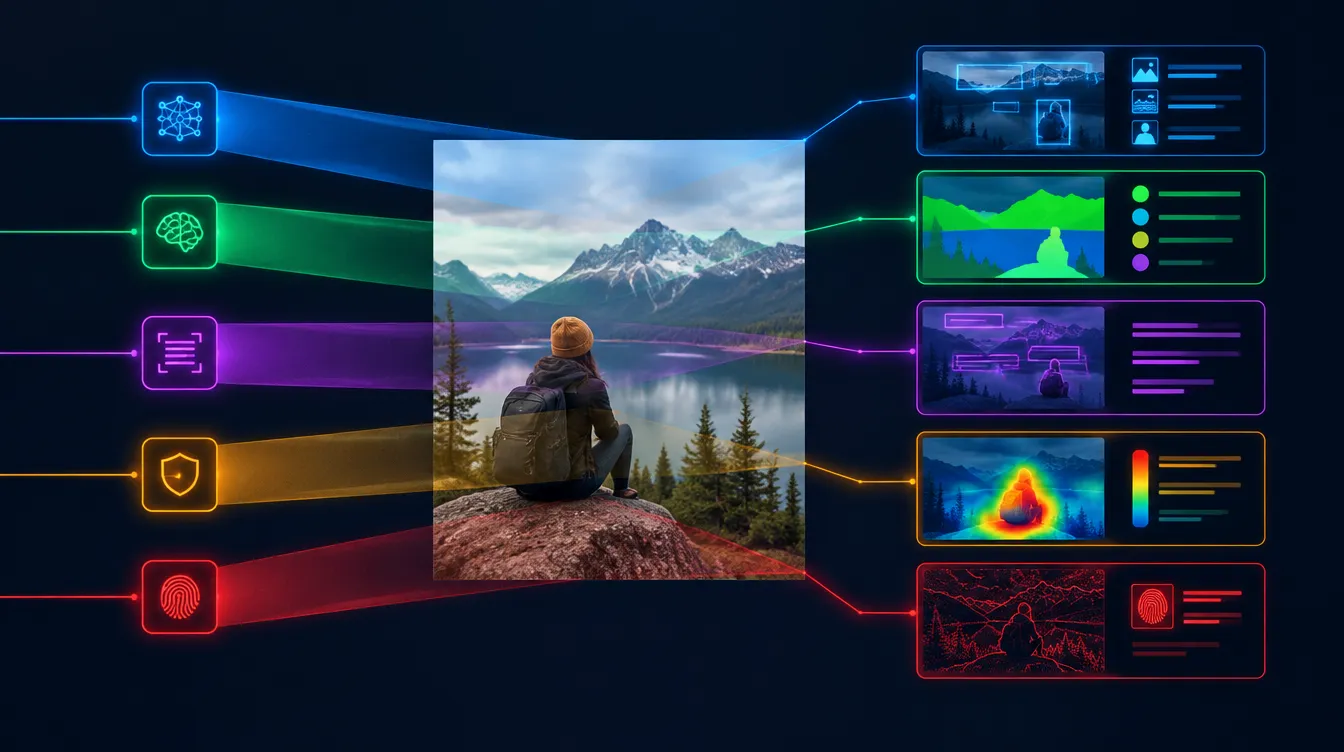
Ensemble detection combines multiple detection methods and synthesizes their verdicts into a single, higher-confidence result. A typical ensemble might include:
- A pixel-level forensics model
- A frequency-domain analyzer
- A provenance checker
- A biological signal detector (for face content)
Each method produces an independent verdict and confidence score. The ensemble system weights these based on:
- Each method's known accuracy for the specific input type (image vs video, high-res vs compressed)
- The agreement or disagreement between methods
- The known blind spots of each method for the specific content
Strengths
Highest accuracy: Ensembles consistently outperform individual methods in benchmarks. The improvement is not marginal — ensemble accuracy of 95%+ is common where individual methods achieve 80-90%.
Robustness: Because different methods fail on different inputs, an ensemble is robust to any single method's blind spot. If pixel analysis is degraded by compression but frequency analysis is not, the ensemble compensates.
Reduced false positives: When multiple independent methods agree, the probability of a false positive (flagging a real image as fake) drops dramatically.
Limitations
Computational cost: Running multiple models takes more compute time and resources than a single detector. Practical ensembles balance thoroughness with speed.
Complexity: Building, maintaining, and retraining an ensemble requires expertise across multiple detection methods. This is primarily available through specialized detection services rather than open-source tools.
Still not perfect: Even ensembles can be wrong, particularly on inputs that degrade the signals for all methods simultaneously (very low resolution, heavy processing, novel generators).
Best for
Maximum confidence when the stakes are high. The recommended approach for any serious detection use case.
How to Choose
The right approach depends on your context:
What Matters More Than Method
Regardless of which detection approach a tool uses, three factors matter more than the specific technical method:
1. Retraining frequency: A detector trained on 2024 generators will miss artifacts specific to 2026 models. The best tools retrain continuously — monthly or even weekly — incorporating new synthetic content as it appears.
2. Confidence calibration: A tool that says "92% likely synthetic" is more useful than one that says "FAKE." Calibrated confidence scores let you weight the result appropriately for your risk tolerance and use case.
3. Transparency about limitations: Honest tools tell you when they're uncertain. A verdict of "inconclusive" on a heavily compressed image is more trustworthy than a confident "REAL" that ignores the signal degradation.
Frequently Asked Questions
Which single method is most accurate?
In isolation, pixel-level forensics using vision transformers currently achieves the highest accuracy on standard benchmarks (88-93% on unprocessed images). However, no single method matches the accuracy of well-designed ensembles (95%+).
Can free tools compete with paid ones?
For casual use, some free tools provide adequate detection. For professional use — journalism, legal, enterprise — paid tools typically offer better accuracy (ensemble methods, continuous retraining), faster processing, and more detailed analysis.
How do I know if a detection tool is actually good?
Look for: published accuracy benchmarks on recent generators, documented retraining schedule, ensemble architecture, calibrated confidence scores, and transparent limitations disclosure. Be skeptical of tools that claim 99%+ accuracy without specifying conditions.
Will one detection tool work for everything?
No tool works perfectly for all content types, resolutions, and generators. The most reliable approach is using a tool that combines multiple methods (ensemble) and reports its confidence honestly.