EU AI Act Article 50: Deepfake Labeling Rules Now Enforceable
As of August 2, 2026, anyone publishing a deepfake in the EU must label it as artificially generated. Article 50 applies even without intent to deceive. What it means for creators and platforms.
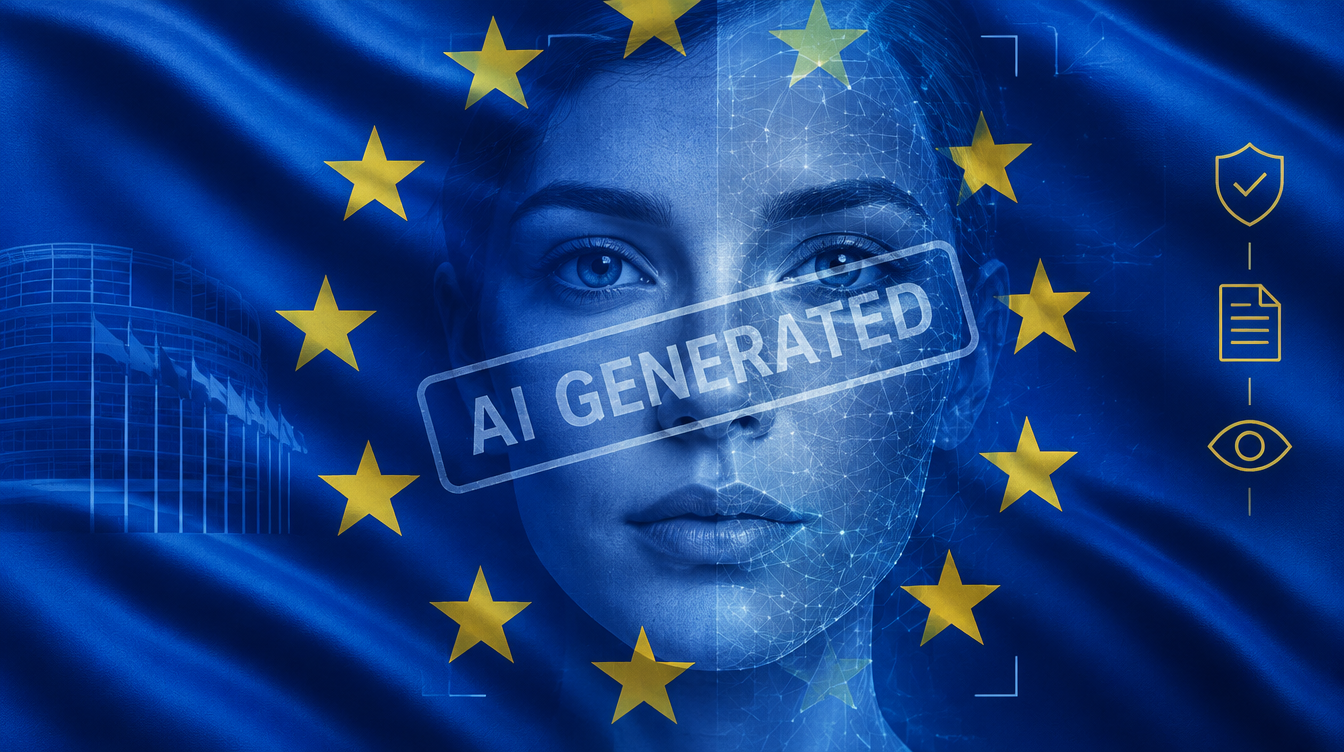
As of August 2, 2026, anyone publishing a deepfake in the European Union must label it as artificially generated. Article 50 of the EU AI Act is no longer a future obligation. It is enforceable law, and it applies more broadly than most people realize.
What Article 50 Requires
The EU AI Act's transparency obligations for synthetic content took effect on August 2, 2026. Article 50 requires that any person or organization deploying an AI system that generates or manipulates content constituting a deepfake must disclose that the content has been artificially generated or manipulated.
Two aspects of this rule are broader than expected.
First, the labeling obligation applies even when there is no intent to deceive. Creating a deepfake for entertainment, satire, or artistic purposes still triggers the disclosure requirement. The law targets the content itself, not the creator's motivation.
Second, the obligation applies even when no real person is depicted. An entirely fictional AI-generated face in a video still requires labeling under Article 50. This distinguishes the EU approach from many other jurisdictions that focus specifically on impersonation or harm to identifiable individuals.
How Enforcement Works
The EU AI Act assigns enforcement to national authorities in each member state. Each country is designating its own competent authority to handle AI Act compliance, similar to how GDPR enforcement operates through national data protection authorities.
Penalties for non-compliance with transparency obligations can reach up to 15 million euros or 3% of annual worldwide turnover, whichever is higher. For large technology companies, the turnover-based calculation produces significantly higher potential fines.
Enforcement will likely be complaint-driven initially, with regulators prioritizing cases involving clear public harm or systematic non-compliance. But the legal liability exists from day one. Any unlabeled deepfake published after August 2, 2026 is technically in violation.
The Global Regulatory Picture
The EU is not acting alone. The regulatory environment for synthetic content is tightening across multiple jurisdictions simultaneously.
In the United States, 48 states now address sexually explicit deepfakes in some form through state legislation. The federal TAKE IT DOWN Act's platform obligations took effect on May 19, 2026, requiring platforms to remove non-consensual intimate images (including AI-generated ones) within 48 hours of a valid report.
The UK's Online Safety Act has given Ofcom enforcement powers over deepfake intimate content, with a September 30, 2026 deadline for platforms to deploy automated detection technology.
Australia, Canada, South Korea, and Japan have all introduced or strengthened deepfake-related legislation in 2025 and 2026. The direction is consistent: unlabeled synthetic content is becoming a legal liability in every major market.
What This Means for Content Creators
If you create or publish AI-generated content that reaches EU audiences, Article 50 applies to you regardless of where you are based. The EU AI Act, like GDPR, has extraterritorial reach. A creator in the United States posting AI-generated content on a platform accessible in the EU is subject to the labeling requirement.
For businesses using AI-generated images or video in marketing, advertising, or social media, the compliance step is straightforward: label the content. Most platforms are adding built-in labeling tools. Using them is now a legal requirement, not a best practice.
For individuals, the practical takeaway is that the era of unlabeled AI-generated content is ending. If you encounter synthetic content without a label, it may be in violation of applicable law, and it should be treated with extra skepticism.
What This Means for Everyone Else
Labeling requirements only work if people pay attention to the labels. The more important skill is the ability to identify AI-generated content independently, whether or not it carries a disclosure.
You can check any image or video at witness.vision/scan to determine whether it was AI-generated. The Witness Chrome extension analyzes images on any webpage as you browse, giving you a detection layer that does not depend on the creator's honesty or compliance with labeling laws.
Regulation is catching up. But your own ability to verify what you see remains the strongest protection.