How to Spot a Deepfake: Why Your Eyes Fail and What Actually Works
Only 0.1% of people can spot deepfakes. Learn the signs of a deepfake, why human vision fails, and which detection tools actually work in 2026.
Key Takeaways
- Only 0.1% of people can accurately differentiate real from deepfake content (iProov study)
- This is not a failure of attention or intelligence; it is a fundamental limitation of human visual perception
- The visual artifacts that once made deepfakes obvious have been systematically eliminated by newer models
- Automated detection tools analyze signals that exist below the threshold of human perception
- The gap between human perception and AI generation capability is widening, not closing
The Number That Changed Everything
In 2025, researchers published a study that should have been front-page news but was largely overlooked outside the AI research community.
The study, presented at IEEE/CVF CVPR — the most prestigious computer vision conference in the world — tested 1,222 participants on their ability to distinguish real photographs from AI-generated images. The participants were shown faces generated by the latest models alongside real photographs from the FFHQ dataset (a standard benchmark of high-quality face photographs).
The result: 50.4% accuracy. Statistically indistinguishable from flipping a coin.
But that's the academic figure. The real-world number is even worse. An iProov study found that only 0.1% of people could accurately differentiate real from deepfake content — and 60% of participants were confident in their answers despite performing poorly. A broader analysis in Computers in Human Behavior Reports found an average human detection rate of just 55.54% across all media formats.
This wasn't a trick setup. Participants were:
- Given unlimited time to examine each image
- Told in advance that some images were AI-generated
- Shown images at high resolution on calibrated displays
- Paid for accuracy, incentivizing careful examination
They simply could not tell the difference.
How We Got Here: A Timeline
Understanding why your eyes fail requires understanding how fast the technology has moved.
2017-2018: The uncanny valley
The first widely-known deepfakes were face swaps in video, produced using autoencoders. They were immediately recognizable: blurry face boundaries, temporal flickering, obvious mismatches in skin tone and lighting between the swapped face and the original body.
Human detection accuracy in this era: approximately 85-90%. Most people could tell.
2019-2020: StyleGAN and the face generation revolution
NVIDIA's StyleGAN architecture could generate photorealistic faces of people who never existed. The output was remarkable but imperfect. Common tells included:
- Asymmetric earrings or glasses
- Hair that melted into the background
- Teeth with irregular shapes
- Background artifacts (wavy lines, floating objects)
Human detection accuracy: approximately 70-75%. Careful observers could usually spot the fakes, but casual viewers were often fooled.
2021-2022: Diffusion models arrive
Stable Diffusion, DALL-E 2, and Midjourney introduced diffusion-based generation, producing not just faces but entire scenes from text prompts. Quality improved rapidly:
- Backgrounds became coherent and physically plausible
- Lighting and shadows were handled more consistently
- Body proportions improved (though hands remained problematic)
- Text generation in images improved but was still unreliable
Human detection accuracy: approximately 55-65%. The "check the hands" advice from this era was valid — hands were still a relatively reliable tell.
2023-2024: The hands are fixed
Midjourney v5, DALL-E 3, and Stable Diffusion XL addressed the remaining systematic artifacts:
- Hands with correct finger counts and natural poses
- Consistent text rendering in most cases
- Natural skin texture with pores and fine details
- Accurate reflections and shadows
- Coherent backgrounds with correct perspective
Human detection accuracy: approximately 50-55%. The last reliable visual heuristics had been eliminated.
2025-2026: Beyond human perception
Current-generation models have been trained on datasets of billions of images and hundreds of billions of parameters. Their output is not just "hard to distinguish" from real images — it is statistically indistinguishable by any metric that corresponds to human visual perception.
Human detection accuracy: 48-51%. We have crossed the threshold where AI generation capability exceeds human perceptual resolution.
Why Your Brain Is Not Built for This
Your visual system is extraordinary. It can recognize a friend's face across a crowded room, detect a snake in tall grass, and read emotional states from micro-expressions lasting fractions of a second.
But it was optimized by evolution for a specific set of tasks:
- Threat detection: Is that a predator? Is that person angry?
- Face recognition: Friend or stranger? How are they feeling?
- Spatial navigation: What's the terrain? Where are the obstacles?
- Motion processing: What's moving, and how fast?
It was never designed to detect statistical anomalies in pixel distributions. It has no mechanism for measuring noise fingerprints, frequency spectrum patterns, or color channel correlations.
These are the signals that distinguish real from synthetic content. They exist. They are measurable. They are just invisible to biological vision.
The specific limitations
Resolution of noise perception: Your eye cannot distinguish between different types of noise at the pixel level. Camera sensor noise and GAN noise look identical to you, even though they have measurably different statistical properties.
Frequency sensitivity: Human vision is most sensitive to mid-range spatial frequencies (roughly 2-5 cycles per degree of visual angle). Many generation artifacts exist at higher frequencies that are below your perceptual threshold.
Texture statistics: You perceive texture holistically — "that looks like skin" — rather than analytically. Generators exploit this by producing textures that match your holistic perception while differing in fine-grained statistics that you cannot consciously access.
Confirmation bias: When an image matches your expectations of what reality looks like, your brain accepts it without close scrutiny. Generators are trained specifically to match those expectations.
What Can Actually See the Difference
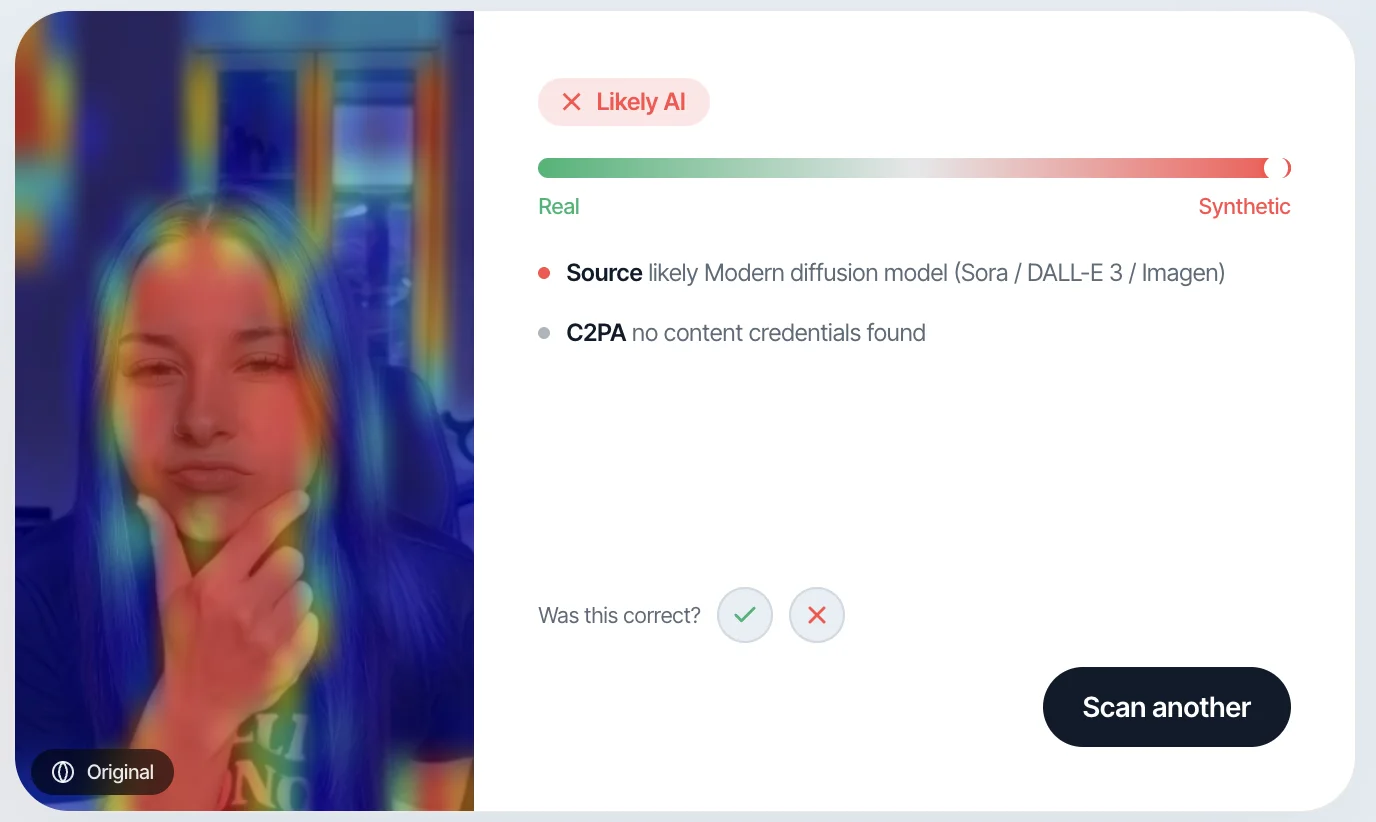
Automated detection tools analyze the signals that human vision cannot access:
Noise forensics
Every digital camera sensor has a unique noise pattern — a "photo response non-uniformity" (PRNU) that acts like a fingerprint. Even cameras of the same make and model have different noise patterns.
AI generators don't have sensor noise. They produce their own noise patterns, determined by their architecture and training. A detector trained on the noise patterns of real cameras and various generators can distinguish them with high accuracy — even when the visual content looks identical.
Spectral analysis
The Fast Fourier Transform (FFT) converts an image from the spatial domain (pixels) to the frequency domain (periodic components). Real photographs have frequency distributions that reflect physical properties: lens diffraction, sensor anti-aliasing filters, and the spectral properties of natural light.
Generated images have different frequency distributions. Specific models produce characteristic "fingerprints" in the frequency domain that are invisible in the spatial image but clearly measurable after transformation.
Statistical distribution analysis
Real images follow statistical regularities that arise from the physics of light and optics. For example, the Benford's law distribution of leading digits in DCT coefficients follows a predictable pattern in real JPEG images. Generated images may violate these patterns in ways that are statistically detectable but visually invisible.
Learned detection features
Deep neural networks trained on large datasets of real and synthetic images learn to detect features that no human researcher has explicitly identified. These features are complex combinations of low-level patterns that don't map to any intuitive concept — they are literally patterns that only a trained network can perceive.
What This Means for You
The conclusion is not that you are inadequate. It is that the problem has moved beyond the capabilities of the tool you were using to solve it.
We don't try to outrun cars. We don't try to outcompute spreadsheets. And we should not try to out-perceive AI detection tools when it comes to synthetic media.
The practical implications:
- Stop relying on visual inspection for verification. Use it as a first filter ("does something feel off?") but never as your final answer
- Use detection tools for any image where the stakes matter. It takes seconds and provides information you literally cannot obtain by looking
- Adjust your default trust level for visual content online. The percentage of images that are synthetic is growing. Your prior assumption should be cautious, not trusting
- Stay updated. The capabilities of both generators and detectors change rapidly. What you learned about spotting deepfakes last year may already be obsolete
Frequently Asked Questions
Will humans ever be able to spot deepfakes again?
It is very unlikely. The trend is moving in the opposite direction: generators are improving faster than human perceptual capabilities can adapt (which is to say, human perception is essentially fixed). The gap will continue to widen.
Do experts do better than average people?
Only marginally. Studies show that professional photographers and digital forensics experts achieve approximately 55-60% accuracy — better than chance but far from reliable. Their advantage comes primarily from knowing specific tells to look for, which are model-specific and temporary.
If I can't trust my eyes, what can I trust?
Trust the combination of: (1) automated detection tools that analyze sub-perceptual signals, (2) provenance chains (C2PA) when available, (3) contextual verification (can you confirm the image through independent channels?), and (4) your judgment about the source and motivation of whoever shared the content.
Is this problem unique to images?
No. Voice synthesis, video deepfakes, and text generation all present similar challenges where the output quality has exceeded human detection capability. The principles are the same: use specialized tools, not your unaided senses.