$80 Million in AI Deepfake Political Ads: The 2026 Midterms Are the First Deepfake Election
Researchers tracked 170 AI-generated political ads with $80M+ in spending. 69% carry no AI disclosure. No federal law exists. What the first deepfake election looks like.
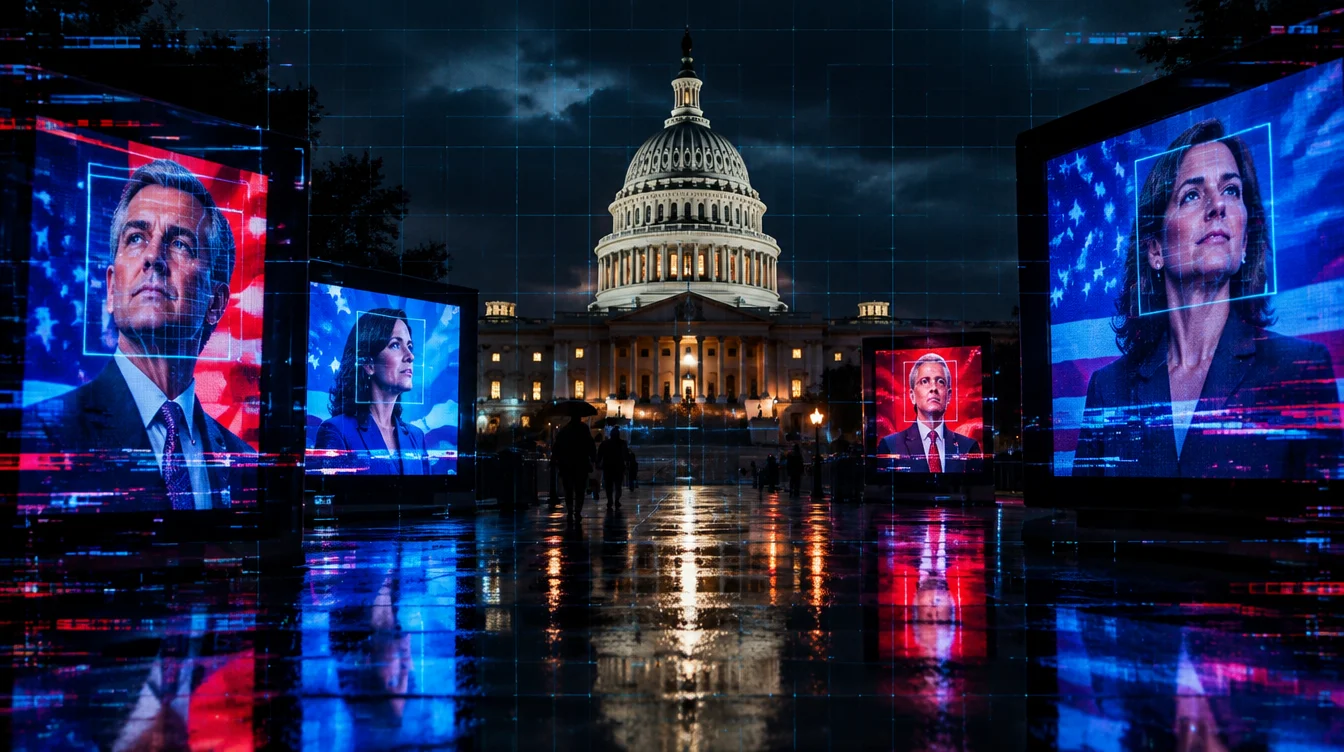
The 2026 US midterm campaigns are the first American election cycle where AI-generated political ads appear regularly on television and social media. Researchers have tracked nearly 170 AI-generated political ads with over $80 million in spending behind them. Most carry no disclosure that AI was used.
Key Takeaways
- Researchers at the Wesleyan Media Project have identified nearly 170 AI-generated political ads in the 2026 midterm cycle, backed by over $80 million in spending [1].
- 80% of the ads come from Republican candidates and their supporters, accounting for 83% of total spending [1].
- 69% of the tracked ads carry no disclaimer about AI use. Those undisclosed ads represent 78% of total spending [1].
- 31 states have passed laws requiring AI-generated ad disclosure, but compliance is essentially the same in states with and without such laws [2].
- There is no federal law regulating AI deepfakes in political advertising. The FEC remains divided on the issue [3].
What the Ads Look Like
These are not subtle enhancements. Researchers documented a range of AI use, from hyperrealistic deepfakes to absurdist AI-generated scenes. One NYU researcher coined the term "slopaganda" for this content: low-quality AI "slop" mixed with propaganda [2].
Fabricated candidate footage. In the Texas Senate race, a Trump-aligned PAC released an AI-generated video depicting Democratic nominee James Talarico in a blue dress, singing a parody about transgender children. A separate ad showed what appeared to be Talarico speaking directly to camera, declaring he is "a Christian who hates Christianity." Talarico never filmed either video. The Talarico deepfake is considered the first realistic AI-generated candidate video used in a US race [3][4].
Fake scenes with real politicians. Republican gubernatorial candidate Bruce Blakeman in New York released ads showing NYC Mayor Zohran Mamdani and Governor Kathy Hochul gardening together and collaborating to raise costs for residents. Neither Hochul nor Mamdani appeared in the ads. The content was entirely AI-generated. A brief disclaimer appeared at the start [4].
Public figures in fabricated scenarios. Researchers documented ads depicting Alexandria Ocasio-Cortez (appearing in at least five separate AI ads), a Louisiana Republican Senate candidate driving a "school bus full of undocumented immigrants," a South Carolina gubernatorial candidate "walking arm in arm with drag queens," Liz Cheney, Mitt Romney, and Mike Pence "carrying pitchforks on the White House lawn," and Dr. Anthony Fauci "running around a state fair with a huge syringe" [2].
AI chatbots as campaign tools. California State Senator Scott Wiener released an AI chatbot that answered approximately 5,000 questions about his opponent Connie Chan, parodying her development record, accent, and naturalized citizenship. Wiener withdrew the chatbot after backlash, acknowledging poor judgment [4].
The Disclosure Problem
The Wesleyan Media Project found that disclosure practices are inconsistent to the point of meaninglessness [1][2]:
- 69% of AI-generated political ads had no disclaimer at all, covering 78% of total spending.
- Among ads that did include disclaimers, the wording varied wildly by state:
- Georgia: "This video has been manipulated or generated with artificial intelligence" - Oklahoma: "Political satire. AI-generated images do not depict actual events" - North Carolina: "You guessed it! AI was definitely used to generate these silly video clips"
Most critically, researchers found that states with AI disclosure laws showed 29% disclaimer compliance, versus 32% in states without such laws. Having a law on the books made essentially no difference [2].
The Regulatory Vacuum
There is no federal law governing AI deepfakes in political advertising [3][4].
FCC: The Federal Communications Commission has prohibited AI-generated voices in robocalls, but the rule does not extend to digital ads, television, or social media content [3].
FEC: The Federal Election Commission has opened a rulemaking proceeding on AI use in campaigns but remains divided along partisan lines. No rules have been finalized ahead of the November 3 election [3].
State laws: 33 states have enacted laws addressing deepfakes in political communications as of October 2026, up from 28 at the start of the year. Most focus on disclosure requirements rather than bans. A few states have enacted narrow bans near election dates: Texas (30 days), Mississippi (90 days), Montana (60 days) [3].
The enforcement gap is real. As researchers noted, compliance rates in states with disclosure laws are statistically indistinguishable from states without them [2].
Why This Matters Beyond Politics
The 2026 midterms are a preview of what happens when AI-generated video becomes cheap, fast, and indistinguishable from real footage at scale.
The tools are accessible. Creating a convincing deepfake of a public figure no longer requires specialized expertise. The same tools that generate a synthetic James Talarico speaking to camera are available to anyone with a laptop and an internet connection.
Detection is not keeping pace. 78% of voters support a ban on AI content making deceptive claims about candidates [4]. But voters cannot enforce what they cannot identify. When 69% of AI-generated political ads carry no disclosure, the burden of detection falls on the viewer, and most viewers cannot tell the difference.
The same techniques scale to other domains. AI-generated video impersonating a political candidate uses the same underlying technology as AI-generated video impersonating a CEO, a family member, or a romantic interest. The $80 million spent on political deepfakes this cycle is a fraction of the $3.7 billion in documented deepfake fraud losses globally.
How to Check What You See
If a political ad, social media video, or image looks suspicious, you can check it before sharing or acting on it.
Upload any image or video frame at witness.vision/scan to check whether it was AI-generated. The Witness Chrome extension can scan images on any webpage, including political ads in your social media feed.
With three weeks until Election Day, verifying before sharing is not just good practice. It is a civic responsibility.
Scan now at witness.vision/scan
- [1]Wesleyan Media Project, "AI-Generated Political Advertising in the 2026 Midterms," October 2026. Tracked nearly 170 AI-generated ads with $80M+ in spending. Reported via CT Mirror, Fast Company, and Salon.
- [2]Ridout, T.N., Fowler, E.F., and Franz, M., "We've Tracked $80M of Spending on Almost 170 AI-Generated Political Ads This Year," Salon, October 6, 2026. Wesleyan Media Project researchers.
- [3]"Regulators Scramble as AI Deepfakes Flood the 2026 Midterms," CampaignNow, October 2026. FCC robocall rule, FEC rulemaking status, state law tracker.
- [4]"AI Deepfake Ads Grow More Popular in US Midterm Campaigns, Blurring Truth," Al Jazeera, October 9, 2026.