Deepfake Fraud by the Numbers: How AI Scams Went From Rare to Routine
Deepfakes grew from 0.1% of fraud to 11% in three years. FBI, Sumsub, and Sensity data charted with 7 original visualizations.

Every major fraud report from the past three years tells the same story: deepfakes have moved from novelty to primary attack vector. We pulled the latest figures from the FBI, FTC, Sumsub, Sensity AI, and Deloitte to chart exactly how fast.
Key Takeaways
- Deepfakes grew from 0.1% of all fraud attempts in 2022 to 11% in 2025
- Deepfake videos online went from 14,678 in 2019 to an estimated 8 million in 2025
- The cost of creating a deepfake video dropped from $20,000/minute to $5 per video
- US deepfake-specific fraud losses hit $1.1 billion in 2025, tripling from $359 million in 2024
- Deloitte projects deepfake-enabled financial fraud will reach $40 billion globally by 2027
Deepfakes as a Share of All Fraud
This is the single most important chart. Sumsub processes millions of identity verification checks annually. Their data shows how fast deepfakes have gone from edge case to mainstream fraud tool.
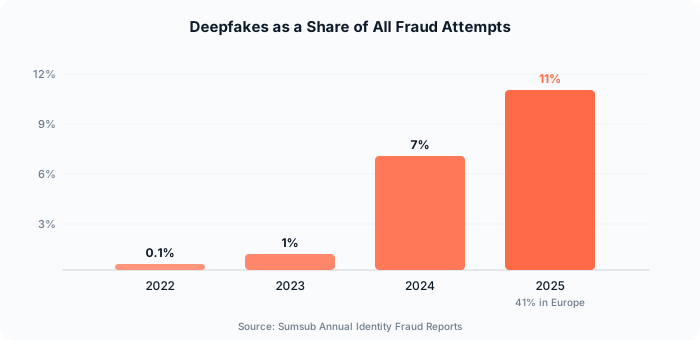
In 2022, deepfakes accounted for 0.1% of fraud attempts on the platform. By 2024, that hit 7%. By 2025, 11% of all global fraud involved deepfakes [1]. In Europe, the share reached 41%.
That is a 110x increase in three years. Deepfakes are no longer a future threat. They are a present-tense, high-volume attack vector.
The Collapsing Cost of Deepfakes
The growth makes sense when you look at what it costs to create one.
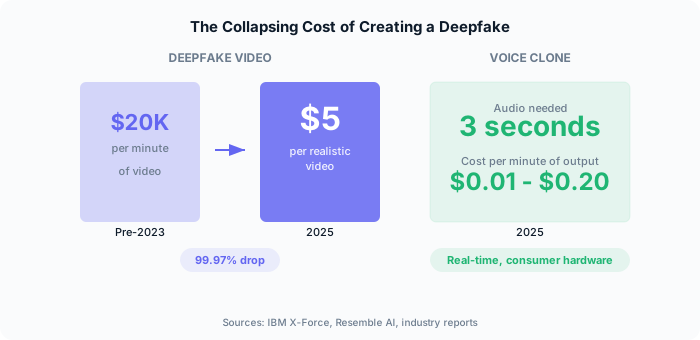
Before 2023, producing a convincing deepfake video cost $300 to $20,000 per minute. That limited the technology to well-funded operations. Today, a realistic deepfake video costs as little as $5. Voice clones cost $0.01 to $0.20 per minute of generated speech, need only 3 seconds of source audio, and run in real time on consumer hardware [2].
When the cost of an attack drops by 99.97%, the volume of attacks follows.
Deepfakes Online: From Thousands to Millions
The sheer volume of deepfake content online has followed its own exponential curve.
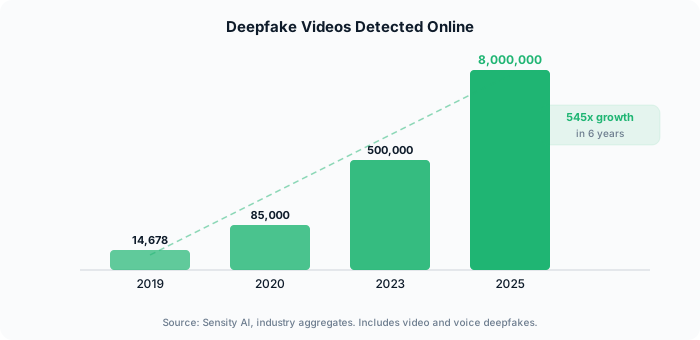
In 2019, Sensity AI (then Deeptrace) cataloged 14,678 deepfake videos across the internet [3]. By 2020, that number reached 85,000. By 2023, approximately 500,000 deepfake videos and voice clips circulated on social media platforms. Current estimates put the 2025 figure at roughly 8 million.
That is a 545x increase in six years. McAfee's 2025 survey found the average American now encounters approximately 2.6 deepfakes per day [4].
What Deepfake Fraud Costs
The FBI created a dedicated AI fraud category for the first time in its 2025 Internet Crime Report: 22,000 complaints with $893 million in losses [5]. Even the FBI acknowledges this is an undercount. Only 7% of investment fraud complaints carried an AI tag, despite investment fraud totaling $8.6 billion.
Independent tracking paints a larger picture:
The trajectory is steep. Deepfake-specific US losses tripled in a single year. Average business losses per incident nearly doubled between 2022 and 2024 [6].
Deloitte projects that without intervention, deepfake-enabled financial fraud will grow from $12.3 billion in 2023 to $40 billion by 2027, a compound annual growth rate of roughly 32% [7].
Deepfake Fraud Attempt Growth (Year-over-Year)
Sumsub's year-over-year growth data shows the acceleration is not slowing down.
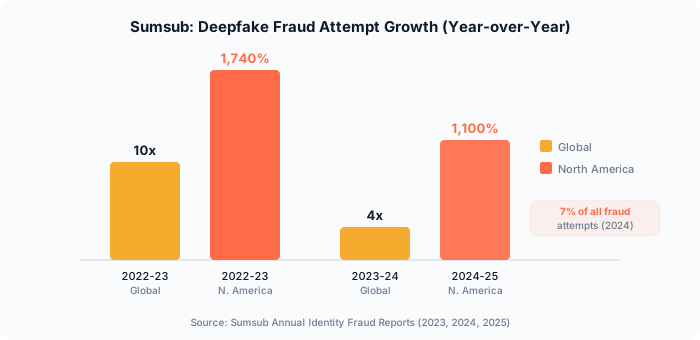
Between 2022 and 2023, deepfake fraud attempts increased 10x globally. In North America specifically, the increase was 1,740%. Between 2023 and 2024, another 4x increase globally. In Q1 2025, North America saw an 1,100% surge [1].
These are observed attempts against real identity verification systems, not projections.
The Broader Fraud Context
Deepfakes are accelerating within a fraud landscape that was already growing fast.
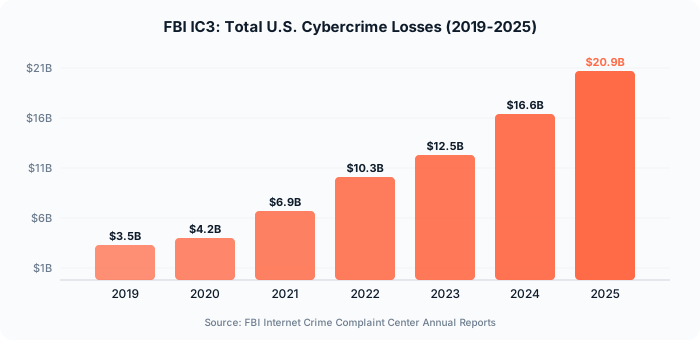
FBI-reported cybercrime losses grew from $3.5 billion in 2019 to $20.9 billion in 2025, a 497% increase [5]. The single-year jump from 2024 ($16.6 billion) to 2025 ($20.9 billion) represents a 26% increase, the steepest annual climb in the report's 26-year history.
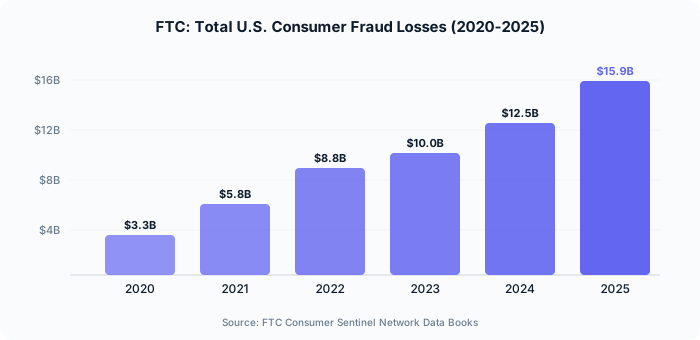
The FTC logged $15.9 billion in consumer fraud losses in 2025, up from $3.3 billion in 2020 [8]. Imposter scams, where AI voice cloning has had the most direct impact, accounted for $3.5 billion of that total.
Romance Fraud: A Category in Transition
Romance scams illustrate how AI is transforming an existing fraud category rather than creating a new one.
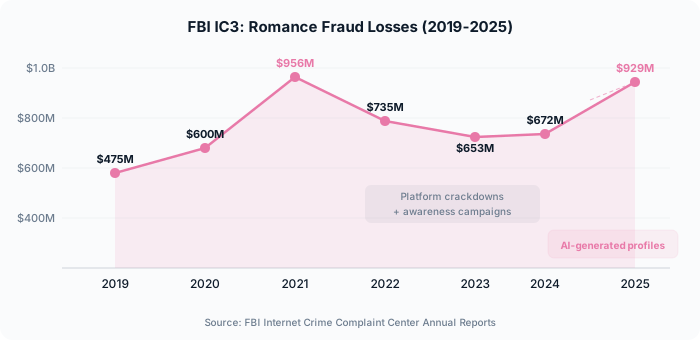
The shape of this chart tells the story. Losses climbed sharply from $475 million in 2019 to a peak of $956 million in 2021, then dropped through 2023 as platforms cracked down and awareness campaigns took hold. But the rebound in 2025 ($929 million) coincides with AI-generated profile photos and real-time video deepfakes becoming widely accessible. Scammers who once relied on stolen photos now generate entirely synthetic faces that defeat reverse image search [5].
What the Numbers Mean
Three patterns emerge from the data:
1. Deepfakes have gone mainstream. From 0.1% to 11% of all fraud in three years. This is no longer a niche threat.
2. Cost collapse drives volume. When creating a deepfake drops from $20,000 to $5, the barrier to entry disappears. Anyone with a laptop can now run attacks that once required specialized teams.
3. Detection is falling behind. The deepfake detection market ($563 million in 2023) is chasing a $40 billion fraud problem [9]. A 2023 UCL study found people could only identify AI-generated speech 65% of the time [10]. That number has likely dropped.
What You Can Do
The numbers are sobering. But behavioral defenses still work.
- Verify independently. If someone calls asking for money or information, hang up and call back on a known number.
- Use a family safe word. It costs nothing and neutralizes voice cloning attacks.
- Check suspicious media. If an image, video, or audio clip seems off, run it through Witness at witness.vision/scan. Free, no account required.
- Stay skeptical of urgency. Scammers create time pressure because it prevents verification. Legitimate emergencies can survive a two-minute callback.
The fraud numbers will keep climbing. The question is whether your defenses climb faster.
- [1]Sumsub, Annual Identity Fraud Reports 2023-2025, https://sumsub.com/newsroom
- [2]IBM X-Force, Resemble AI 2025 Deepfake Threat Report
- [3]Sensity AI (formerly Deeptrace), deepfake detection reports 2019-2025
- [4]McAfee, 2025 consumer deepfake survey
- [5]FBI Internet Crime Complaint Center, Annual Reports 2019-2025, https://www.ic3.gov
- [6]Surfshark deepfake fraud research, Regula, Adaptive Security
- [7]Deloitte Center for Financial Services, deepfake fraud projection
- [8]Federal Trade Commission, Consumer Sentinel Network Data Books 2020-2025, https://www.ftc.gov/reports
- [9]Kings Research / The Insight Partners, Deepfake AI Detection Market reports
- [10]University College London, "People cannot distinguish AI-generated speech from real speech," PLOS ONE, 2023