AI Voice Cloning: How Scammers Use Your Voice Against You
AI voice cloning needs just 3 seconds of audio. Learn how scammers exploit cloned voices and how a family safe word can protect you.
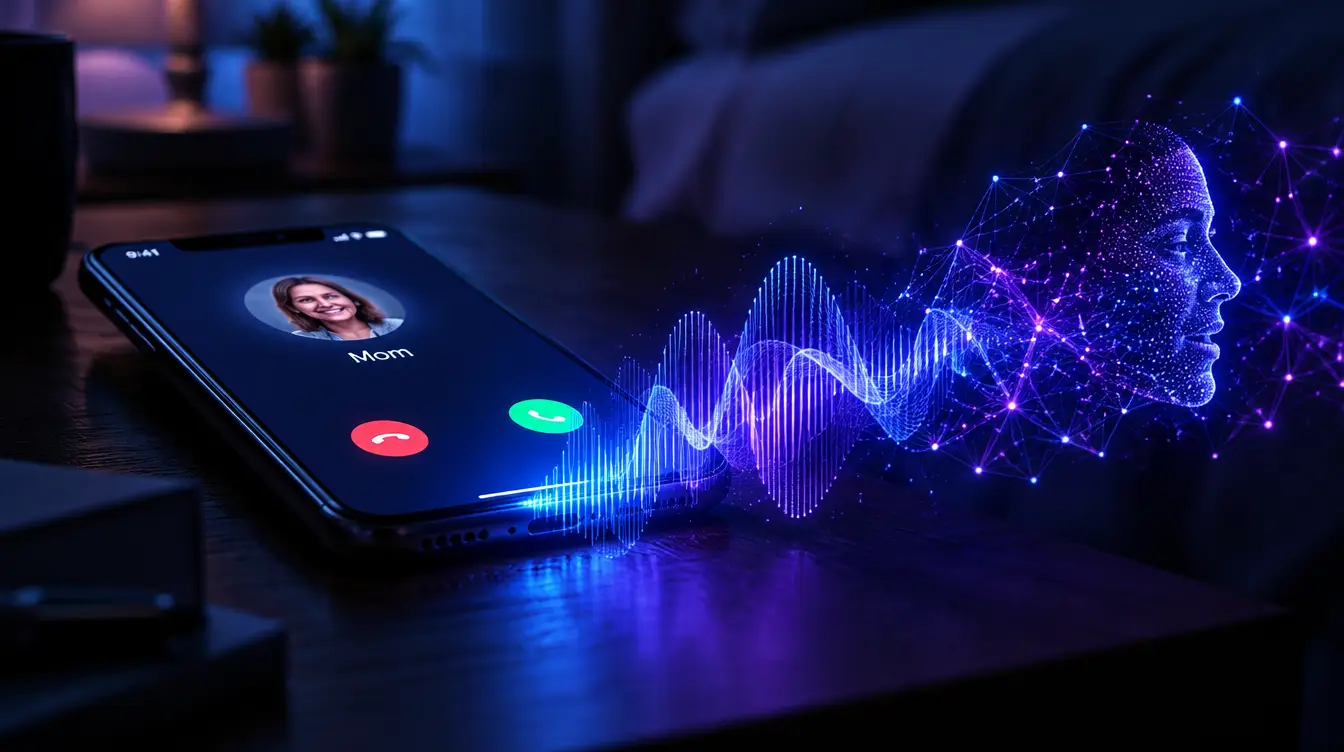
Three seconds of your voice is all it takes. That is the amount of audio a modern AI voice cloning tool needs to generate a convincing replica of how you speak, laugh, or cry for help [1]. Scammers are already using this technology to call your parents, your children, and your spouse, and the voice on the other end sounds exactly like you.
The 3-Second Problem
AI voice cloning has moved from a novelty to a weapon faster than almost any other consumer technology. Tools that once required 30 minutes of recorded speech to produce a passable imitation now work with a single short clip. A voicemail greeting, a TikTok video, a conference call recording, even a few words pulled from an Instagram story.
The quality is startling. In a 2023 University College London study, participants could only identify AI-generated speech about 73% of the time, even when they were told in advance that some clips were fake [2]. That number has likely dropped further as models have improved.
One in four adults has experienced an AI voice cloning scam or knows someone who has, according to a 2023 McAfee global survey [3].
The FTC reported that Americans lost $3.5 billion to imposter scams in 2025, with phone calls remaining the most common contact method for the highest individual losses [4]. Voice cloning is turbocharging a category of fraud that was already enormous.
How the Scam Works
The mechanics are simple enough that a teenager could execute them. Here is the typical chain:
- Harvest audio. The scammer finds a short clip of the target's voice. Social media is the most common source. Public videos, podcast appearances, or even outgoing voicemail messages all work.
- Clone the voice. Using commercially available AI tools, the scammer creates a synthetic model of the target's voice. This takes minutes, not hours.
- Call the victim. The scammer calls a family member or close contact, often a parent or grandparent. They use the cloned voice to deliver an urgent, emotional script: "I've been in an accident," "I'm in jail," "I need money right now."
- Demand fast payment. Wire transfers, gift cards, cryptocurrency. Anything hard to reverse. The urgency is deliberate. Panic short-circuits critical thinking.
- Disappear. Once payment clears, the scammer is gone.
Some variants skip the live call entirely. Scammers send voice messages through WhatsApp or text platforms, giving the victim no opportunity to ask probing questions in real time.
Why It Works So Well
The human brain is wired to respond to a familiar voice in distress. When you hear your daughter crying and asking for help, your first instinct is not skepticism. It is fear. Scammers weaponize that biology.
They also exploit caller ID spoofing, making the call appear to come from your family member's actual phone number. Combined with a cloned voice, the deception becomes nearly airtight.
Real Cases, Real Damage
This is not theoretical. Here are documented examples:
The 2019 UK case was early. The technology has gotten dramatically better and cheaper since then. What once required a state-level operation is now accessible to anyone with a laptop and a free trial.
How to Protect Yourself
1. Establish a Family Safe Word
This is the single most effective countermeasure. Choose a word or phrase that every family member knows and that would never appear in public content. If someone calls claiming to be a relative in trouble, ask for the safe word.
A good safe word is:
- Something you would never post on social media
- Easy to remember under stress
- Not a pet name, birthday, or anything guessable
- Changed if you suspect it has been compromised
Have the conversation in person, not over text or phone. Make sure elderly family members understand why it matters and practice using it.
2. Hang Up and Call Back
If you receive a distress call from a family member, hang up and call them directly on a number you already have saved. Do not call back the number that reached you. If the real person answers, the scam is over.
This feels cruel in the moment. It is not. It is the responsible thing to do. Scammers rely on you staying on the line, swept up in panic.
3. Listen for Tells (But Don't Rely on Them)
Current AI voice clones sometimes exhibit subtle artifacts:
- Unnatural breathing patterns or no breathing at all
- Flat emotional range that does not shift naturally during conversation
- Slight metallic quality or background hum
- Awkwardness with interruptions or back-and-forth dialogue
These tells are becoming less reliable as the technology improves. Use them as an additional signal, not your primary defense.
4. Limit Your Voice Footprint
You cannot completely avoid having your voice online, but you can reduce unnecessary exposure:
- Set social media accounts to private or friends-only
- Avoid posting long, clear audio clips publicly
- Be cautious about voice-based social platforms
- Review and remove old voicemails on public-facing business lines
5. Verify Before You Pay
No legitimate emergency requires payment via gift card, cryptocurrency, or wire transfer. No hospital, police station, or bail bondsman operates this way. If someone asks for payment through these channels, it is a scam, regardless of whose voice is on the line.
What About AI Voice Detection?
Detecting AI-generated audio is possible, but it is harder than detecting AI-generated images. Audio deepfakes leave statistical traces: artifacts in the spectral frequency, irregularities in pitch transitions, patterns in background noise that differ from real-world recordings.
Witness analyzes uploaded media for signs of AI generation. If you receive a suspicious voice message as an audio file or video, run it through Witness at witness.vision/scan. Free, no account required. Detection works best on recorded media rather than live phone calls, so save any suspicious voicemails or audio messages before deleting them.
If you suspect a voice clone scam:
- Save the audio file or voicemail
- Do not send money under any circumstances
- Contact the supposed caller directly through a known number
- Report the incident to the FTC at reportfraud.ftc.gov or the FBI's IC3 at ic3.gov
The Bigger Picture
AI voice cloning is not going away. The tools are improving, the cost is dropping, and the barrier to entry is essentially zero. Legislation is beginning to catch up. The FTC issued a final rule in 2024 that specifically targets AI-impersonation of individuals [8], and several US states have passed or proposed laws criminalizing non-consensual voice cloning.
But law enforcement moves slowly. Scammers do not.
The most durable protection is not technological. It is behavioral. A family safe word costs nothing, takes two minutes to establish, and neutralizes the most dangerous aspect of voice cloning: the emotional certainty that the voice on the phone belongs to someone you love.
Have that conversation today. Not after the call comes.
- [1]Microsoft Research, "VALL-E: Neural Codec Language Models are Zero-Shot Text to Speech Synthesizers," 2023, https://arxiv.org/abs/2301.02111
- [2]University College London, "People cannot distinguish AI-generated speech from real speech," PLOS ONE, 2023, https://doi.org/10.1371/journal.pone.0287627
- [3]McAfee, "The Artificial Imposter," 2023, https://www.mcafee.com/blogs/privacy-identity-protection/artificial-intelligence-ai-voice-cloning-scams/
- [4]Federal Trade Commission, "FTC Data Shows Consumers Reported Losing More Than $15 Billion to Fraud in 2025," 2026, https://www.ftc.gov/news-events/news/press-releases/2026/02/nationwide-fraud-losses-top-15-billion-2025
- [5]CNN, "A mother got a call from her daughter. It was a scammer using AI to clone the teen's voice," 2023, https://www.cnn.com/2023/04/29/us/ai-scam-calls-kidnapping-voice-cloning
- [6]CBC News, "This couple lost $21,000 to an AI voice cloning scam. Here's how it happened," 2023, https://www.cbc.ca/news/canada/ai-voice-cloning-scam-1.6975732
- [7]The Wall Street Journal, "Fraudsters Used AI to Mimic CEO's Voice in Unusual Cybercrime Case," 2019, https://www.wsj.com/articles/fraudsters-use-ai-to-mimic-ceos-voice-in-unusual-cybercrime-case-11567157402
- [8]Federal Trade Commission, "FTC Finalizes Rule Banning Impersonation of Government and Businesses," 2024, https://www.ftc.gov/news-events/news/press-releases/2024/04/ftc-finalizes-rule-banning-impersonation