Auto and Property Insurance Fraud: How AI-Edited Damage Photos Get Paid
36% of consumers would consider editing a claim photo. How AI-edited damage photos show up in car and property claims, the checks that catch them, and an interactive example.
Auto and property claims run on photos. A dented door, a cracked windshield, a water-stained ceiling: the claimant takes a picture, uploads it, and an estimate follows. That speed is great for honest customers. It also makes these claims the easiest target for AI-edited evidence, because the photo is often the only evidence the insurer ever sees.
This article is for information only and is not legal advice.
Key Takeaways
- Aviva detected a record £233 million of suspect claims in 2025 and says a growing number are supported by AI-generated images and manipulated documents, particularly in motor.[1]
- 36% of US consumers would consider digitally altering a claim photo or document. Among Gen Z it is 55%.[2]
- The hardest fake to catch is a real photo of the real car or home with only the damage added.
- Combine AI detection, metadata, duplicate search and claim cross-checks, and ask for live photos on risky claims.
Try It: Real Damage or AI?
A claimant uploads this photo. Is the damage real?
Look closely, then choose.
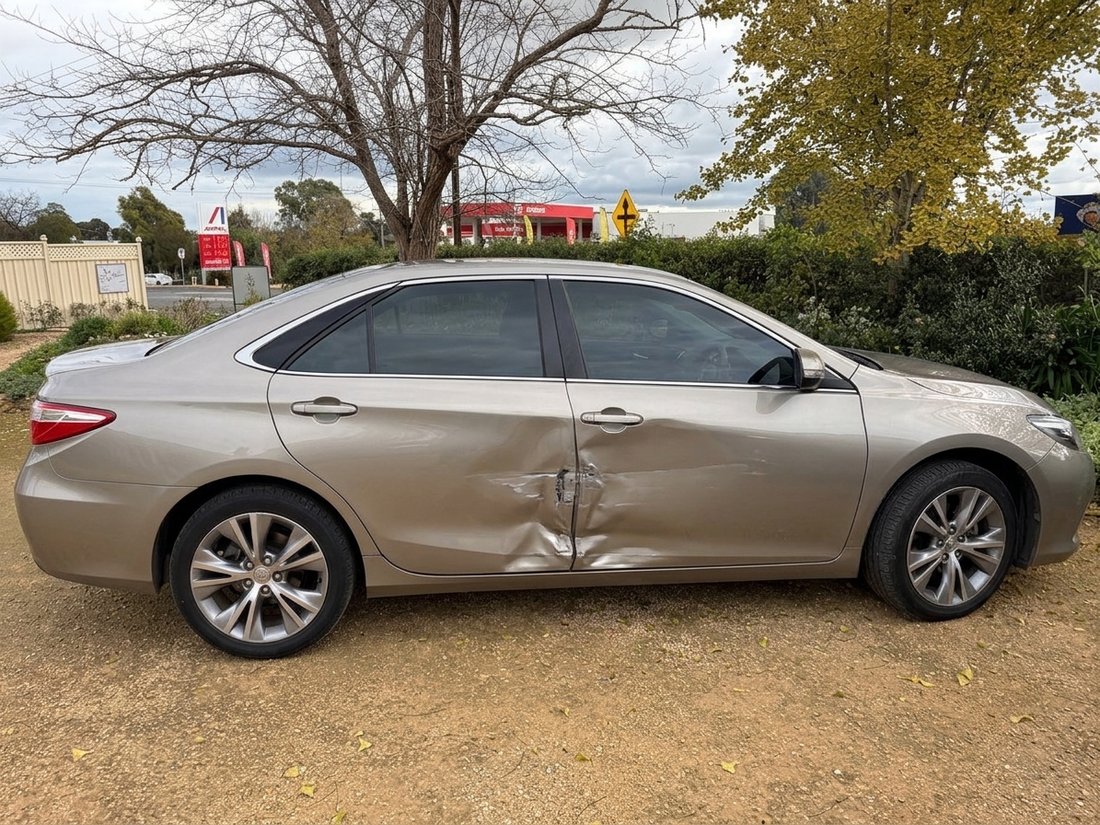
Original photo by RegionVisitor90, Wikimedia Commons, CC BY 4.0. Damage added by Witness with an AI image editor for this demonstration.
The Scale of Auto and Property Fraud
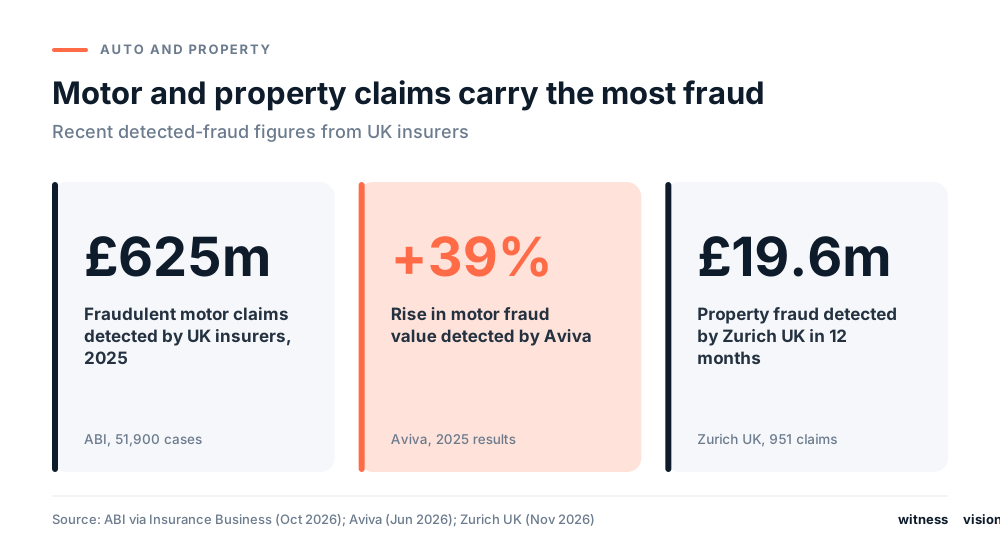
- Auto: UK insurers detected £625 million of fraudulent motor claims across 51,900 cases in 2025, more than half of all detected fraud cases.[3] Aviva says the value of motor fraud it detected rose 39%.[1]
- Property: Zurich UK detected £19.6 million of fraudulent property claims across 951 cases in 12 months, alongside £28.1 million in motor.[4] Allianz UK reports an £80,000 escape-of-water claim that was backed by a doctored photo.[5]
- US: the Coalition Against Insurance Fraud estimates property and casualty fraud at about $45 billion a year.[6]
Who Would Fake a Claim Photo?
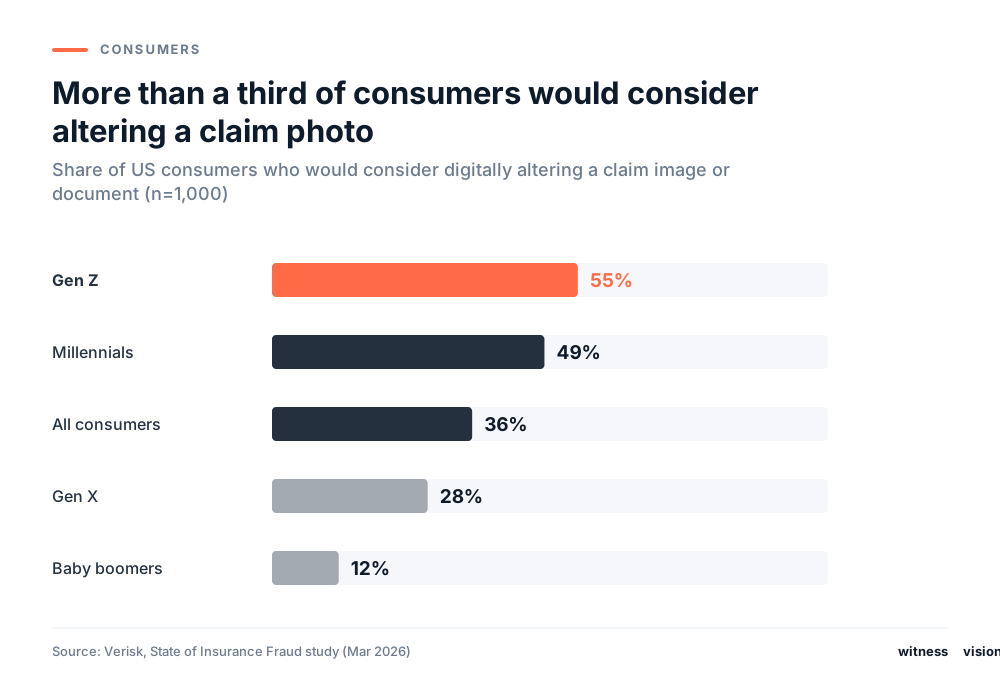
Verisk's 2026 survey of 1,000 US consumers found 36% would consider digitally altering a claim image or document, even if it broke their insurer's rules. Willingness rises sharply among younger policyholders: 55% of Gen Z and 49% of millennials. 13% said it is acceptable to create images of damage that never happened.[2]
On the insurer side, 99% of claims professionals in the same study said they have encountered manipulated or AI-altered documentation.[2] In the US, the National Insurance Crime Bureau reports mentions of AI in questionable claims rose more than 1,400% from 2025 to mid-2026. That counts mentions, not confirmed cases, but the direction is clear.[7]
What AI Fakes Look Like in Auto and Property Claims
Real photos can also become raw material. Allianz UK found that 73% of drivers who post photos of their car online didn't know fraudsters can lift those images for fake claims.[5]
Forensic Checks That Catch Fake Damage Photos
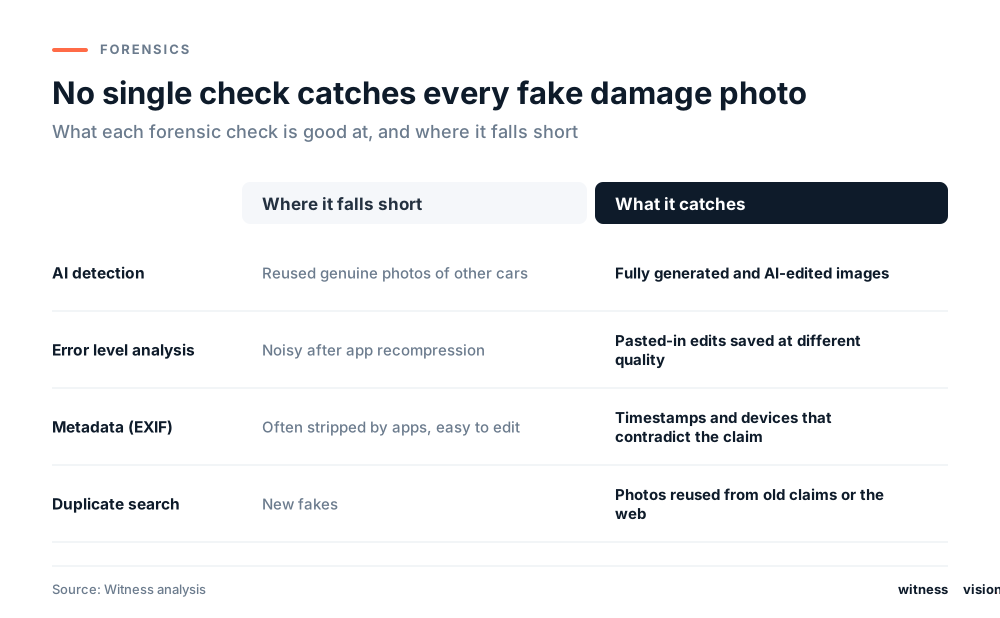
AI-generation detection
Trained models look for patterns that AI image generators and editors leave behind, often in texture and frequency details invisible to the eye. Test any tool on partial edits like the one above, not only fully synthetic images.
Error level analysis
JPEG images compress consistently. An edited and resaved area can compress differently. Useful, but noisy, because messaging apps recompress images too.
Metadata
EXIF data can show the device, time and location of a photo. Missing metadata is not proof of fraud. Metadata that contradicts the claim story is worth a second look.
Duplicate and reverse image search
Perceptual hashing and reverse search catch genuine photos reused from other claims or lifted from social media.
Cross-Check the Whole Claim
- Vehicle or property identity: does the plate, VIN or address match the policy?
- Damage vs estimate: does the repair scope match the damage shown?
- Damage vs incident: does the reported impact or cause fit the photos?
- Timing: do photo timestamps fit the incident date and policy dates?
- Repairer or contractor: do they exist, with a valid license and address?
Fitting Detection Into Claims and SIU Workflows
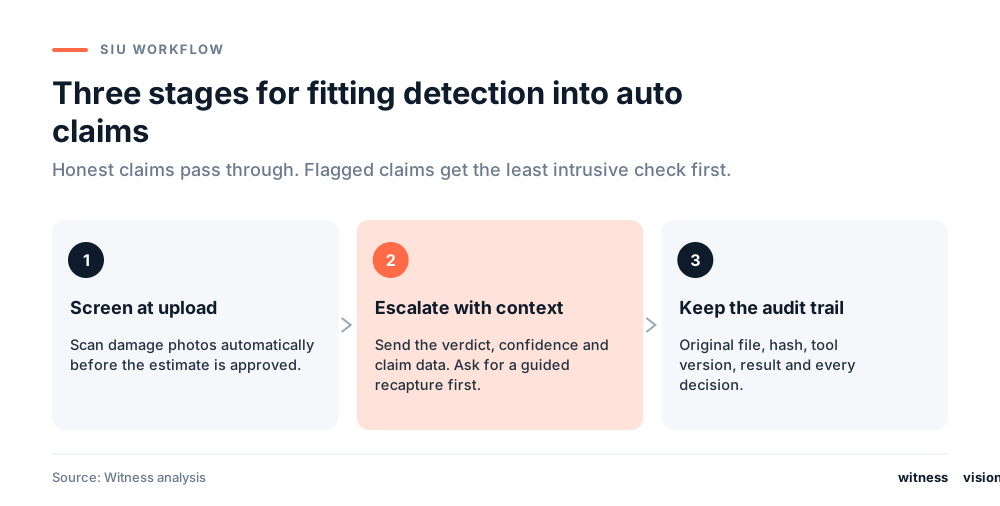
Start with the least intrusive response. A guided in-app recapture, a short live video walkaround or a desk inspection resolves most flags from honest customers in minutes. Fraudsters often abandon the claim.
Regulatory Context
- US: most states require insurers to run anti-fraud programs, often with a special investigations unit, and to report suspected fraud. The NAIC Model Bulletin on insurers' use of AI, in force in 24 states plus DC as of April 2026, covers how carriers govern AI tools, including third-party detection.[8]
- UK: suspected fraud can be reported to the Insurance Fraud Bureau, and the FCA expects firms to run effective fraud controls.
No regulator mandates a specific detection tool. What regulators expect is a documented, reasonable anti-fraud process, and that increasingly covers digital evidence.
How Witness Fits
Witness checks claim photos for signs of AI generation and editing. Each scan returns a clear verdict, Real or AI, with a confidence score and a plain-language explanation your team can add to the claim file. Pro users can export a forensic report.
Scan a damage photo or see Witness for insurance.
Frequently Asked Questions
What is auto insurance fraud?
Deliberately deceiving a car insurer for money, such as staging a crash, inflating repair costs, claiming old damage as new, or submitting edited damage photos.
Can AI fake car damage photos?
Yes. Widely available AI image editors can add realistic dents, scrapes and cracks to a real photo in seconds, matching the paint, lighting and reflections.
How do insurers detect fake damage photos?
By combining AI-generation detection, metadata checks, duplicate image search and cross-checks against the estimate and incident details, then asking for live photos when something is flagged.
Is submitting an AI-edited photo in a claim a crime?
Yes. Submitting false evidence to support a claim is insurance fraud. Using AI doesn't change that.
Related reading
- What Is Insurance Fraud? How AI Is Changing It
- Deepfake Detection for Insurance Claims: Tools and Workflow
- Return Fraud in 2026: The AI Photo Problem
- [1]Insurance Business UK, Aviva detects record £233 million in fraud as AI tools and ghost broking accelerate, June 2026.
- [2]Verisk, AI Editing Tools Are Fueling a New Era of Insurance Fraud, March 17, 2026.
- [3]Insurance Business UK, Fewer fraud cases, fatter claims as average scam hits £14,300, October 2026, reporting ABI data.
- [4]Zurich UK, Zurich detects £109m of fraud, November 5, 2026.
- [5]Allianz UK, Posting car photos fuels fraud, June 5, 2026.
- [6]Coalition Against Insurance Fraud, The Impact of Insurance Fraud on the U.S. Economy, August 2022.
- [7]Insurance Business, Insurance fraud: AI tools surge across US claims and cargo, November 2026, reporting NICB data.
- [8]NAIC, Implementation map of the Model Bulletin on the Use of AI Systems by Insurers, April 2026.