Return Fraud in 2026: Types, Warning Signs, and the AI Photo Problem
Return fraud and abuse cost US retailers about $100B in 2025. The main types, the warning signs, and how AI-edited damage photos and fake receipts are changing refund fraud.
Return fraud is when someone abuses a store's return or refund process to get money or goods they aren't entitled to. It has always been a cost of retail. What changed in the last two years is the evidence. Many online refunds now depend on a single photo of a "damaged" item or a "receipt," and both can be faked with an AI app in seconds.
This guide covers how big the problem is, the main types of return fraud, how AI is changing it, and how to stop it without treating honest customers like suspects.
Key Takeaways
- US shoppers were expected to return about $850 billion of merchandise in 2025. Retailers estimate 9% of returns are fraudulent.[1]
- Appriss Retail puts 2025 losses from return fraud and abuse at roughly $100 billion. Most of it is abuse, not outright fraud.[2]
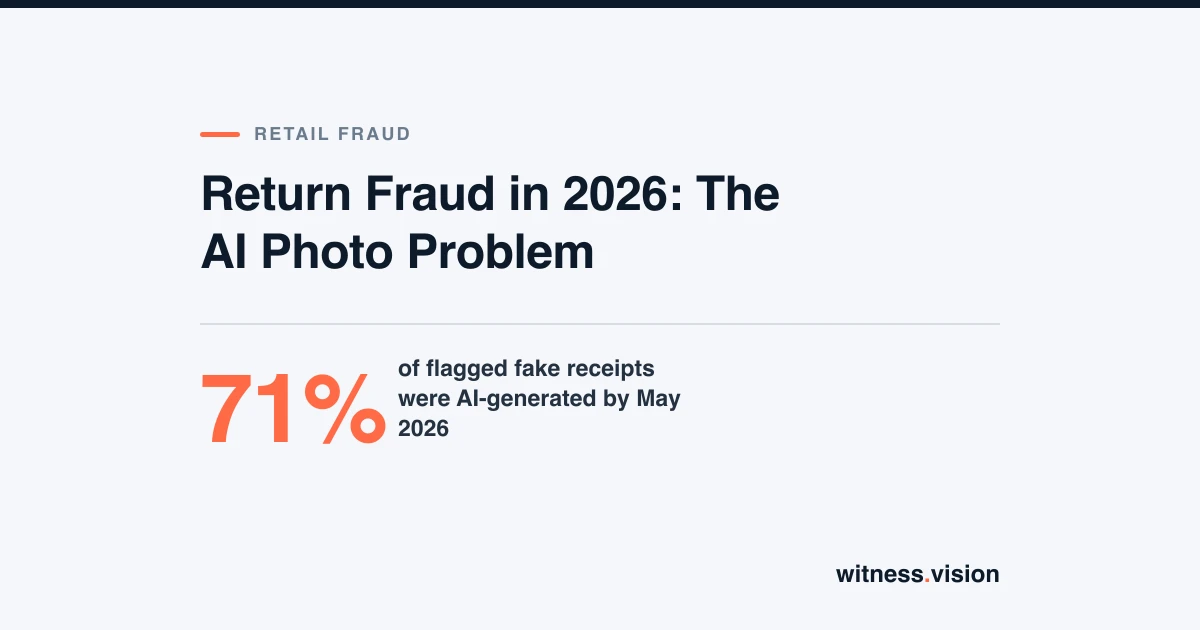
- AI is now used to fake the evidence itself: edited "damaged item" photos and generated receipts. In one expense dataset, AI-generated receipts went from 0% to 71% of flagged fakes in about a year.[7][8]
- The fix is risk-based: add checks only where the refund is high-value or the evidence looks wrong.
How Big Is Return Fraud?
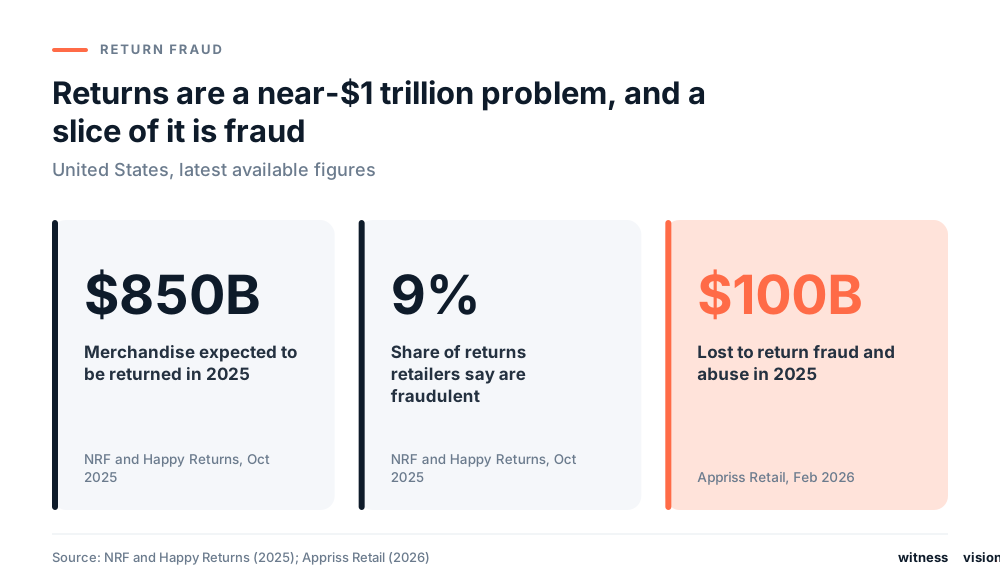
Returns are one of the largest money flows in retail. The National Retail Federation and Happy Returns expected US consumers to return $849.9 billion of merchandise in 2025, about 15.8% of sales. Retailers in that survey said 9% of all returns are fraudulent.[1]
Appriss Retail measures it differently. Its 2026 benchmark estimates that about 14% of returns in 2025 involved fraud or abuse, worth roughly $100 billion.[2]
The two figures come from different surveys and definitions, so they are not directly comparable. Both point the same way: return fraud is a nine-figure problem for large retailers and a real margin hit for small ones.
Return Fraud vs Return Abuse

The distinction matters because the response is different.
- Return abuse bends the policy without breaking the law: wearing a dress once and returning it, ordering three sizes to keep one, or returning items long after use. Appriss estimates abuse at about $86 billion in 2025.[2]
- Return fraud involves deliberate deception: fake or altered receipts, returning stolen goods, or claiming damage that never happened. Appriss estimates this at about $14 billion.[2]
Abuse is best handled with policy. Fraud needs verification.
The Main Types of Return Fraud
The last one is where AI has had the biggest effect.
The New Problem: AI-Faked Refund Evidence
AI-edited "damaged item" photos
Many online stores refund low-value orders on a photo alone, because shipping the item back costs more than the item. That makes the photo the only evidence.
In 2025, Chinese media reported a wave of buyers using AI to edit product photos for "refund without return" claims, from rotten fruit to torn bed sheets.[5] In one case covered by China Daily, a buyer submitted an AI-faked video showing six of eight live crabs dead and received a refund. Police later found the video was fabricated, recovered the money, and detained the buyer.[3] Wired reported the same trend across Chinese e-commerce platforms.[4]
It is not limited to China. In a June 2026 survey of 2,091 consumers across seven markets, fraud-prevention company Riskified found that about half had used generative AI to help write return or refund claims, and merchants reported damage photos that appeared AI-generated or manipulated.[6]
AI-generated receipts
Image tools can now produce realistic receipts on demand, with the right store layout, thermal-paper texture, creases and shadows.
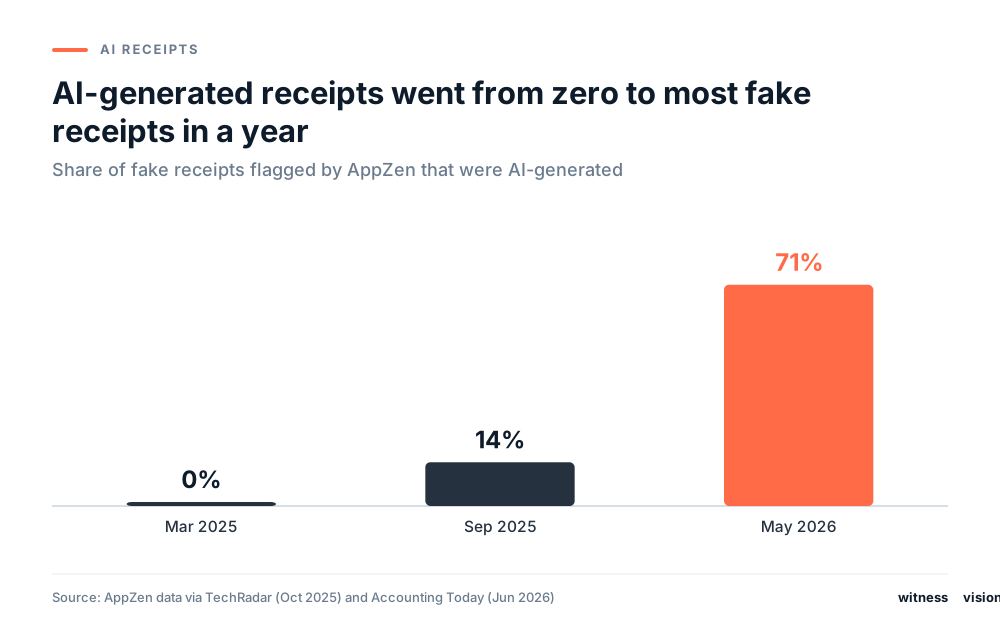
Expense-audit company AppZen reported that 14% of the fraudulent documents it flagged in September 2025 were AI-generated, up from none the year before.[7] By May 2026, AI-generated receipts made up 70.8% of the fake receipts it flagged.[8] That data comes from expense reports, not retail returns, but the same fake receipts work at a returns counter or in a warranty claim.
Try it: spot the edited receipt
We made a mock receipt, then asked an AI image editor to change one price. It took one prompt and a few seconds.
One receipt had a single line changed by AI. Can you tell which?
Tap the receipt you think was edited.
Mock receipt created by Witness for this demo. Harbor & Pine is a fictional store.
Why it's hard to catch
- No item comes back. Refund-without-return policies leave the photo as the only evidence.
- Agents have seconds per claim. Support teams review hundreds of requests a day.
- People can't spot AI images by eye. In a peer-reviewed study, participants identified AI-generated faces with about 48% accuracy, roughly a coin flip.[9]
- It scales. One person can file dozens of faked claims across many stores in an afternoon.
Warning Signs
In the claim
- Many refund requests from one account, address, device or payment method
- Claims clustered on high-value or refund-without-return items
- Damage that doesn't fit the product (water damage on an item shipped sealed)
- Pressure for an instant refund rather than a replacement
In the photo
- Damage that looks too clean, too uniform, or oddly placed
- Lighting or shadows on the damaged area that don't match the rest of the image
- Smeared or blurry texture at the edges of the damage
- The same or a near-identical photo used on more than one claim
- Screenshots instead of original camera files
In the receipt
- Fonts, spacing or logos that don't match the store's real receipts
- Totals, tax or item codes that don't add up
- Store numbers, register IDs or timestamps that don't exist in your system
How to Prevent Return Fraud
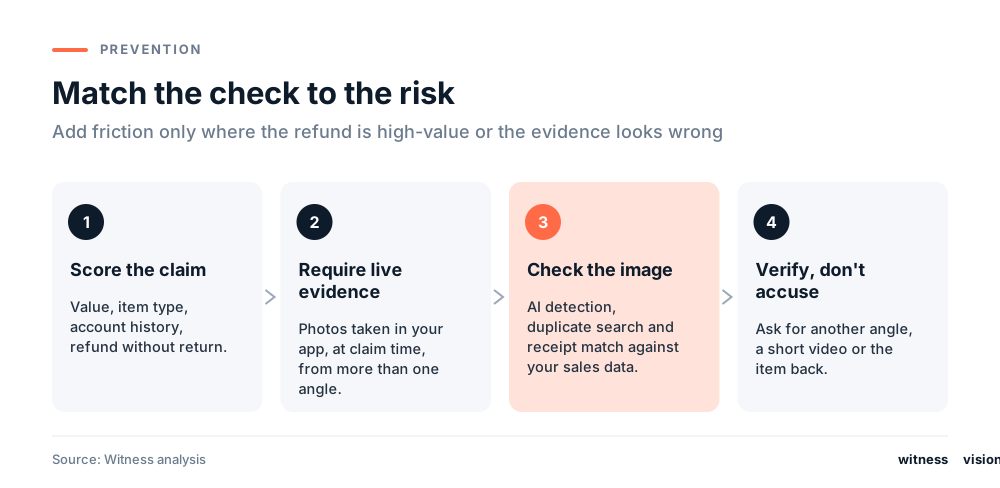
1. Score the claim first
Treat a $12 first-time request differently from a $400 refund-without-return claim from a repeat account. Most claims should pass with no friction.
2. Require live evidence for risky claims
Ask for photos taken inside your app or form at the time of the claim, not uploads from the camera roll. Ask for two or three angles, or a short video. That is much harder to fake convincingly than one image.
3. Check the image and the receipt
Run high-risk refund photos through an AI image detector. Test it on partial edits, since often only the damaged area is changed. Match receipt details (store, register, transaction ID, time, amount) against your own sales data. If the transaction doesn't exist, neither does the receipt.
4. Look for reused images
Hash incoming photos and compare them across claims. Many "damage" photos are copied from other customers, review sites or earlier claims.
5. Verify, don't accuse
AI detection gives a probability, not a verdict on the customer. When a photo is flagged, ask for another angle, a short video, or the item back. Honest customers usually comply quickly. Fraudsters often drop the claim.
6. Publish clear rules
State what evidence you require and when. Clear policies deter casual abuse and give support agents something consistent to point to.
Is Return Fraud Illegal?
Yes. In the US, return fraud is generally prosecuted as theft or fraud under state law, and some states have specific statutes. Florida, for example, makes it a crime to request a refund with a fraudulently obtained or false receipt.[10] Using AI to fake a photo or receipt doesn't change the legal picture. It only makes the evidence easier to produce. Check with counsel for your state.
How Witness Helps
Witness checks images for signs of AI generation and editing. Upload a refund photo or receipt image and get a clear verdict, Real or AI, with a confidence score and a plain-language explanation. It is built to catch AI-edited photos as well as fully generated ones.
Check a refund photo, see how edited photo detection works, or read about Witness for returns fraud.
Frequently Asked Questions
What is return fraud?
Abusing a retailer's return or refund process to get money or goods you aren't entitled to, such as returning used, stolen or fake items, or claiming damage that didn't happen.
What is the difference between return fraud and return abuse?
Fraud involves deliberate deception, like fake receipts or fake damage claims. Abuse bends the policy without breaking the law, like heavy bracketing or wardrobing.
How do people use AI for return fraud?
Mainly by editing photos to add damage to items that arrived fine, and by generating fake receipts for returns, warranty claims or expenses.
Can you tell if a refund photo was edited with AI?
Often, with a detection tool. By eye it is very hard, especially when only a small part of a real photo was changed.
Should I deny a refund if a photo looks AI-edited?
Not on a detection result alone. Ask for more evidence or the item back, and use the result to decide what to check next.
Related reading
Figures from Riskified, AppZen and Appriss Retail come from companies that sell fraud-prevention products.
- [1]National Retail Federation and Happy Returns, Consumers Expected to Return Nearly $850 Billion in Merchandise in 2025, October 15, 2025.
- [2]Appriss Retail, The 2026 Total Retail Loss Benchmark Report, February 2026.
- [3]China Daily, AI-driven refund scams spur calls for stronger e-platform protection, December 12, 2025.
- [4]Wired, Scammers in China Are Using AI-Generated Images to Get Refunds, December 2025.
- [5]OECD.AI Incidents Monitor, AI-generated damage photos used for refund-only fraud in China, July 2025.
- [6]Riskified, Rewriting the Rules on Returns, June 22, 2026.
- [7]TechRadar, Workers are scamming their employers using AI-generated fake expense receipts, October 27, 2025.
- [8]Accounting Today, Use of AI receipts in expense fraud soars, June 23, 2026.
- [9]Nightingale and Farid, AI-synthesized faces are indistinguishable from real faces and more trustworthy, PNAS, 2022.
- [10]Florida Statutes, § 812.017, Use of a fraudulently obtained or false receipt.