SynthID Detector: How to Check If an Image Has a Google Watermark
How to check if an image or video carries a Google SynthID watermark. What SynthID is, where it appears, how detection works, and what it means when the watermark is missing.
Witness Team · Editorial
Key Takeaways
- SynthID is Google DeepMind's invisible watermark, embedded directly into AI-generated images, audio, video, and text at the moment of creation. It survives screenshots, cropping, and re-encoding.
- Over 100 billion pieces of content have been watermarked with SynthID as of mid-2026 [1]. Adoption extends beyond Google. OpenAI, ElevenLabs, NVIDIA, and Kakao now use it.
- Checking for SynthID is not yet widely available. Google offers a detection portal (waitlist-based) and surfaces results in "About this image" in Chrome and Search. OpenAI offers a public verification tool for checking content generated through its tools.
- A positive SynthID detection is a strong signal. It means the content was produced by a participating AI tool. But a missing watermark proves nothing. Most AI generators do not embed SynthID.
- SynthID and C2PA solve different problems. SynthID lives in the pixels and survives re-encoding. C2PA is metadata that can be stripped. Both have blind spots. Detection tools that read neither are flying blind.
- Witness reads C2PA provenance and checks for SynthID watermarks via OpenAI's verification tool. When neither provenance signal is present, statistical AI detection covers the gap for content with no watermark of any kind.
What SynthID is
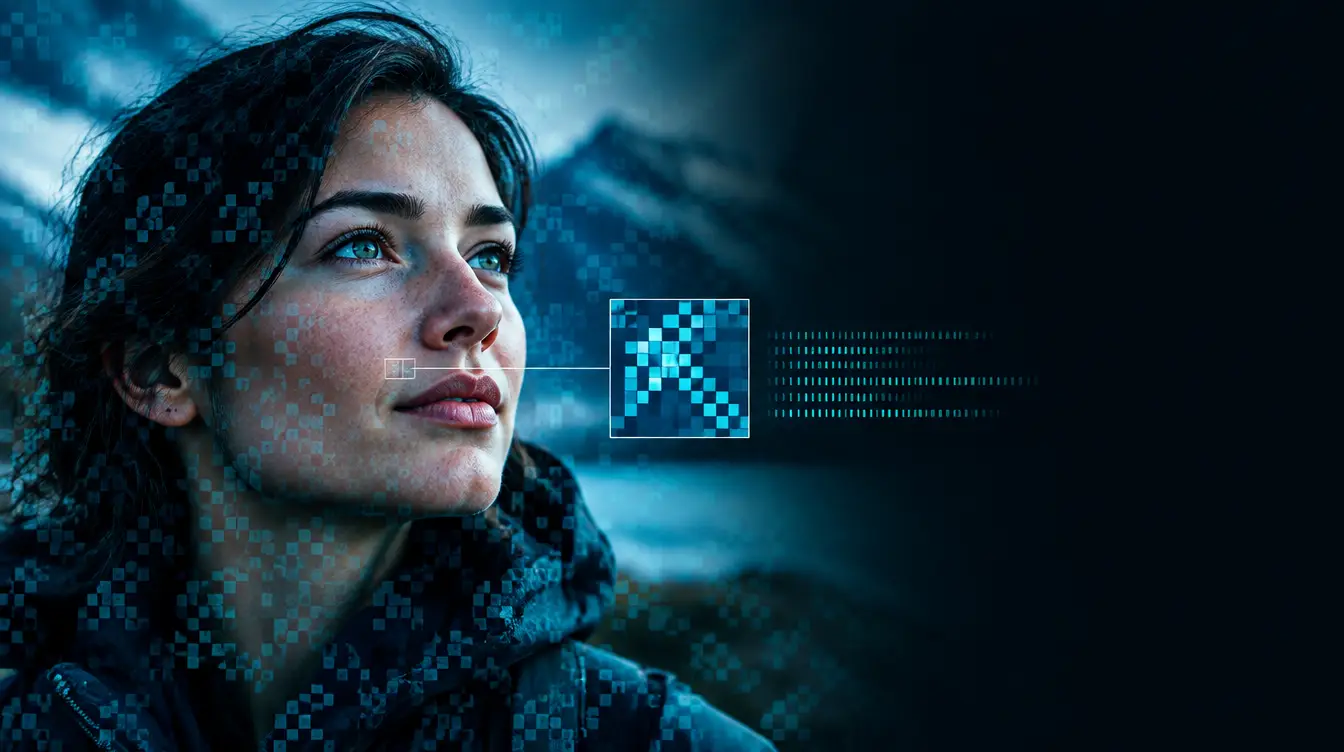
SynthID is a watermarking system developed by Google DeepMind that embeds an imperceptible signal into AI-generated content at the point of creation. The watermark is not visible to the human eye. It does not degrade image quality. And unlike metadata-based approaches, it is embedded in the content itself, in the pixel values for images, in the waveform for audio, in token probability distributions for text.
Google introduced SynthID for images in 2023, initially limited to output from its Imagen model. By 2024 it had expanded to audio and video. In 2025 Google open-sourced the text watermarking component [2]. The system was designed from the start to survive the transformations that destroy most other signals: JPEG compression, screenshot capture, resizing, cropping, and moderate editing.
The core idea is not new. Digital watermarking has existed since the 1990s. What changed is the integration point. SynthID is applied during the generation process, not after it. The watermark is part of the output from the first pixel forward. This makes it harder to remove without visibly degrading the content, because the watermark and the image are produced together rather than layered.
By mid-2026, Google reported that SynthID had been applied to over 100 billion items across its products [1]. That number is large, but it reflects the scale of Google's ecosystem (Search, Gemini, YouTube, Workspace) rather than the breadth of the AI generation landscape.
Where SynthID appears today
The watermark shows up in content produced by a specific and growing set of tools.
Google's own products. Images from Gemini and Imagen carry SynthID. Audio generated through Google's tools is watermarked. YouTube uses SynthID to label AI-generated or AI-modified content [3].
OpenAI. In early 2026, OpenAI adopted SynthID for content generated through its API and consumer products. This was a significant shift. The two largest AI companies now use the same watermarking standard, which substantially increases the share of AI-generated content that carries a machine-readable provenance signal [4].
ElevenLabs. The voice synthesis platform embeds SynthID in its generated audio, making it possible to verify whether a voice clip was created using ElevenLabs tools.
NVIDIA. NVIDIA embeds SynthID in its AI image generation outputs.
Kakao. The Korean technology company adopted SynthID for its AI image generation services.
Who is missing. Midjourney does not embed SynthID. Stable Diffusion does not embed SynthID. Flux does not. Open-source image generators running locally do not. Any model fine-tuned and deployed independently does not. The gap is not small. A large share of the AI-generated images circulating online, and nearly all of the deliberately deceptive ones, come from tools that embed no watermark of any kind.
How to check for SynthID
There is no single, universally available SynthID detector. Access is currently limited to a few channels.
Google's SynthID detector portal. Google operates a detection tool that can analyze uploaded media for the SynthID watermark. Access is waitlist-based and has been prioritized for journalists, researchers, and fact-checkers. General public access has not been announced [5].
"About this image" in Chrome and Google Search. When you encounter an image through Google Search or in Chrome, you can access "About this image" from the context menu. If the image carries SynthID, Google surfaces that information alongside other context like when the image first appeared online and where else it has been published. This is the most accessible path for everyday users, but it only works within Google's ecosystem.
Gemini app. Content generated through Gemini is tagged with SynthID metadata. The app indicates when content was AI-generated, using the embedded watermark as the underlying signal.
OpenAI's verification tool. OpenAI offers a public verification tool for checking whether content was generated through its tools. The tool checks for both SynthID watermarks and C2PA metadata. Developers can also access this programmatically through OpenAI's Content Provenance API.
What you cannot do today. You cannot download a standalone SynthID detector and run it locally. You cannot check an arbitrary image from an arbitrary source for SynthID through a public, unrestricted tool. The verification infrastructure exists, but broad public access is still rolling out.
What SynthID detection tells you
A positive SynthID detection is a near-certain signal that the content was generated by a participating AI tool. The watermark is cryptographically tied to the generation process. Finding it means the content passed through Google's, OpenAI's, ElevenLabs', or another adopter's generation pipeline.
This is a strong result. Unlike statistical AI detection, which estimates probability based on learned patterns, a watermark is a deterministic signal. It was either embedded or it was not. False positives are possible in theory (the detection operates on a confidence spectrum, not a binary switch), but in practice, SynthID's false positive rate on images is reported at one in ten billion [6]. For practical purposes, a positive detection is definitive.
The watermark also carries some degree of attribution. Because different adopters use SynthID through Google's framework, the detection can indicate which tool family produced the content, though the granularity of this attribution varies.
What a missing SynthID watermark means
This is where most people get it wrong, and where the stakes are highest.
A missing SynthID watermark does not mean the content is real. It means the content was not produced by one of the small number of tools that currently embed SynthID. That is a much weaker statement.
Consider what is not covered:
- Images generated by Midjourney, Stable Diffusion, Flux, or any of the hundreds of open-source models available on Hugging Face
- Face swaps created with tools like FaceFusion, DeepFaceLab, or similar
- Voice clones from services other than ElevenLabs
- Any AI-generated content that has been processed through a tool or pipeline that strips the watermark
- Content from before the adopting tools implemented SynthID
The absence problem is not hypothetical. The most damaging deepfakes in documented fraud cases, election disinformation, and non-consensual intimate imagery typically come from open-source or semi-open tools that embed no watermark. The people creating deliberately deceptive content are selecting tools that do not leave traces. A detection strategy built entirely on watermark verification would miss exactly the content it most needs to catch.
This is the fundamental limitation of any opt-in provenance system, whether SynthID, C2PA, or anything else. It works when the creator cooperates. It is silent when the creator does not.
SynthID vs C2PA: different tools, different failure modes
SynthID and C2PA are both provenance technologies, but they work differently and fail differently.
SynthID lives in the pixels. The watermark is part of the content itself. Screenshot the image, re-encode it, upload it to a platform that strips all metadata. The watermark survives, because it is encoded in the pixel values, not in a sidecar file. Google reports robustness across standard transformations including JPEG compression, scaling, and cropping [7].
C2PA lives in the metadata. The Coalition for Content Provenance and Authenticity attaches a cryptographic manifest to the file. The manifest records what created the content, what tool was used, and what edits followed. The signature chains back to a certificate issued to the camera maker or software vendor. It is strong when present. But re-encode the file, strip the metadata, or take a screenshot, and the manifest is gone. Every major social media platform strips C2PA metadata on upload.
The strengths are complementary. SynthID covers the re-encoding gap that breaks C2PA. C2PA covers the attribution gap that SynthID cannot fill for non-AI content (real photographs, edited footage, newsroom imagery). Neither covers content from non-participating tools.
How Witness fits
Witness uses three independent detection layers, each catching what the others miss.
Layer 1: C2PA provenance. When an image carries a valid C2PA manifest, Witness reports who signed it, whether it was a camera manufacturer or an AI generator, and what the signature chain says about the content's origin. Adobe Firefly, Google's tools, and OpenAI's products all participate in C2PA.
Layer 2: SynthID watermark verification. Witness checks for SynthID watermarks using OpenAI's verification infrastructure. When a watermark is found, the result is near-certain: the content was produced by an OpenAI tool. This layer catches images that pass visual inspection but carry an invisible watermark in the pixel values.
Layer 3: Statistical AI detection. This is the layer that catches everything else: content from generators that embed no watermark, content that has been stripped of metadata, content from open-source tools, face swaps, and the long tail of deceptive media that no provenance system reaches.
The three layers address different failure modes:
- C2PA is near-certain when present but fragile. Metadata gets stripped on social media upload.
- SynthID survives screenshots and re-encoding but only covers participating tools (currently OpenAI, Google, ElevenLabs).
- Statistical detection works on any input regardless of provenance. It does not require the creator's cooperation. But it is probabilistic, not deterministic.
Together, the three layers cover more ground than any one alone. Provenance and watermarks catch the cooperative case with high certainty. Statistical detection catches the adversarial case with calibrated probability. When multiple layers agree, confidence is high. When they disagree, that disagreement is itself the finding.
The bigger picture
Watermarking adoption is growing. The fact that Google and OpenAI now use the same system is significant. SynthID's expansion to text, audio, and video means that a meaningful share of AI-generated content now carries a machine-readable signal. Over 100 billion watermarked items is not a small number [1].
But the math still does not work out in favor of watermarks alone. The tools producing the most harmful deepfakes, the face swaps used in romance scams, the cloned voices used in financial fraud, the synthetic media used in election interference, overwhelmingly come from tools that embed nothing. Documented deepfake-related fraud losses reached $12 billion globally in 2025 [8], and the content driving those losses was not generated by Gemini or DALL-E.
Watermarks solve the provenance problem for cooperating tools. They do not solve the detection problem for adversarial content. Both problems need solving, and they need different approaches.
The most reliable verification in 2026 layers multiple signals. Check for provenance (C2PA, SynthID where available). Run statistical detection. Consider the source. Consider the context. No single signal gives certainty. Multiple independent signals together get close.
Check any image or video now
Upload at witness.vision/scan. Witness reports C2PA provenance alongside statistical AI detection. Five free scans per day, no account required.
- [1]Google DeepMind, "SynthID: Identifying AI-generated content," 2026. Google reported over 100 billion items watermarked across its products by mid-2026.
- [2]Google DeepMind open-sourced the SynthID text watermarking component in October 2025, published as part of the Responsible AI toolkit.
- [3]YouTube began using SynthID to detect and label AI-modified content uploaded to the platform, complementing its existing disclosure requirements for creators.
- [4]OpenAI announced adoption of SynthID for content generated through its API and consumer products in early 2026, marking the first major cross-company adoption of the standard.
- [5]Google's SynthID detection portal launched with limited access for journalists and researchers. General availability timeline has not been publicly confirmed.
- [6]Google DeepMind reported a false positive rate of approximately one in ten billion for SynthID image watermark detection, based on internal evaluation.
- [7]Google DeepMind, "SynthID: Technical Report," describing robustness evaluation across JPEG compression, resizing, cropping, and color adjustment transformations.
- [8]Deloitte Center for Financial Services estimated global deepfake-related fraud losses at $12 billion in 2025, projected to reach $40 billion by 2027.