Insurance Fraud Statistics 2026: AI, Deepfakes and What Fraud Costs
Insurance fraud statistics for 2026 from named primary sources: US and UK fraud costs, how AI and deepfakes are changing claims fraud, detection accuracy and the outlook.
Most "AI insurance fraud" statistics online have no source. Every number on this page links to a named primary source. Where insurance-specific data doesn't exist yet, we say so and use the closest reliable proxy.
Last updated November 19, 2026.
Key Insurance Fraud Statistics
How Big Is Insurance Fraud?
United States
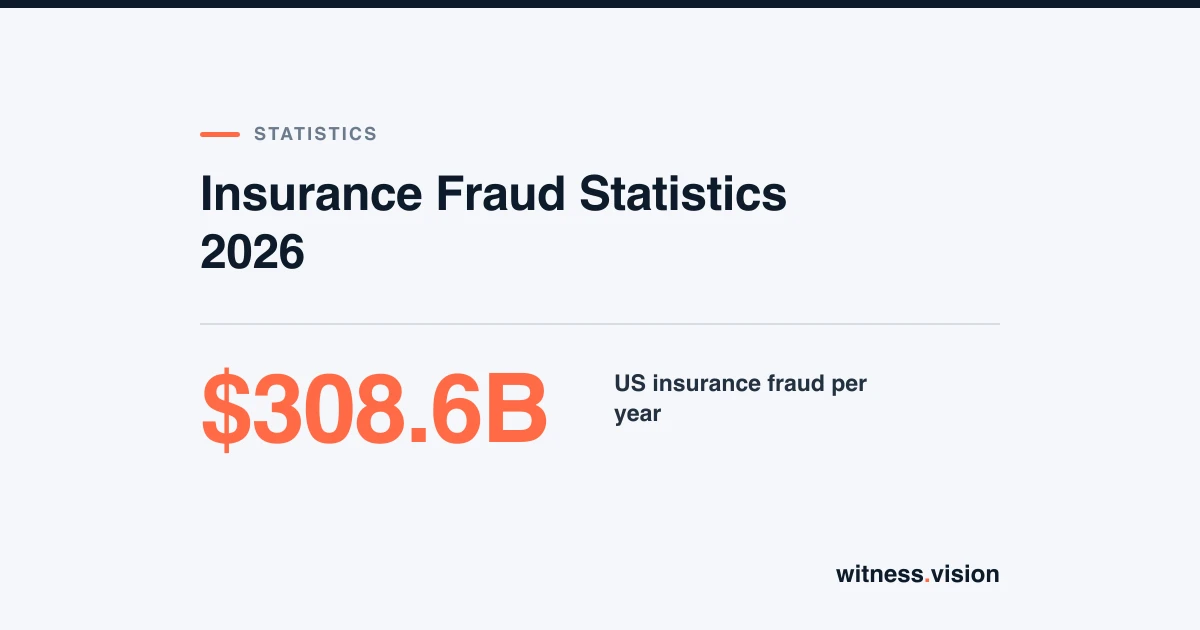
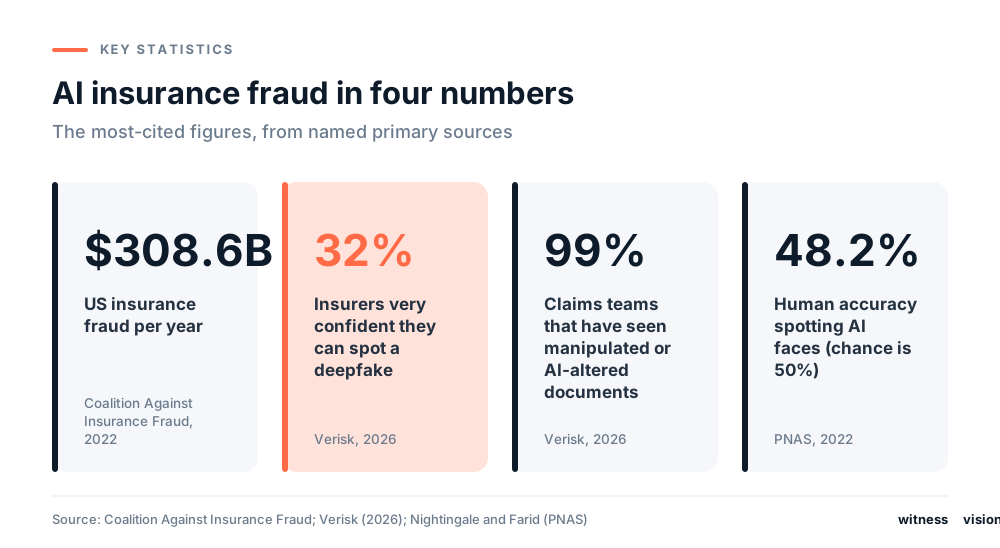
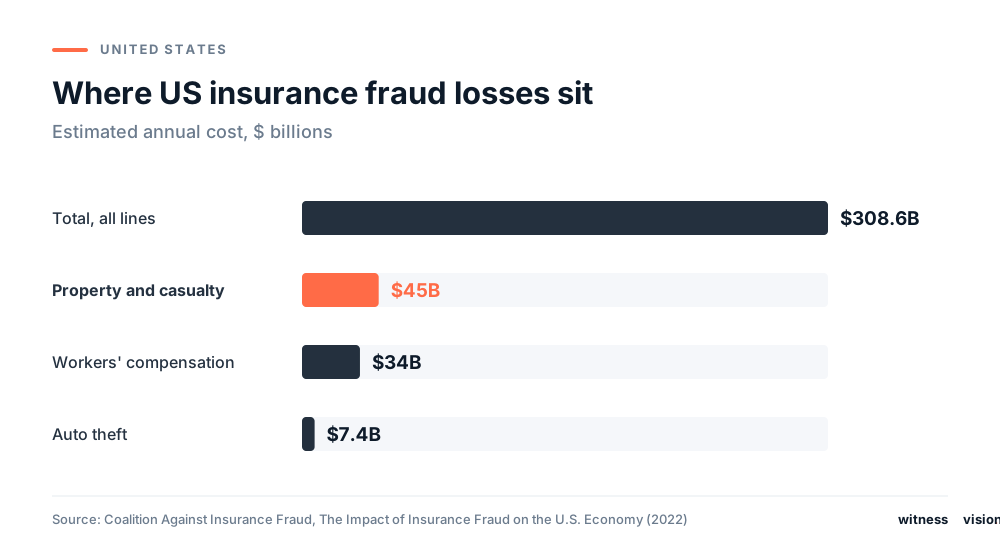
The Coalition Against Insurance Fraud estimates US insurance fraud at $308.6 billion a year, including about $45 billion in property and casualty, $34 billion in workers' compensation and $7.4 billion in auto theft.[1] Fraud is present in roughly 10% of P&C losses.[2]
United Kingdom
Insurers detected £1.34 billion of fraudulent claims in 2025, up 14% on the year even as case numbers fell, including £625 million across 51,900 motor claims.[3] Zurich UK alone detected 4,359 fraudulent claims worth £109.3 million in 12 months, its highest ever, and named generative AI among the tools fraud gangs now use.[4]
Australia
Insurance Council members detected about A$560 million of opportunistic motor and property fraud in 2023, and estimate about A$400 million more goes undetected each year.[10]
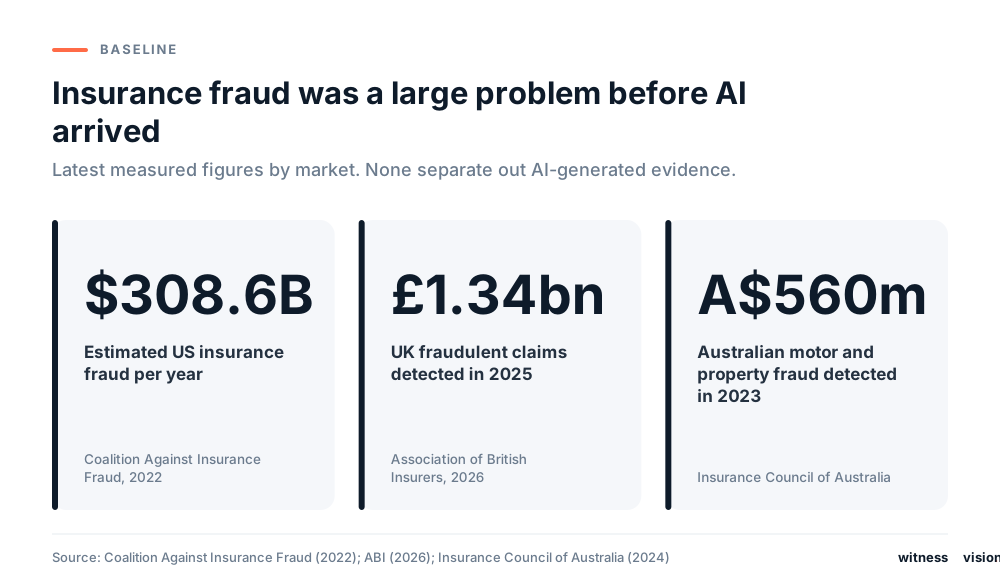
None of these figures separate out AI-generated evidence. That data doesn't exist yet at industry level.
How AI Is Changing Insurance Fraud
What insurers report
- Verisk (2026): 98% of 300 US claims professionals agree AI editing tools are driving more digital insurance fraud. Only 32% are very confident they could identify a deepfake.[5]
- Zurich UK (2026): lists AI-generated documents and evidence alongside staged accidents and ghost broking as tactics used by organized fraud networks.[4]
- Swiss Re Institute (2025): rates deepfakes and disinformation as a high-impact emerging risk for insurance fraud.[11]
- ACFE and SAS (2026): 44% of anti-fraud professionals saw deepfake social engineering rise significantly in the past two years. Only 7% feel more than moderately prepared.[7]
Signals from adjacent sectors
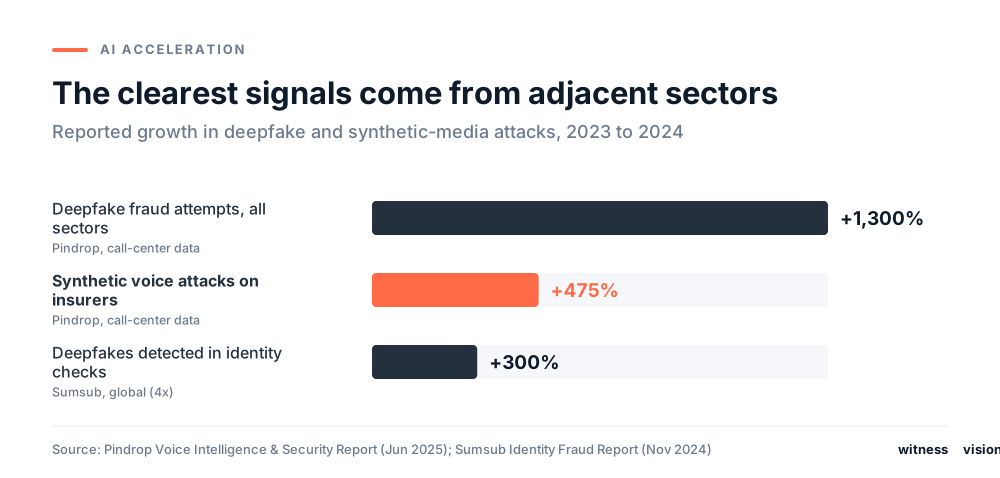
- Pindrop: deepfake fraud attempts rose more than 1,300% in 2024. Synthetic voice attacks on insurers rose 475%, the fastest of any sector it tracks.[6]
- Sumsub: deepfakes detected in identity checks rose 4x from 2023 to 2024.[12]
- Signicat: deepfakes now make up about 6.5% of fraud attempts at European financial institutions, including insurers.[13]
- FBI IC3: reported internet crime losses reached $20.9 billion in 2025, up 26%.[14]
Can People and Machines Spot AI Fakes?
- People can't. In a peer-reviewed PNAS study, 315 participants identified AI-generated faces with 48.2% accuracy, slightly worse than a coin flip.[8]
- Machines do better, but less than lab numbers suggest. The Deepfake-Eval-2024 benchmark found detector performance fell by 45% to 50% on real-world deepfakes compared with older academic benchmarks.[15]
What AI-Enabled Fraud Could Cost
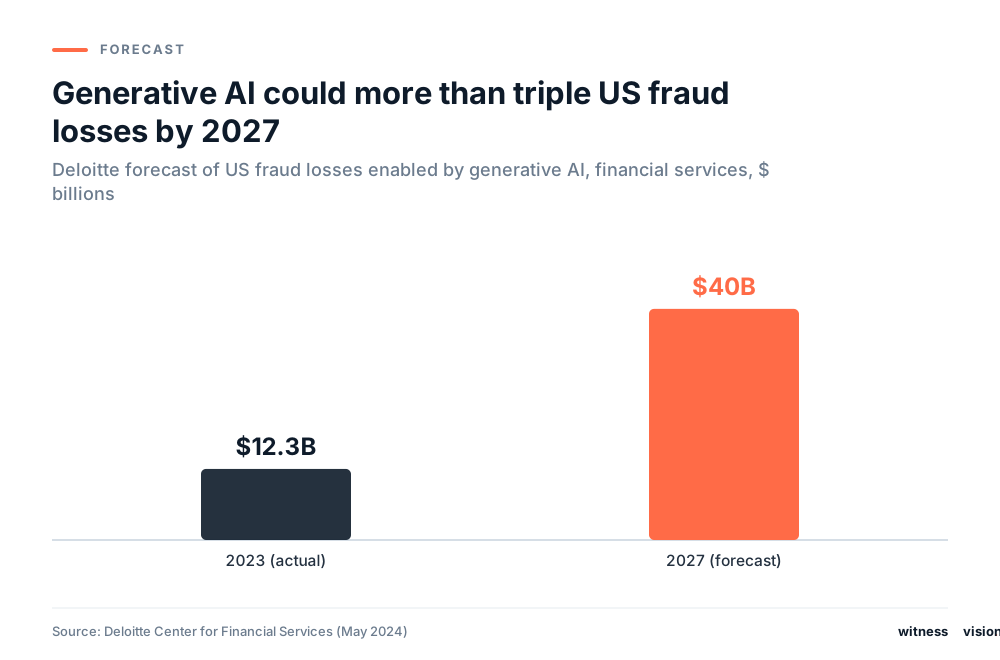
Deloitte projects generative-AI-enabled fraud losses in US financial services could reach $40 billion by 2027, up from $12.3 billion in 2023, a 32% annual growth rate.[9] That forecast covers financial services broadly, not insurance alone.
No one has measured what AI-made evidence adds to insurance fraud yet. A simple sensitivity model shows the scale:
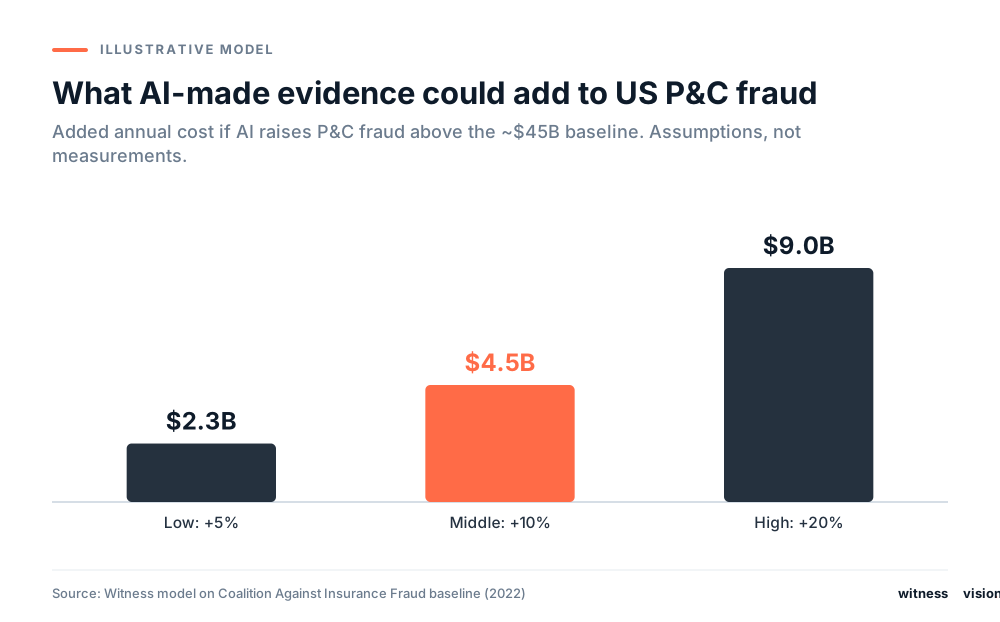
Illustrative model, not a measurement. If AI-made or AI-altered evidence adds 5% to 20% to the ~$45 billion US P&C fraud baseline, that is roughly $2.3 to $9.0 billion a year. The middle case is plausible because most fraud tools score claim data rather than media authenticity, digital-first claims mean fewer inspections, and fakes keep getting cheaper.
The payout is only part of the cost. Investigation, legal work, reviewer hours, delays to honest claims and reputational damage all add to it, and honest policyholders pay for all of it through premiums.
Regulation at a Glance
No regulator has yet issued insurance-specific guidance on AI-generated claim evidence.
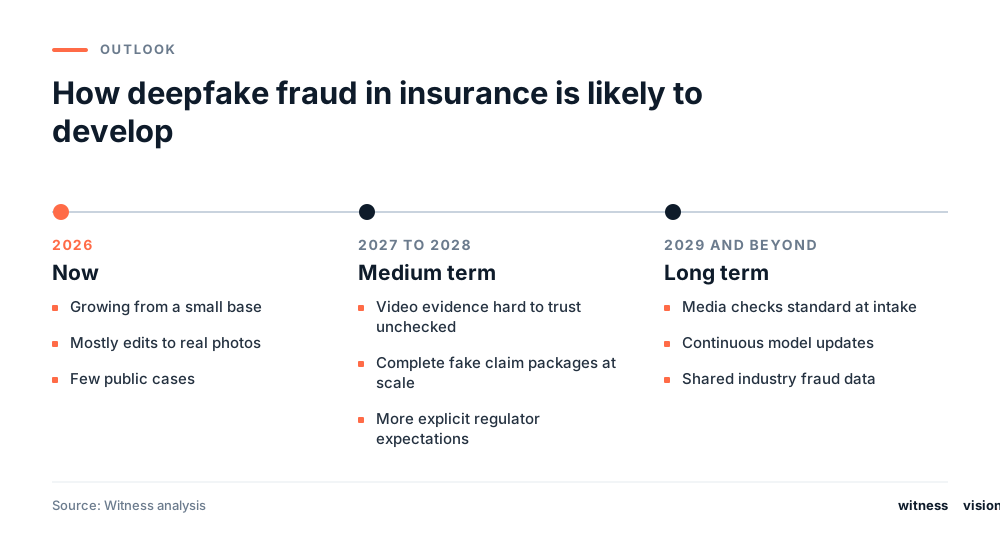
Outlook
How Witness Helps
Witness checks photos and video for signs of AI generation and editing. Each scan returns a clear verdict, Real or AI, with a confidence score and a plain-language explanation.
Try a scan or see Witness for insurance.
Frequently Asked Questions
How much does insurance fraud cost each year?
About $308.6 billion a year in the US across all lines, according to the Coalition Against Insurance Fraud. UK insurers detected £1.34 billion of fraudulent claims in 2025.
What percentage of insurance claims are fraudulent?
The Coalition Against Insurance Fraud estimates fraud is present in about 10% of US property and casualty losses.
How much insurance fraud involves AI or deepfakes?
No regulator or industry body reports it separately yet. Nearly all insurers believe AI editing is driving more fraud, and adjacent sectors show deepfake attacks growing several-fold per year.
Can people spot AI-generated images?
Not reliably. In a PNAS study, people identified AI-generated faces at about chance level.
Related reading
- What Is Insurance Fraud? How AI Is Changing It
- Deepfake Detection for Insurance Claims: Tools and Workflow
- Deepfake Fraud by the Numbers
Verisk, Pindrop, Sumsub and Signicat sell fraud-prevention products. Their figures are self-reported.
- [1]Coalition Against Insurance Fraud, The Impact of Insurance Fraud on the U.S. Economy, August 2022.
- [2]Coalition Against Insurance Fraud, Fraud Stats.
- [3]Association of British Insurers, Fraudsters target bigger payouts as insurers detect £1.34 billion of bogus claims, October 2026.
- [4]Zurich UK, Zurich detects £109m of fraud, November 5, 2026.
- [5]Verisk, AI Editing Tools Are Fueling a New Era of Insurance Fraud, March 17, 2026.
- [6]Pindrop, 2025 Voice Intelligence & Security Report, June 12, 2025.
- [7]ACFE and SAS, 2026 Anti-Fraud Technology Benchmarking Report, March 2026.
- [8]Nightingale and Farid, AI-synthesized faces are indistinguishable from real faces and more trustworthy, PNAS, 2022.
- [9]Deloitte Center for Financial Services, Generative AI is expected to magnify the risk of deepfakes and other fraud in banking, May 29, 2024.
- [10]Insurance Council of Australia, Insurance industry boosts fight against fraud and scams, May 21, 2024.
- [11]Swiss Re Institute, SONAR 2025: How deepfakes, disinformation and AI amplify insurance fraud, June 2025.
- [12]Sumsub, Identity Fraud Report 2024, November 2024.
- [13]Signicat, The Battle Against AI-driven Identity Fraud, February 2025.
- [14]FBI Internet Crime Complaint Center, 2025 Internet Crime Report, April 2026.
- [15]Chandra et al., Deepfake-Eval-2024, arXiv, 2025.
- [16]NAIC, Implementation map of the Model Bulletin on the Use of AI Systems by Insurers, April 2026.
- [17]FinCEN, FinCEN Issues Alert on Fraud Schemes Involving Deepfake Media, November 13, 2024.
- [18]EU AI Act, Regulation (EU) 2024/1689; European Parliamentary Research Service, AI Omnibus briefing782651_EN.pdf), 2026.