Black Friday 2026: AI Makes Fake Online Shops Harder to Spot
AI-built fake shops are flooding Black Friday. 10,000+ counterfeit fashion domains found this month. Eight checks to run before you pay, and how to scan a product photo.
By Zulal Akarsu, Founder, Witness
Witness Team · Editorial
Key Takeaways
- Security researchers warn that this year's Black Friday fake shops are built with AI: polished storefronts, product photos and ads that look like the real brand [1].
- Researchers counted more than 10,000 counterfeit shopping domains impersonating 166 fashion brands in 26 countries, with 1,549 still live in early November [2].
- Fake-website infringements rose 59% in 2024, according to an industry report that ties the rise to AI making fake sites cheaper to build. 58% of people who bought a fake by accident were fooled by a polished design and branded imagery [3].
- An AI-made product photo has no original to find, so a clean reverse image search no longer proves a photo is genuine [4].
- Before you pay, check the address, the discount, the photos, the payment method and the contact details. You can scan any product photo with Witness for free.
What changed this year
Fake shops are not new. What has changed is how little effort a convincing one takes.
A few years ago, a fake store needed stolen product photos, a copied layout and ads that often looked slightly off. Today AI tools produce unique product shots, model photos and ad creatives in minutes. The result looks like a real brand's campaign, and nothing in it has appeared anywhere before.
One security firm's Black Friday warning describes exactly this: AI-built storefronts and ads that send shoppers to sites impersonating brands such as Nike, Ugg, Ray-Ban and Michael Kors [1]. Earlier this year, the same researchers tracked more than 55 fake-shop campaigns across 12 European countries [5].
There is a newer twist too. Researchers found that some fake shops had been picked up by the search indexes AI assistants rely on, so a shopper asking a chatbot "where can I buy this on sale?" can be pointed to a fake store [2].
The numbers behind the warning
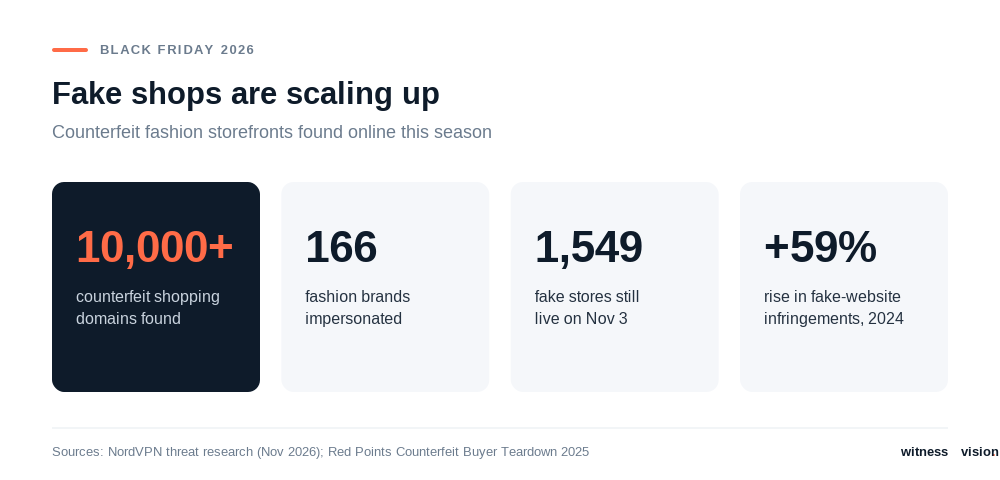
Researchers counted more than 10,000 counterfeit shopping domains impersonating 166 fashion brands, with 1,549 still live in early November [2]. Fake-website infringements rose 59% in 2024 [3], and earlier this year one security team tracked 55+ fake-shop campaigns across 12 European countries [5].
Why a clean reverse image search means less now
The old advice was simple: run the product photo through a reverse image search. If it shows up on the brand's own site, the shop stole it.
That still catches stolen photos. But an AI-generated photo is an original. It has never been posted anywhere, so a reverse search finds nothing, which can look like a good sign when it is not. Bellingcat documented a seller who admitted, after customer complaints, that every product image was AI-generated, and pointed out that made-up photos let sellers avoid the image matching that catches copied brand photos [4].
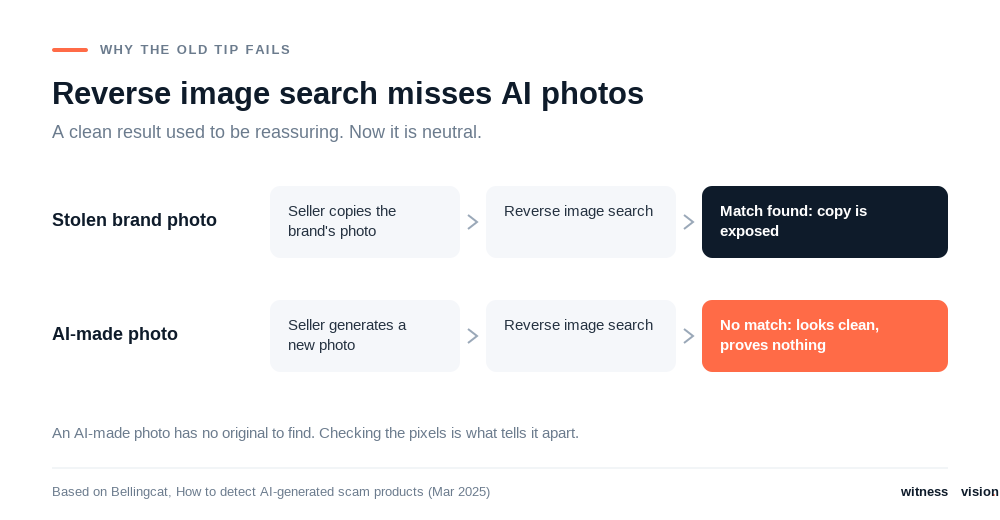
So treat "no matches found" as neutral, not reassuring.
Eight checks before you pay this Black Friday
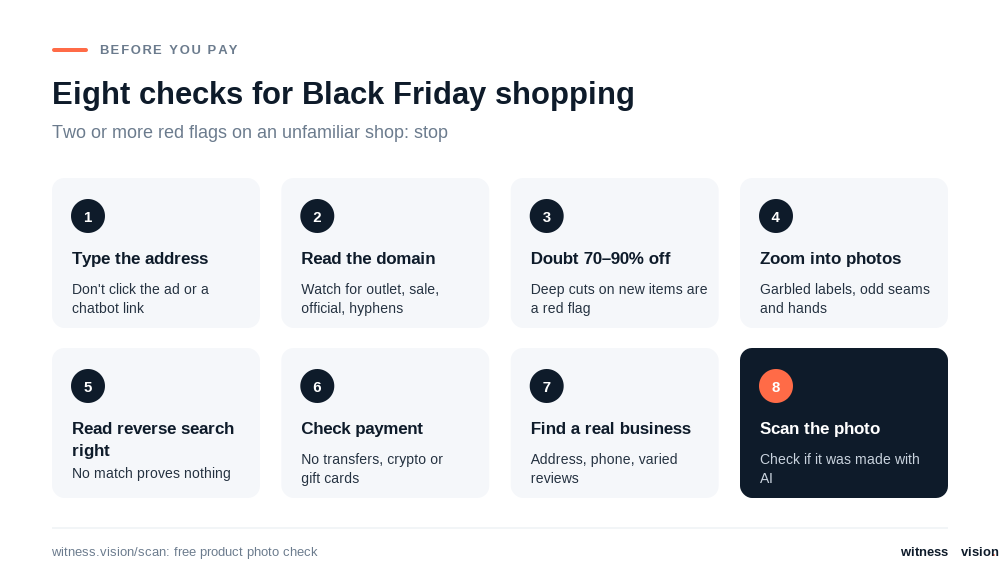
- Type the brand's address yourself. Don't click through from an ad, a text message or a chatbot answer. Go to the site you already know.
- Read the domain slowly. Extra words such as "outlet", "sale", "official" or "factory", unusual country endings and hyphens are common in fake domains. A domain registered in the last few weeks plus a huge discount is a strong warning sign.
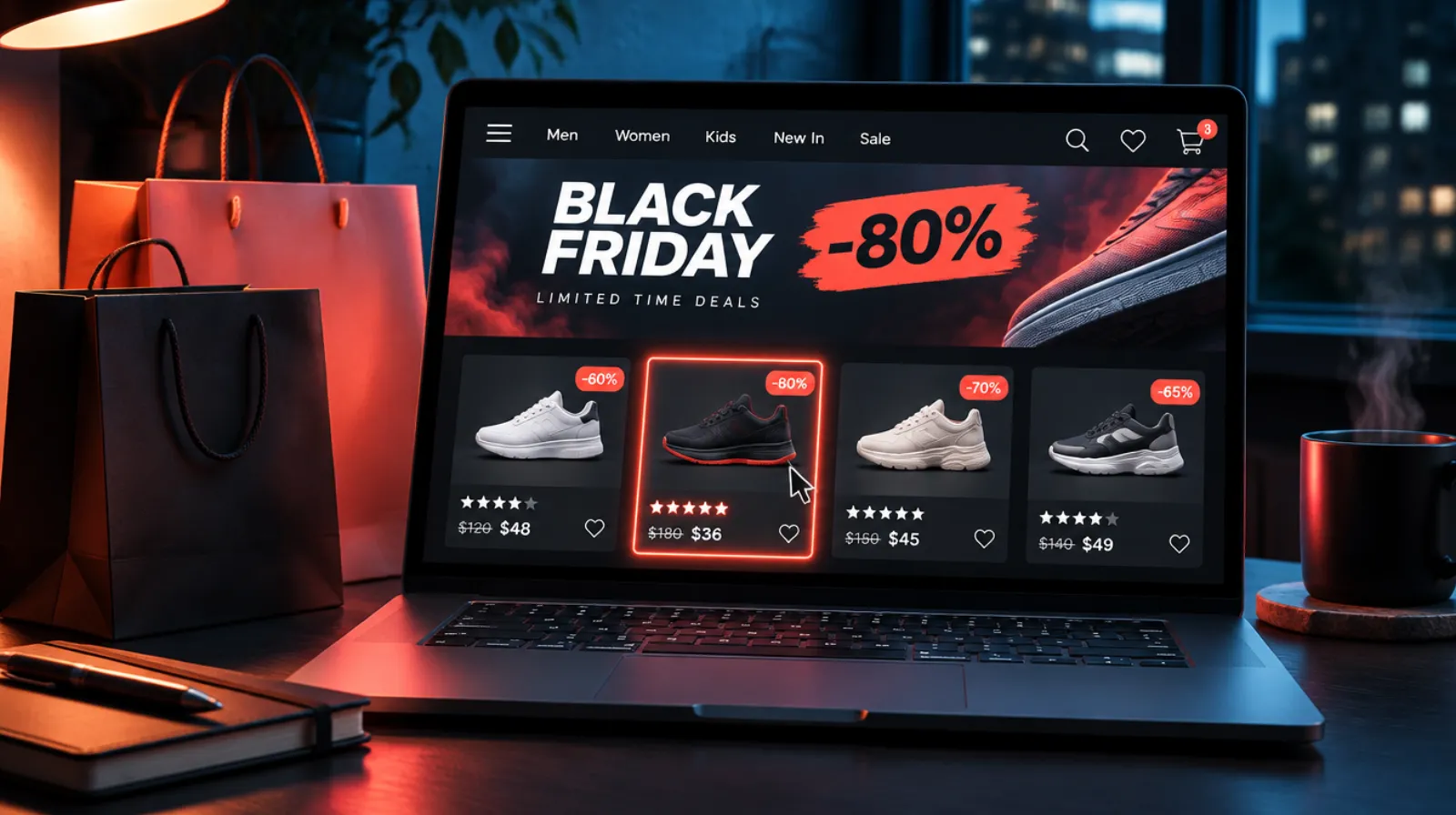
- Be suspicious of 70% to 90% off current-season items. Real Black Friday deals on new products are rarely that deep.
- Look closely at the photos. Zoom in on labels, logos and stitching. Watch for text that turns into squiggles, laces or seams that don't connect, hands that look wrong in model photos, and every photo sharing the same flawless lighting.
- Reverse search, and read the result correctly. A match on another site means the photo was copied. No match proves nothing either way.
- Check how they want to be paid. Bank transfer, crypto, gift cards or a sudden switch to an unfamiliar payment page are reasons to stop. Pay by credit card or another method with buyer protection, so you can dispute the charge.
- Look for a real business behind the site. No street address, no phone number, only a contact form, and reviews that all appeared in the same week are bad signs.
- Scan the product photos. Save the image, or right-click it with the Witness Chrome extension, and check whether it was made with AI.
How to check a product photo with Witness
Upload the photo at witness.vision/scan, or right-click it on the listing page if you have the Chrome extension installed. Witness returns a verdict, Real or AI, with a confidence score in a few seconds. It reads the pixels themselves, so it works even when a photo has been re-saved and stripped of its metadata.
Your first scans are free, no account needed.
One thing to keep in mind: a Real verdict tells you the photo is a real photograph, not that the shop is real. Fake shops often use stolen genuine photos, so use the scan together with the checks above.
If you already ordered from a fake shop
- Call your card issuer or payment provider and ask to dispute the charge. The sooner, the better.
- Report the site. In the US, use the FTC at reportfraud.ftc.gov. In the UK, use Action Fraud. In the EU, contact your national consumer protection authority.
- Change any password you reused when creating an account on the site.
- Watch for follow-up scams. Fake "delivery problem" texts and refund offers often follow a fake-shop purchase.
For brand protection teams
The same AI imagery that fools shoppers also slips past tools that look for copies of a brand's official photos. Witness can check storefront, listing and ad images in bulk and returns a report for each one. If your team reviews fake shops at scale, get in touch.
- [1]Bitdefender, "AI fake shops: Black Friday and Cyber Monday shopping safety," November 2026, https://www.bitdefender.com/en-us/blog/hotforsecurity/ai-fake-shops-black-friday-cyber-monday-shopping-safety
- [2]Cord Cutters News, reporting NordVPN Threat Intelligence research, November 7, 2026, https://cordcuttersnews.com/beware-online-shoppers-chatgpt-and-other-ai-tools-have-cited-over-10000-fake-shopping-websites-in-a-massive-black-friday-scam/
- [3]Red Points, "Counterfeit Buyer Teardown 2025," https://publicinterestnetwork.org/wp-content/uploads/2025/12/Red-Points-Report-2025-Counterfeit-Teardown_.pdf
- [4]Bellingcat, "How to detect AI-generated scam products," March 25, 2025, https://www.bellingcat.com/resources/2025/03/25/detecting-ai-products/
- [5]Bitdefender Labs, "Fake shops in Europe," 2026, https://www.bitdefender.com/en-us/blog/labs/fake-shops-europe-samsung-world-cup-scams